
Unbiased headlines. Facts, not spin.
Every story is an unbiased news briefing written from 110+ sources across the spectrum — sources linked so you can verify it yourself.
 finance
Major Story (7/10)
September 16, 2026 at 04:01 AM
finance
Major Story (7/10)
September 16, 2026 at 04:01 AM
20-Year Treasury Auction Prices at Record 5.42% Yield as Foreign Demand Hits Series Low
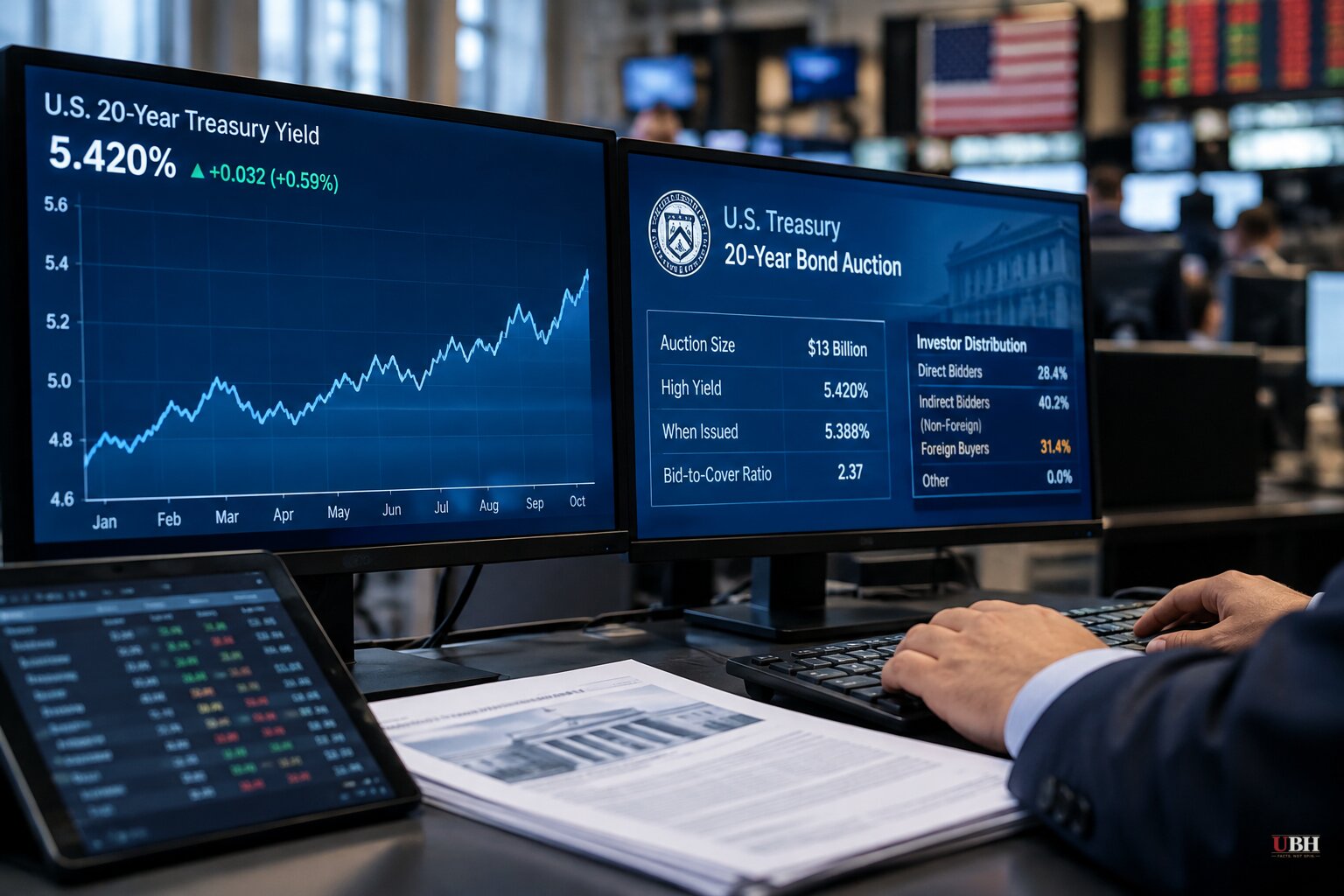
The U.S. government paid the highest yield on record Tuesday to sell 20-year Treasury bonds, and the buyers who normally show up weren't there in the usual numbers.
The Treasury sold $13 billion of 20-year bonds at a high yield of 5.420%, according to Wolf Street. That's the highest yield since the 20-year bond was reintroduced in March 2020, breaking the previous record of 5.245% set in October 2023. A month earlier, the August 19 auction priced at 5.204%. In July, it took 5.163%.
The auction tailed by 2.0 basis points, meaning the bond sold at a higher yield (5.420%) than the 5.400% level it was trading at in the when-issued market just before the sale, per Investing Live and Newsquawk. Wolf Street called that tail "substantial," noting it's not the biggest ever for this auction series but a clear signal that demand came in weaker than the market expected.
Foreign Buyers Stepped Back
Indirect bidders, the category that includes foreign central banks buying through the New York Fed, took just 52.5% of the auction, down from 62.9% in August, according to ZeroHedge. Wolf Street confirms that's the lowest indirect share in the six-year history of the modern 20-year auction.
Direct bidders picked up the slack, jumping to 30.7% from 24.6% the prior month, the highest on record for that category, per ZeroHedge. Primary dealers, the buyers of last resort, were left holding 16.9% of the sale.
Newsquawk's analysis frames this plainly: dealers being forced to absorb a bigger share while domestic real-money buyers substitute for foreign accounts is "a pattern that has historically been read as weaker sponsorship rather than neutral." The bid-to-cover ratio came in at 2.57, above August's 2.53 but below the recent six-auction average of 2.65, according to Investing Live.
Bessent Points to Oil
Treasury Secretary Scott Bessent, testifying before Congress the same day, was asked to explain the recent run-up in yields. He pointed to oil prices and argued last week's 10-year and 30-year auctions were among the most successful in 20 years, according to ZeroHedge.
Oil has in fact been climbing. WTI crude was up $4.59 to $105.97 on the day, according to Investing Live's Adam Button. That's a real and relevant input, since higher energy costs feed directly into inflation expectations that bond buyers price into long-dated yields.
But ZeroHedge pushed back hard on Bessent's framing of last week's auctions as evidence of strength, arguing those sales looked good only because they landed on days when yields had already spiked sharply, handing buyers a price concession and making them eager to bid. Tuesday's 20-year auction came without that kind of concession since yields had already been sitting near 5% for most of the day, and it argued that made this auction a more honest read on underlying demand, and a much weaker one.
The auction results are the auction results: a record yield, a 2-basis-point tail, and a record-low indirect share. Whether that adds up to what ZeroHedge called "as close to a failed auction as Bessent would like to get" is an editorial judgment, not a fact reflected in the auction mechanics themselves. Wolf Street's read is more measured, framing the result as consistent with "shockingly high fiscal deficits" and years of elevated inflation without declaring the auction a failure outright.
What Happens Next
Wolf Street points out that after the prior record yield in October 2023, the 20-year yield fell roughly 130 basis points over the following 11 months, a reminder that record highs in this market haven't been permanent.
Newsquawk frames the open question as whether the tail cheapens the bond further in secondary trading, how the 10-year and belly of the curve trade in sympathy, and whether upcoming long-end auctions produce the same indirect pullback. A repeated pattern of weak foreign takedowns, Newsquawk notes, has in past episodes fed through to wider swap spreads and a steeper back end of the curve.
The secondary market gave an early answer Tuesday morning: the 20-year yield rose to 5.44% ahead of the auction, according to Wolf Street. Whether foreign buyers return at the next long-bond sale, and whether Congress does anything about the deficit spending Wolf Street says is driving the term premium higher, remain open questions with no resolution date attached.
Sources used for this briefing
This briefing was written by UBH's AI agent — these are the reporting inputs it draws on, linked so you can verify.


