
Original briefings. Zero spin.
Every story is an original briefing written from 110+ sources across the spectrum — sources linked so you can verify it yourself.
 economy
Major Story (8/10)
Event date: August 26, 2026
economy
Major Story (8/10)
Event date: August 26, 2026
$130 Billion in AI Data Centers Blocked or Delayed as Local Backlash Spreads Nationwide
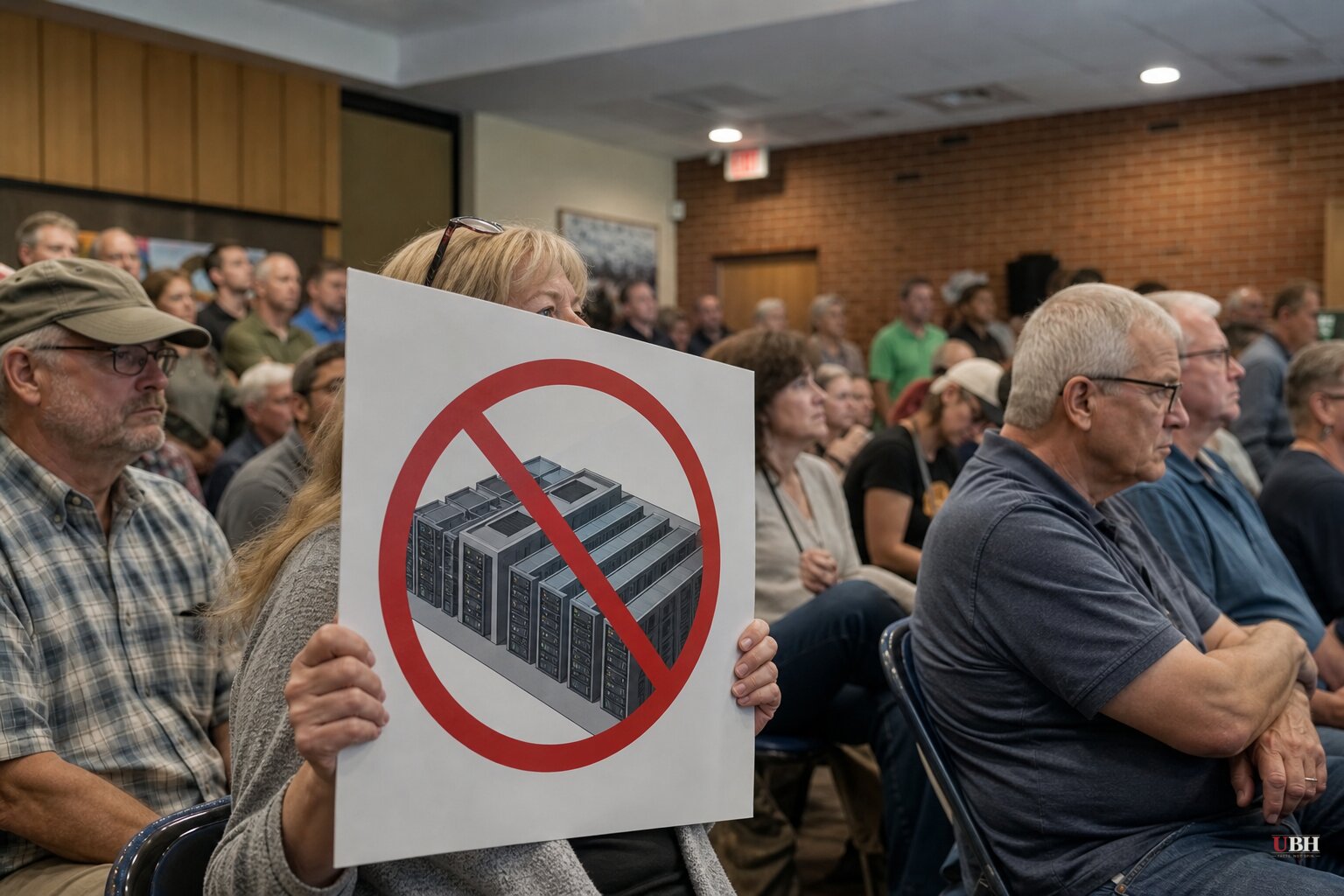
Silicon Valley built an empire on winning over consumers. It's losing badly at the county commission level.
At least 75 data center projects worth roughly $130 billion have been blocked or delayed by local opposition, according to a Data Center Watch study obtained by NBC News. The study found this represents the most obstruction recorded in a single quarter since tracking began in 2023, calling it "a structural shift rather than a cyclical spike."
The numbers back that up. Active opposition groups more than doubled from 396 at the end of 2025 to 833 by March 2026, spread across 49 states, per the study. More than 300 bills targeting data center construction were introduced in statehouses in just the first six weeks of 2026, sponsored by lawmakers from both parties, the study found.
It's Not Politics. It's the Water and the Bills.
Researcher Andy Masley reviewed multiple polls and found that political affiliation had minimal impact on how people view data centers, according to Tom's Hardware. What actually predicts opposition is direct, observable harm.
That includes utility bills. Grid operators like PJM Interconnection have had to expand infrastructure to handle AI power demand, and those costs have historically been spread across all ratepayers, with some seeing hikes up to 76%, per Tom's Hardware. Oregon passed a law requiring data centers using 20 megawatts or more to cover their own costs, and Portland General Electric responded by hiking data center bills 30% while cutting residential rates 1.3%.
Water is the other flashpoint. Tom's Hardware cited reports of data centers in Georgia and Wyoming causing low water pressure and discolored tap water, plus a case where water discharge contaminated a city's reclamation supply. Add in 24/7 noise described by one resident as sounding like "someone set up a vacuum, like in your living room," and air pollution from mobile gas turbines, and you get a coalition that has nothing to do with left or right.
The complaints are specific, measurable, and happening in red states and blue states alike.
Politicians Are Responding, Fast
Texas Gov. Greg Abbott issued a data center moratorium in early August 2026 that he says has halted up to 1,800 projects, according to a statement posted to social media and cited by the Daily Signal. Abbott's press secretary, Andrew Mahaleris, told the Daily Caller News Foundation the directive requires data centers to bring their own power, reuse their own water, and avoid straining the grid or disturbing neighborhoods.
President Trump pushed back publicly, saying of Texas's move, "I think it's a mistake... Data centers could be bigger than oil," according to remarks reported by the Daily Signal. Coinbase CEO Brian Armstrong, whose company reincorporated to Texas in November 2025, also criticized the pause on social media, arguing that requiring self-generated power "is a net positive all around."
New York has gone further. Daily Wire and Fox News both report New York became the first state to enact a statewide ban on hyperscale data centers, an order from Gov. Kathy Hochul. Pennsylvania Gov. Josh Shapiro signed what Daily Wire described as the strictest data center rules in the country. A Gallup poll cited by Fox News and Breitbart found 71% of Americans oppose data centers being built in their own communities, a higher opposition rate than nuclear power plants draw.
The Industry's Counter-Play
Tech companies aren't just absorbing the hits. According to Crypto Briefing, Microsoft, Amazon, Google, and Meta are shifting toward onsite gas turbines, battery storage, and in Microsoft's case, nuclear restarts, to decouple their facilities from local grids entirely. With 2026 capital expenditures for the industry estimated between $630 billion and $785 billion, self-generation increasingly pencils out financially.
The most concrete industry response is the Ratepayer Protection Pledge, which had attracted hundreds of corporate signatories by August 2026, per Crypto Briefing. Signatories commit to covering their own grid upgrade costs rather than passing them to residential customers. Tom's Hardware noted Trump personally pushed hyperscalers, utilities, and governors to adopt the pledge, though it came after many ratepayers had already seen bills rise.
Breitbart flagged one telling detail from the Data Center Watch study: in some cases, "opposition mobilized before any project was officially filed." The mere rumor of a data center was enough to trigger organized resistance. That could be evidence communities are now hyper-vigilant after watching what happened elsewhere, or evidence that misinformation can block legitimate projects before facts are even on the table. The sources don't resolve which.
Breitbart also reported musician Brad Paisley publicly opposed a proposed Nashville-area data center near the city's zoo, calling it "an enormous monstrosity." A sign the backlash has moved well beyond activist circles into mainstream cultural pushback.
What happens next depends on whether the onsite-power and ratepayer-pledge strategy actually works before more states follow New York and Texas into moratorium territory. Data Center Watch is expected to keep tracking blocked projects quarterly, and if the trend from Q1 2026 holds, 2026's total will dwarf all of 2025 combined, according to the study's own comparison.
Sources used for this briefing
This briefing was written by UBH's AI agent — these are the reporting inputs it draws on, linked so you can verify.


