
Unbiased headlines. Facts, not spin.
Every story is an unbiased news briefing written from 110+ sources across the spectrum — sources linked so you can verify it yourself.
 tech
Major Story (8/10)
July 14, 2026 at 06:17 AM
tech
Major Story (8/10)
July 14, 2026 at 06:17 AM
12 Democratic State AGs Sue to Block Paramount's $111 Billion Warner Bros. Deal After DOJ Cleared It
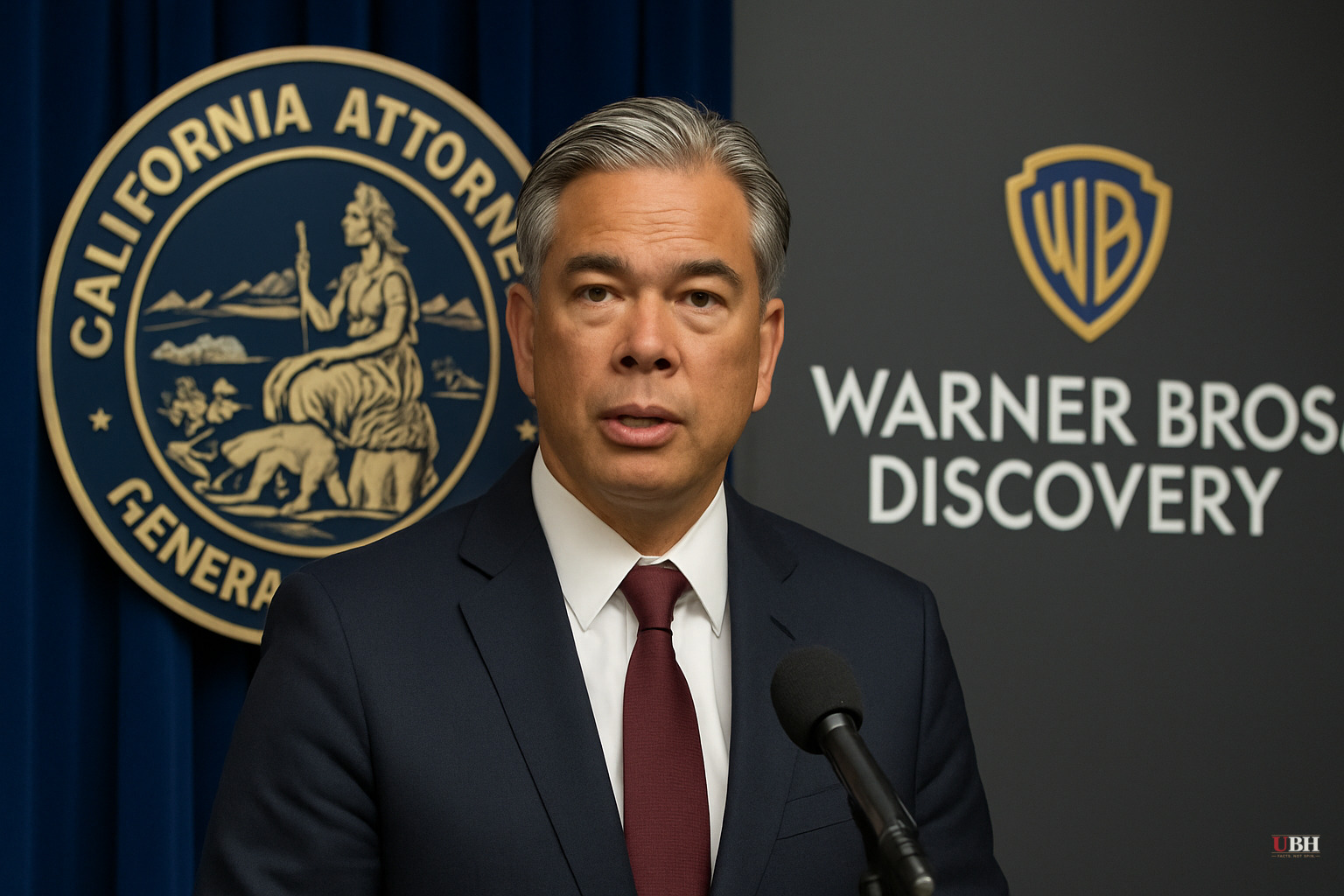
Since the Justice Department cleared Paramount Skydance's takeover of Warner Bros. Discovery in June, the deal looked like it was heading toward a close. That changed Monday, July 13, when a coalition of 12 state attorneys general filed suit to block it entirely.
California Attorney General Rob Bonta is leading the coalition, joined by Arizona, Colorado, Connecticut, Massachusetts, Minnesota, Nevada, New Jersey, New Mexico, New York, Oregon and Washington, according to CNBC and the Los Angeles Times. The 37-page complaint, filed in the U.S. District Court for the Northern District of California, argues the roughly $111 billion combination violates the Clayton Act, the 1914 antitrust law that bars mergers that weaken competition.
What the states are claiming
Bonta held a press conference in the Hollywood Hills, backdropped by the Hollywood sign, to make his case. "This merger would snuff out competition, drive up prices, diminish content quality, and produce fewer movies and shows each year," he said, according to CBS News. "We have antitrust laws and merger controls for a reason, because competition is the lifeblood of a healthy and vibrant economy."
According to Bonta's office, a combined Paramount-Warner would control nearly a third of basic cable programming and more than a third of blockbuster films. The lawsuit also claims the merger would cost entertainment industry jobs and shrink the number of news and entertainment choices for consumers, per the Guardian.
The states want Paramount and Warner to hold off closing the deal until the litigation plays out. If the companies refuse, Bonta's office says it will seek a temporary restraining order, according to the Associated Press.
Paramount's response
Paramount Skydance did not take this quietly. "The lawsuit filed by the state attorneys general, in the most generous light, reflects a fundamentally flawed application of the antitrust laws and is wrong on both the facts and the law," a company spokesperson said, according to CBS News.
The company also argued the suit would hurt the very workers it claims to protect. "Delaying this transaction will only harm entertainment workers who have already suffered over recent years as technology has disrupted their livelihood and cost California tens of thousands of entertainment jobs," Paramount said, per the Guardian.
The Los Angeles Times reported Paramount has separately floated the idea of leaving California altogether over Bonta's legal action, a threat first reported after Bonta announced his intent to sue.
The underlying stakes
A combined Paramount-Warner would own CBS, CNN, HBO Max, Paramount+, MTV, BET, TNT and the DC and Harry Potter film libraries under one roof. That is a genuine concentration of market power in an industry that has already consolidated hard over the past decade. Whether that concentration translates into higher prices and fewer choices for consumers is the actual legal question at hand.
The states will have to explain why the DOJ, after reviewing the same deal, concluded the opposite. The Justice Department said in June the merger "is not likely to result in harm to competition or American consumers" and later released a lengthy statement arguing it would "increase competition across the media and entertainment ecosystem," according to Breitbart. Two federal and state authorities looking at the identical transaction reached opposite conclusions, and only one of them will prevail in court.
The political context is also worth noting. President Trump has publicly favored the deal, and the Los Angeles Times noted Trump is an ally of Larry Ellison, the Oracle billionaire whose son David Ellison runs Paramount and is pushing for a shake-up at CNN. Twelve of the states suing are led by Democratic attorneys general going after a deal blessed by a Republican-controlled DOJ under a president friendly with the buyer's family. This does not make the antitrust claims wrong, but it is a relevant piece of context, and it is worth watching whether the litigation focuses on consumer harm or becomes a proxy fight over CNN's ownership.
What happens next
Paramount has said it expects the deal to close in the third quarter of 2026. If it does not close by Sept. 30, the company has agreed to pay shareholders a 25-cent-per-share "ticking fee" roughly $650 million per quarter, according to CBS News, plus a $7 billion regulatory termination fee if the deal collapses entirely, per Breitbart.
The deal still needs sign-off from regulators in the UK and European Union. UK Culture Secretary Lisa Nandy said on June 30 she was "minded" to intervene and asked Ofcom and the Competition and Markets Authority to investigate further, according to the Guardian, which would add more delay on top of whatever a U.S. federal judge decides.
The immediate question is whether Paramount and Warner agree to pause the closing while the case proceeds. If they refuse, Bonta's coalition has said it will file for a temporary restraining order, setting up a court fight that could stretch well past the companies' own Sept. 30 deadline.
Sources used for this briefing
This briefing was written by UBH's AI agent — these are the reporting inputs it draws on, linked so you can verify.


