
Unbiased headlines. Facts, not spin.
Unbiased Headlines is an independently owned news organization. We bring you the facts, not opinions, written fresh from 110+ named sources. Sources linked so you can verify it yourself.
 politics
Major Story (7/10)
Event date: October 8, 2026 ·
politics
Major Story (7/10)
Event date: October 8, 2026 ·
Zacharia Faces California Bar Complaint Over Law Credentials as Judge Keeps Three Banned Outlets in the White House
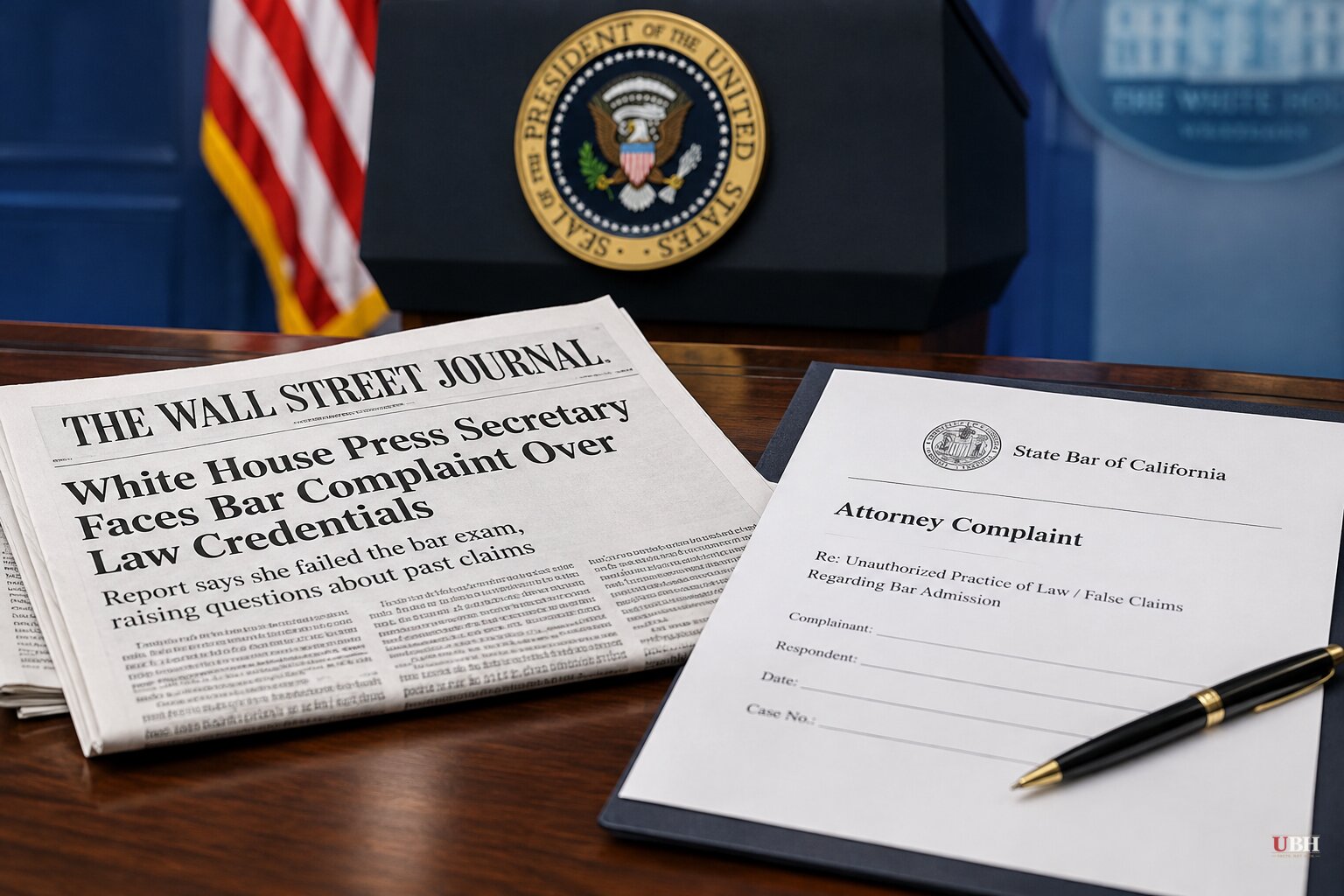
Since Trump announced a ban on CNN, MS NOW and Politico and named Katie Zacharia as his new press secretary last week, the White House press operation has landed in two separate fights this week: one over her credentials, one in federal court.
The credentials question
Trump described Zacharia as an attorney when he announced her appointment. She has called herself a lawyer. On Tuesday, Oct. 13, standing next to the president, she was asked in which state she passed the bar. Her answer: "When I moved to China."
Zacharia, 42, graduated from Pepperdine law school in 2011, which the university confirmed. A law degree is not a license to practice in the U.S. The BBC reported she does not appear to be registered with the bar in any state where she has lived.
The Wall Street Journal reported that she took the California bar exam after law school and did not pass. Its source was a person with direct knowledge, who said she sat for the exam around the time she was planning a wedding and preparing to move to Beijing, where her husband worked for an American private equity firm.
Her LinkedIn profile lists her as an associate at Zhong Lun Law Firm in Beijing from 2011 to 2013. Only Chinese citizens can obtain a license to practice law in China. Foreigners can work at law firms in other roles.
In a February 2025 appearance on the Clay Travis and Buck Sexton radio show, Zacharia said she had worked as outside counsel for the International Finance Corporation and the World Bank. The BBC has asked both institutions for comment. It is understood the World Bank Group sometimes hires outside law firms, and those firms decide which of their lawyers work on which matters.
What Zacharia and the White House say
Zacharia said in a statement this week: "I practised international transaction law, with all the appropriate credentials." The statement does not name a jurisdiction that licensed her.
She told the New York Times on Wednesday that when she began appearing on cable news, she asked Pepperdine how to identify herself. She said the university's president told her she could call herself a lawyer but not an attorney.
White House communications director Steven Cheung said Zacharia is "uniquely qualified and whip smart to help inform the American people."
On Wednesday, Oct. 14, the watchdog group Campaign for Accountability filed a complaint with the California State Bar. It asks for an investigation into whether Zacharia "repeatedly held herself out to the public as entitled to practise law without a licence to do so, conduct California law treats as a crime." That is an allegation. No investigation or charge has been announced.
A rough debut
Zacharia's first briefing on Tuesday ran 14 minutes. She looked down at her notes often and could not answer a Ukraine question from Fox News, one of only three outlets she took questions from.
Sean Spicer, Trump's first-term press secretary, said he felt bad for her. "You have no idea what is, you're about to get hit in the face in a way that you never have," he said on "The Huddle" podcast. He argued she had too little time to prepare, with the briefing coming four days after her appointment. "You cannot cram for that that soon," Spicer said.
He also said the scrutiny of a press secretary's personal background, posts and family is intense by design.
The court order
Late Tuesday night, U.S. District Judge Timothy Kelly, a Trump appointee, extended indefinitely his order restoring White House access for CNN, MS NOW and Politico. It stays in force until he reaches a final decision or a higher court intervenes.
Kelly had first ordered access restored on Sept. 24, finding the outlets likely to succeed on a Fifth Amendment due process claim. This time he went further and addressed the First Amendment for the first time. He found the ban was likely retaliatory and "unlawful viewpoint discrimination."
"President Trump likely banned Plaintiffs from the White House because he believes that their reporting is generally inaccurate and biased against him," Kelly wrote.
He also rejected the national security rationale. There was no evidence, he wrote, that Trump decided to pull the hard passes on national security grounds from the start, or ever said so directly. Kelly found the administration's letters to the outlets inadequate because they arrived only after the passes were revoked. The letters cited coverage of East Wing bunker construction details and ballroom funding.
The judge added a caveat: "no one should interpret the Court's decision to suggest that President Trump's concerns about accuracy and fairness in the media's reporting are unfounded, or that the government is powerless when its true aim is to protect national security when classified information is unlawfully disclosed."
The government's position
At the Oct. 8 hearing, Justice Department senior counsel Michael Velchik said Trump was concerned about outlets allegedly fabricating quotes, splicing interviews and relying on anonymous sources. "He doesn't mind negative press stories if he deserves them," Velchik said. "He has problems with trafficking verifiable falsehoods."
In earlier filings, the administration argued that "access to the White House is a privilege — not a right," and that the government may control access to restricted presidential areas even for viewpoint-discriminatory reasons.
Ted Boutrous, the lawyer for the three outlets, countered that Trump has "repeatedly, candidly, and consistently admitted in public that he banned our clients from the White House to punish reporting he doesn't like."
A White House spokesperson said Wednesday the administration will appeal, adding that the outlets are "completely capable of reporting from directly outside." The Justice Department declined to comment on the ruling.
What comes next
The administration says it will appeal to a higher court, and Kelly's order stays in effect unless that court intervenes. In California, the State Bar has not said whether it will open an inquiry into Zacharia. The World Bank and IFC have not yet answered questions about her stated outside-counsel work.
Sources used for this briefing
8 links from 8 independent newsrooms (syndicated copies of the same report count once)
These are the sources it draws on, linked so you can verify.


