
Unbiased headlines. Facts, not spin.
Unbiased Headlines is an independently owned news organization. We bring you the facts, not opinions, written fresh from 110+ named sources. Sources linked so you can verify it yourself.
 politics
Major Story (7/10)
politics
Major Story (7/10)
Supreme Court Lets FCC Skip Deadline on Party Ad Discounts, Keeps Policy Alive for Nov. 3 Midterms
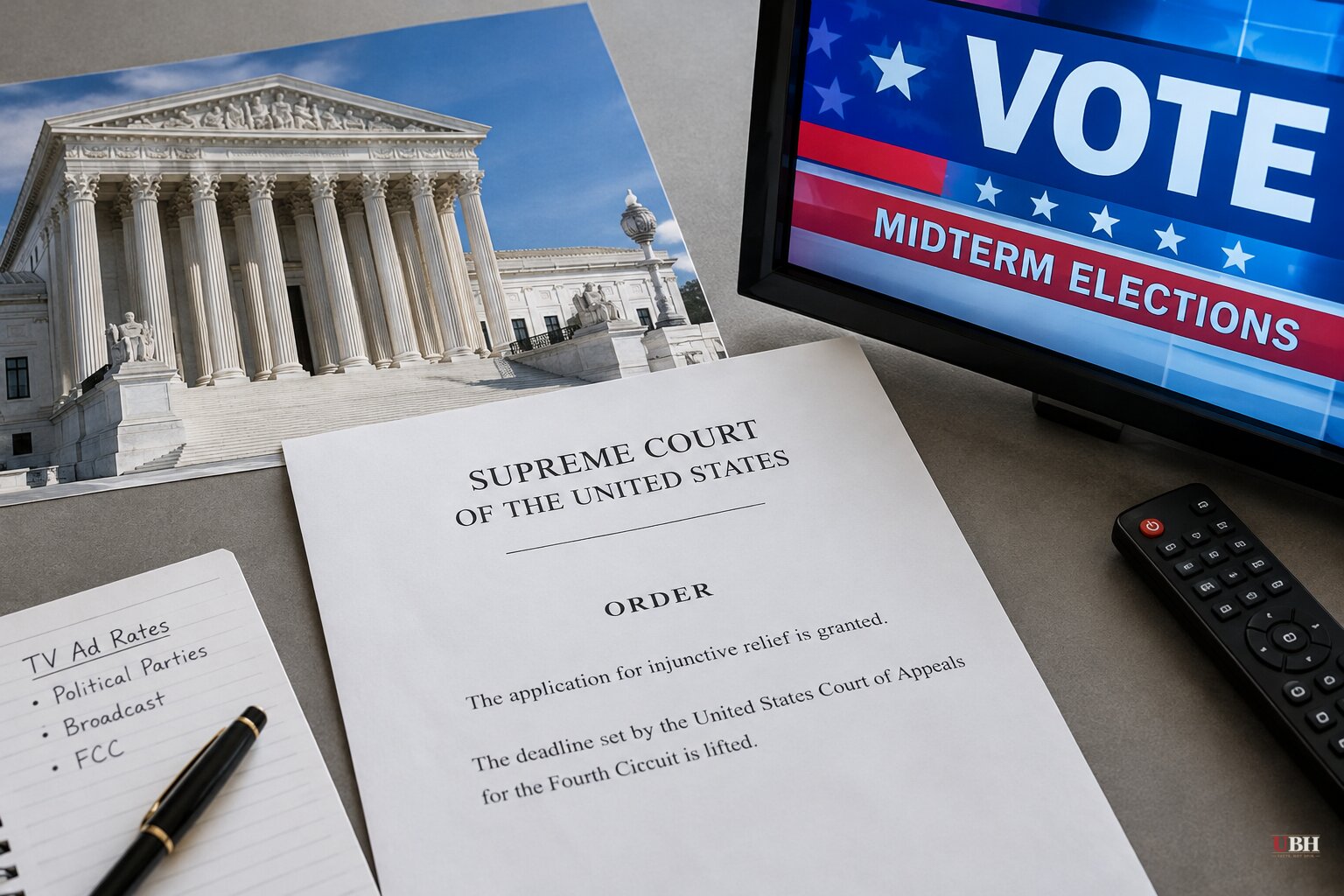
The Supreme Court sided with the Trump administration and Republican party committees for the second time in six weeks on Wednesday, Oct. 14. It blocked a lower-court order that would have forced the Federal Communications Commission to rule on a Democratic challenge to its political ad pricing policy before the Nov. 3 midterms.
The order was unsigned. Justices Sonia Sotomayor and Ketanji Brown Jackson said they would have denied the stay applications.
How the dispute started
Federal law requires broadcasters to charge legally qualified candidates no more than their lowest unit charge in the 60 days before a general election. This year that window opened Sept. 4.
In March, the FCC's Media Bureau issued a public notice extending the discount to party committees running coordinated ads and to certain joint fundraising committees that include non-candidate members. The notice did not go through a public comment process.
Democratic candidates, including Sen. Jon Ossoff of Georgia, former Sen. Sherrod Brown of Ohio and former Gov. Roy Cooper of North Carolina, challenged the notice at the FCC in April. The agency did not act on the petition.
The candidates then went to the 4th Circuit Court of Appeals. They argue the statute gives the discount to candidates, not to committees. A party or joint fundraising committee buying an ad is spending its own money, they say, and should pay the regular rate.
The court fight
On Aug. 25, a 4th Circuit panel voted 2-1 to set aside the notice. Judge J. Harvie Wilkinson dissented. He said the appeals court should not have reviewed the notice while it was still pending at the FCC, and that barring parties from the discount restricted political speech on the eve of an election.
The Supreme Court stayed that ruling on Sept. 4, in an 8-1 order with Jackson the lone dissenter. It said the candidates had to wait for the FCC to resolve their application before seeking judicial review. It also found the National Republican Congressional Committee and the National Republican Senatorial Committee likely to suffer irreparable harm, citing their claims that broadcasters were already rescinding favorable rates. That order addressed jurisdiction, not the merits.
On Oct. 7, the same 4th Circuit panel issued a writ of mandamus ordering the FCC to decide the pending challenge by noon on Oct. 9. Judge Robert B. King, a Clinton appointee, wrote that "any 'chaos' is the FCC's fault, not ours." The court accused the agency of repeated "delay tactics" more than five months after the petition was filed.
Chief Justice John Roberts issued an administrative stay on Oct. 8, before the deadline arrived.
What the justices said
The full court's order on Oct. 14 found the 4th Circuit's mandamus ruling "inappropriate under the circumstances." Federal law, the court said, "does not obligate the commission to act within a particular time frame."
The order added: "Our system of separation of powers does not allow the Judiciary to meddle" in the workings of another branch. The court said the FCC would suffer "irreparable harm" if the lower court's order stayed in effect.
An FCC spokesperson called the decision "right on the law" and said it "avoids the specter of upending the rules for political ads right in the middle of an ongoing election." FCC Chair Brendan Carr posted a single letter on X: "W."
The money behind it
The rule applies to both parties on its face. In practice, the dollars are lopsided.
Federal Election Commission filings show the three major Democratic committees held roughly $136 million in cash at the end of July. The Republican committees held nearly $279 million. The Democratic committees also reported about $17.9 million in debt, and the Republican committees reported none.
Democratic candidates have leaned more on contributions from individuals. Republicans have raised more through party committees funded by large donors. That is why the policy is widely seen as favoring the GOP.
The FCC currently has a 2-1 Republican majority. Anna Gomez, its lone Democrat, objected to the process. "The American public should not have sweeping election-year rule changes forced on them in the dark, on the eve of the election, without a single opportunity for public input," she said. In an August statement she wrote, "Nothing about this proceeding was handled correctly." She warned the policy could affect broadcasters' ad revenue.
The nonpartisan Campaign Legal Center said the rule change was "contrary to the text and purpose of the federal statute and would effectively grant super PACs an advertising discount."
What happens next
The Supreme Court has not ruled on whether the FCC's reading of the statute is lawful. The Sept. 4 stay of the 4th Circuit's Aug. 25 ruling remains in effect, so party committees can keep buying ads at the candidate rate through Election Day.
The Democratic candidates' petition is still pending at the FCC, and with the deadline lifted the agency is under no court-ordered timeline to act. Whether the discounts survive after Nov. 3 is a question the FCC and the courts have yet to answer.
Sources used for this briefing
7 links from 7 independent newsrooms (syndicated copies of the same report count once)
These are the sources it draws on, linked so you can verify.


