
Unbiased headlines. Facts, not spin.
Every story is an unbiased news briefing written from 110+ sources across the spectrum — sources linked so you can verify it yourself.
 tech
Notable (6/10)
August 10, 2026 at 07:36 PM
tech
Notable (6/10)
August 10, 2026 at 07:36 PM
YouTube Doubles Watch-Hour Requirement for New Creators Starting February 2027
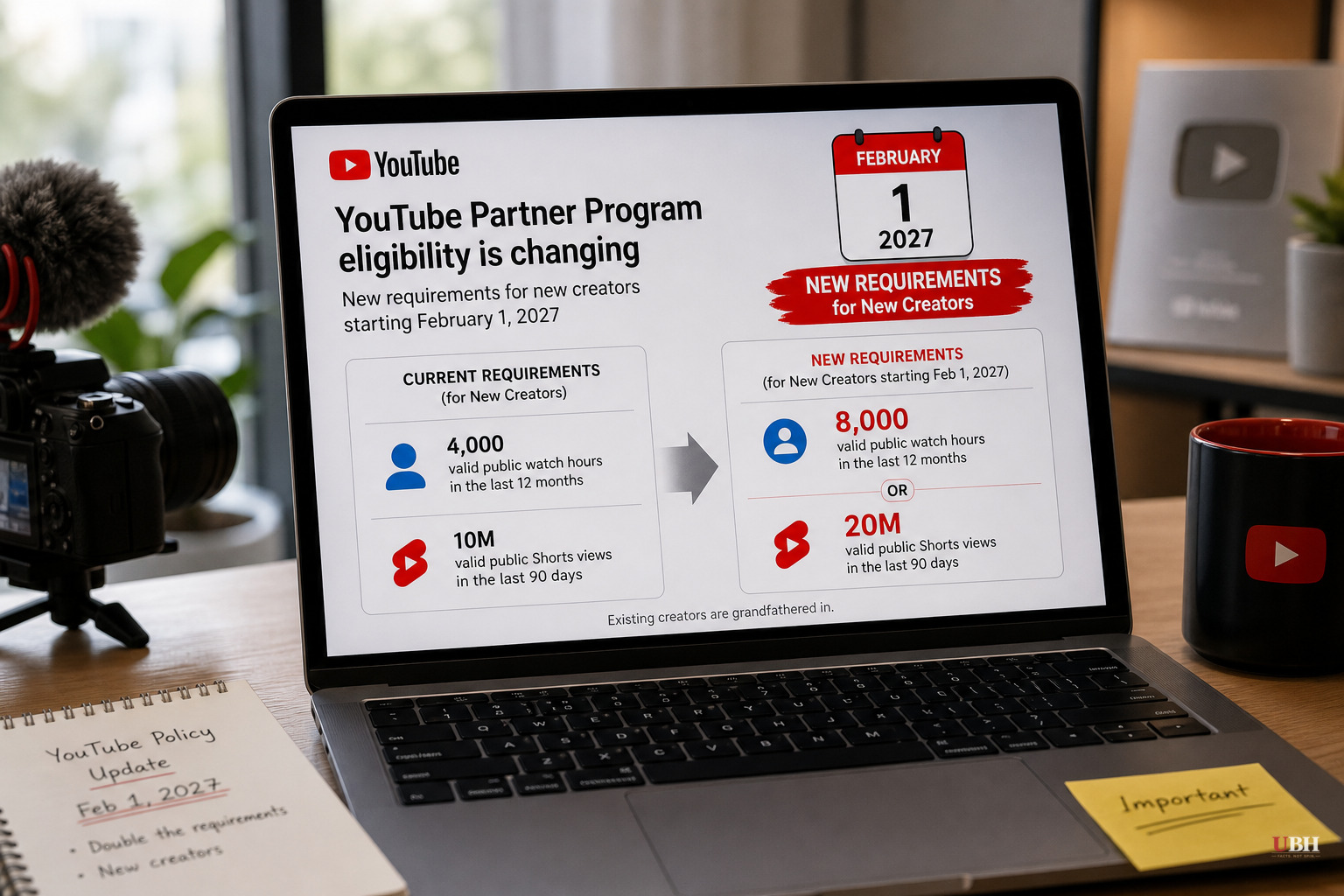
YouTube just raised the bar for anyone hoping to make money off the platform. Starting February 1, 2027, new creators will need 1,000 subscribers plus 8,000 qualified watch hours over the past year, or 20 million qualified Shorts views in the last 90 days, to join the YouTube Partner Program, according to The Verge and TechCrunch. That's double the current requirement of 4,000 watch hours, and double the current 10 million Shorts views threshold.
For creators already in the Partner Program, YouTube says nothing changes on the entry side, according to TechCrunch. But they're not off the hook entirely. Everyone in the program will need to hit new maintenance minimums: 1,000 watch hours a year, 1 million Shorts views, or two long-form videos or five Shorts uploaded every 90 days, per The Verge. Existing creators have to accept the new terms by January 31, 2027, or they lose their ability to earn.
YouTube also announced a separate rule for the Shorts Creators Pool specifically: creators need to keep 10 million Shorts views over a rolling 90-day window to get paid from that pool. Fall below it, and TechCrunch reports you don't get kicked out of the Partner Program entirely, you just stop earning from Shorts until you climb back above the threshold. Your long-form earnings keep flowing.
Why YouTube says it's doing this
YouTube's official line, per both outlets, is scale. The platform says it now sees over 200 billion daily Shorts views and more than a billion hours of watch time on TVs every single day. In YouTube's framing, the old thresholds were built for a smaller platform, and it's simply recalibrating for where the business is now.
There's also a strategic angle. The Verge notes YouTube has been striking deals with names like Trevor Noah and rolling out season-based organization for videos, moves that look a lot like YouTube trying to become a premium TV competitor alongside Netflix, HBO Max, and Disney Plus. Raising the bar to monetize might double as a filter, pushing out low-effort spam and reinforcing YouTube's pitch to advertisers that its content is closer to television quality than amateur video.
The tradeoff
TechCrunch's own reporting flags the obvious downside: doubling the threshold makes it harder for new creators to break in and start earning, "which could in turn lead to fewer new entrants being able to monetize their content." If you needed 4,000 watch hours yesterday and you need 8,000 tomorrow, half as many people clear that bar in the same amount of time.
Defenders of the move have a reasonable counterargument. A platform with over 200 billion daily Shorts views has an obvious spam and low-quality-content problem, and a higher bar filters out accounts gaming the system for ad pennies. Higher thresholds also mean YouTube is paying out to creators with real, sustained audiences rather than one-hit-wonder channels that hit a threshold once and coast. That's not an unreasonable business call for a company managing billions in ad revenue.
But YouTube's blog post, quoted by both outlets, leans hard into the upside: expanding the cheaper Premium Lite subscription to every country where Premium is offered, and noting that "when a user signs up for Premium, partners, on average, earn more than when the user was watching ads." That's true, but it's also doing a lot of work to distract from the fact that getting into the program in the first place just got twice as hard.
Revenue splits stay the same, 55 percent to long-form creators, 45 percent to Shorts, according to both The Verge and TechCrunch. So the pie split isn't changing. Who gets a slice of the pie is.
Not just a YouTube problem
YouTube isn't alone in messing with creator payouts right now. TechCrunch reports that Elon Musk's X revised its creator rewards guidelines over the weekend to only reward original content, and Facebook launched a new monetization program this spring aimed at pulling creators away from TikTok and YouTube. Every platform is fighting over the same pool of creators and the same advertising dollars, and every platform is adjusting the rules to fit its own priorities.
The open question is what happens to the creators who don't make the new cut. Someone sitting at 5,000 watch hours today, comfortably above the current 4,000-hour bar, will be locked out come February 2027 unless they double their output or their audience grows fast. YouTube hasn't said how many current applicants would fail to meet the new standard, and neither source provides that number. That's the real test of whether this is a quality filter or a barrier that just shrinks the pool of people YouTube has to pay.
Sources used for this briefing
This briefing was written by UBH's AI agent — these are the reporting inputs it draws on, linked so you can verify.


