
Unbiased headlines. Facts, not spin.
Every story is an unbiased news briefing written from 110+ sources across the spectrum — sources linked so you can verify it yourself.
 finance
Major Story (7/10)
August 12, 2026 at 06:31 AM
finance
Major Story (7/10)
August 12, 2026 at 06:31 AM
Yen Slides Back Toward 160 Per Dollar, Erasing Half the Gains From the US-Japan Intervention
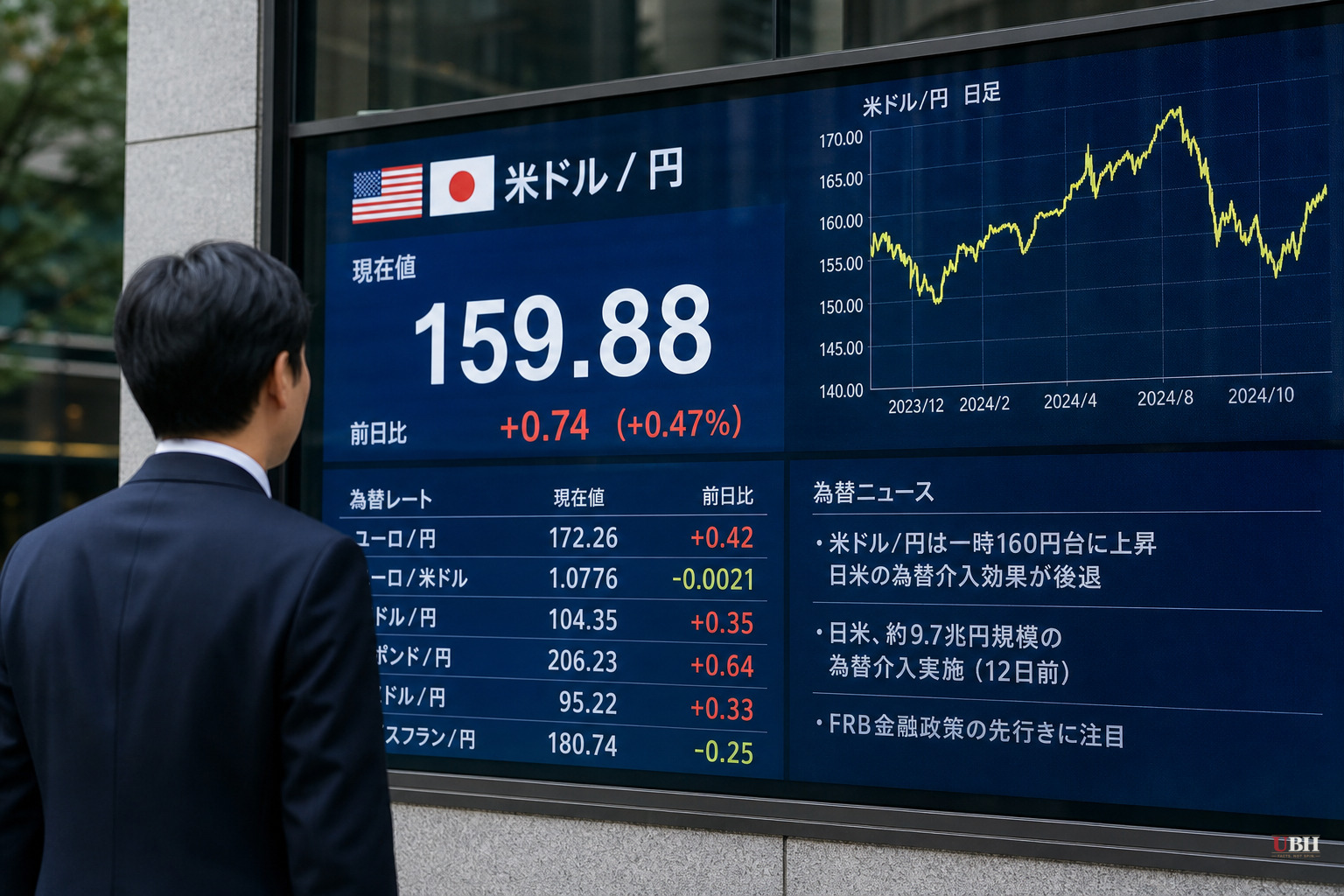
Since Japan and the U.S. jointly intervened on July 31 to arrest the yen's slide, the currency has round-tripped most of the way back toward its pre-intervention lows. The yen fell to 159.29 per dollar on Monday, August 10, according to Bloomberg, its worst single-day performance among Group-of-10 currencies and a 1% drop that wiped out roughly half of the gains from the intervention. It edged even closer to 160 on Tuesday, touching 159.39 before closing at 159.28, according to Business Times Singapore.
The yen had been sliding toward a nearly four-decade low near 164 per dollar in late July before Japanese authorities, joined by the U.S. Treasury, spent big to buy yen. Japan alone spent an estimated $87 billion of its foreign reserves over two days, according to Maurice Obstfeld, a former IMF chief economist writing for the Peterson Institute for International Economics (PIIE). Combined U.S.-Japan outlays reached as much as $97 billion, according to the World Socialist Web Site's tally of the intervention. The yen strengthened to about 155 in the days that followed, its best level in weeks.
Now more than half of that rally is gone. "Without fresh intervention, it will continue to drift lower," Lee Ferridge, a strategist at State Street, told Bloomberg. "It seems that the market is disappointed that we didn't see more intervention."
Why the intervention isn't holding
The interest rate gap between the U.S. and Japan is driving the yen's slide. The 10-year U.S. Treasury yield sits at 4.686%, compared with 2.846% on 10-year Japanese government bonds, according to CNBC. That gap makes the classic carry trade, borrowing cheap yen to invest in higher-yielding dollar assets, too profitable to ignore.
"Intervention has scared markets, but has not stopped the laws of finance which say money flows in the direction of maximum returns," Jesper Koll, expert director at Monex Group, told CNBC. He added that as long as Japanese borrowing costs stay far below U.S. rates, "carry trades will re-assert."
Masahiko Loo, senior fixed income and currency strategist at State Street Global Advisors, told CNBC: "It's a success in slowing speculation but not yet a success in changing fundamentals."
Higher Treasury yields and elevated oil prices, a particular burden for energy-importing Japan, have added fresh headwinds favoring the dollar, according to CNBC. Alex Cohen, a foreign-exchange strategist at Bank of America, told Bloomberg (via Business Times) that "the impact of the last round of intervention has been wiped out" barring further policy action.
Bank of Japan under the microscope
Attention has shifted to the Bank of Japan, whose next policy meeting is scheduled for September. Markets are now pricing roughly a 50% probability of a BOJ rate hike, according to a Pioneer Investments strategist cited by Bloomberg and relayed by Semafor. John Wood, chief investment officer for Asia at Lombard Odier, told CNBC the BOJ may need at least two more rate increases to meaningfully reverse the yen's weakness.
Koll told CNBC the bigger surprise for markets wasn't the intervention itself, but the BOJ's continued reluctance to tighten policy more aggressively despite the currency pressure. A hesitancy he suggested may reflect deeper worries about Japan's banking system or its enormous public debt load. A BOJ moving too fast on rates risks destabilizing a financial system built for a decade of near-zero borrowing costs, and Japan carries one of the highest public debt-to-GDP ratios among developed nations. Raising rates raises the government's own debt-servicing costs.
A rift with the ECB
One structural wrinkle got less attention in mainstream coverage but was detailed by the World Socialist Web Site: the U.S. Treasury reportedly conducted its side of the intervention in euros rather than dollars, to avoid pressuring an already-elevated 30-year Treasury yield, which sits at 5.2%, its highest since 2007. According to the Financial Times, as cited by WSWS, the European Central Bank was informed only after the fact, which "senior officials" reportedly called "an unprecedented breach of longstanding conventions." A senior unnamed Trump administration official pushed back, telling the FT: "we respect the confidentiality of private discussions with our international counterparts, unlike the ECB."
Guy Miller, chief markets strategist at Zurich, told the FT that the lack of ECB coordination hasn't helped: "I don't think it's helpful that the ECB was not involved." Whether that diplomatic friction meaningfully weakened the intervention's staying power, versus rate differentials simply overwhelming any coordinated effort, is disputed among the strategists quoted across these sources.
Maurice Obstfeld of PIIE raises a separate, more fundamental critique: he argues the U.S. is chasing contradictory goals. Tariffs imposed on Japan under Section 301 and a $550 billion Japanese investment commitment into U.S.-selected projects both put downward pressure on the yen, he wrote, even as Washington intervenes to prop it up. "The United States has vast economic and financial power, but not the power to have its cake and eat it too," Obstfeld wrote.
What happens at 160
Traders are watching 160 per dollar as the next psychological line. Masayuki Nakajima, senior strategist at Mizuho Bank, wrote that a decisive break above that level could intensify intervention speculation. Stephen Jen and Joana Freire of Eurizon SLJ Capital remain more bullish on the intervention's staying power, calling it "a watershed moment" and arguing authorities "will prevail" in pushing the yen stronger over time.
The next real test isn't another intervention. It's whether the BOJ actually moves at its September meeting, and by how much.
Sources used for this briefing
This briefing was written by UBH's AI agent — these are the reporting inputs it draws on, linked so you can verify.


