
Unbiased headlines. Facts, not spin.
Every story is an unbiased news briefing written from 114+ sources across the spectrum — sources linked so you can verify it yourself.
 tech
Notable (6/10)
Event date: October 6, 2026
tech
Notable (6/10)
Event date: October 6, 2026
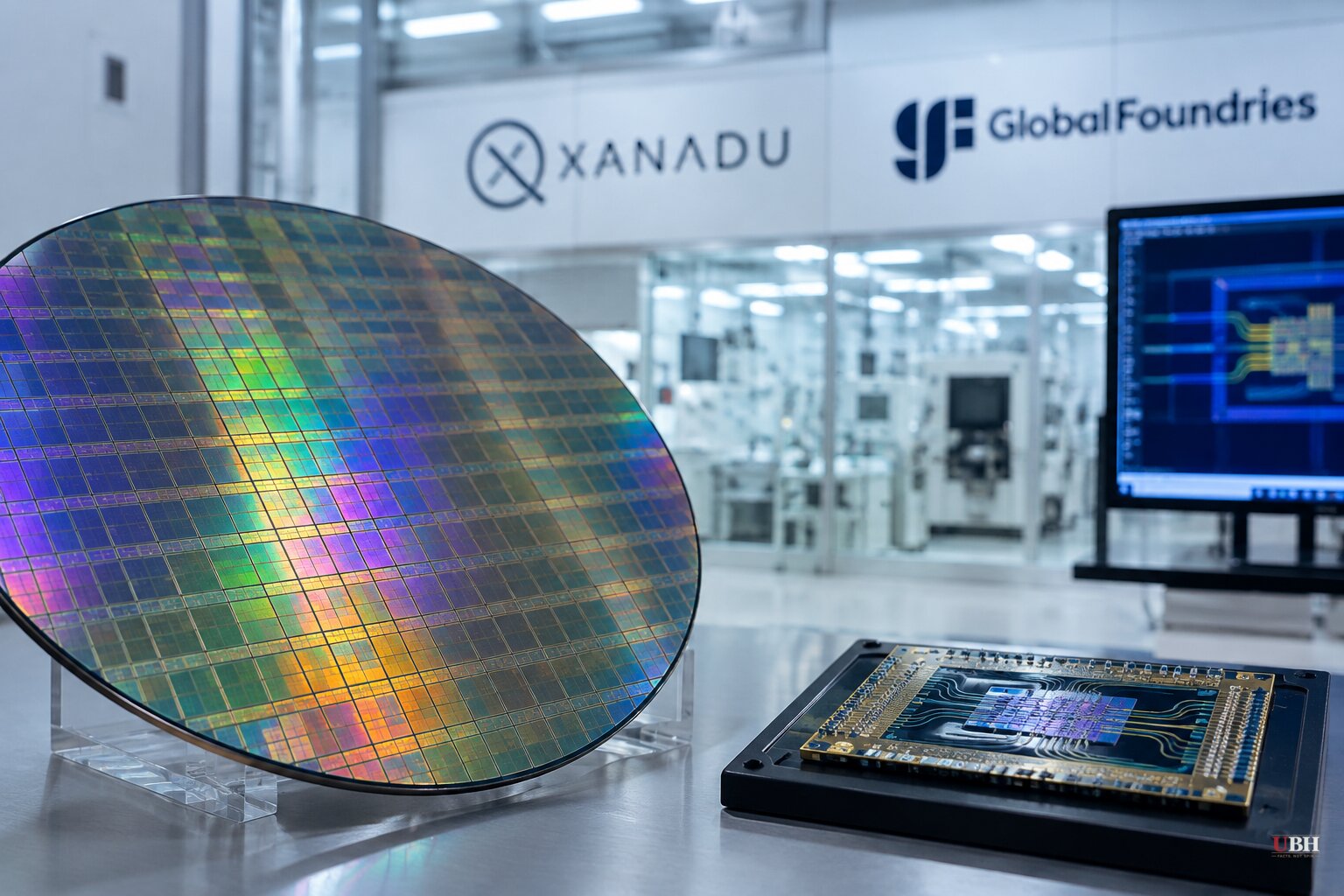
Xanadu Signs GlobalFoundries Deal to Build Photonic Quantum Parts in New York; Pasqal's €50 Million EU Pilot Line Moves to Execution
Following our earlier report this week on India's 5.56 km open-air quantum key link, the quantum story moved from the lab to the factory floor on Oct. 6, with announcements on two continents.
Xanadu moves to a commercial fab in New York
Xanadu Quantum Technologies (NASDAQ/TSX: XNDU) said it has signed a strategic multi-year manufacturing partnership with GlobalFoundries. GF will produce the two core hardware components of Xanadu's planned fault-tolerant photonic quantum computers. Both will be made on GF's 300mm commercial wafer line in Malta, New York.
The first component is ultra-low-loss silicon nitride optical circuits. These work as the circuit boards of Xanadu's chips, routing individual photons.
The second is superconducting nanowire single-photon detectors, known as SNSPDs.
What matters is the venue. Until now, parts like these have typically come out of specialized research fabs and university clean rooms. A 300mm line is the same wafer format used for conventional chips at volume.
Why loss is the whole game
Photonic machines encode information in particles of light, not in the superconducting circuits IBM and Google use or the trapped ions used by IonQ and Quantinuum. Light holds its quantum state longer because photons barely interact with their surroundings.
The cost is that a lost photon is gone for good. Xanadu's own August 2026 roadmap names photon loss as the primary error source in its architecture. Getting it below a threshold is, by the company's account, the prerequisite for fault-tolerant operation.
That is why a fab partner matters here. Getting nanoscale superconducting films and low-loss nitride waveguides to coexist in one industrial process flow, reliably and at 300mm scale, is an engineering problem that has to be solved before volume production makes sense. The announcement says GF will do the manufacturing. It does not show that the loss targets have been met on production wafers.
Europe's version: a subsidized consortium
Also on Oct. 6, Pasqal (NASDAQ: PSQL), a neutral-atom quantum computing company, said its Q-PLANET pilot line has moved into its execution phase. Q-PLANET stands for Quantum Pilot Line for production of Advanced chips for Neutral atom European Technologies.
The numbers:
- €50 million (about $57.2 million) over three years
- 28 partners from 11 European countries
- Co-funded by the EU Chips Joint Undertaking and national and regional bodies, including France 2030, ERDF, Business Finland, Austria's FFG and the Ministry of Science, Research and Arts of Baden-Württemberg
The consortium is to develop chip-scale lasers at four wavelengths (461, 698, 795 and 1013 nm), atom chips for quantum processors and sensors, and microfabricated vapor cells for atomic clocks and field sensors. It will also write standardized Process Design Kits and Assembly Design Kits so commercial foundries can build the parts repeatably.
Pasqal leads the 1013 nm chip-based laser work. It is also an end user of the vapor cells and lasers, setting top-level specifications and testing them in its own quantum processors.
"Three months after our kick-off in Brussels, Q-PLANET has moved from ambition to execution," said Pasqal CTO Loïc Henriet. "Together with our 28 partners, we are building a European supply chain for neutral-atom technologies, while bringing quantum industrialization closer to concrete user needs."
Pasqal framed the project as part of the EU's push for strategic autonomy and a resilient supply chain. It said the work is in line with the upcoming EU Quantum Act. The intended customers include HPC centers at TGCC, Forschungszentrum Jülich and CINECA, and users in drug discovery and advanced materials.
Two models, same bottleneck
The two announcements show different routes to the same problem. Xanadu is buying capacity from a commercial foundry on U.S. soil. Pasqal is coordinating a publicly co-funded consortium to build a regional supply chain from scratch, starting with lasers and vapor cells.
For taxpayers, the Europe model comes with a public price tag of €50 million over three years. The announcement does not break out how much comes from the EU versus national and regional budgets.
Both stories come from the companies' own announcements. The performance claims, such as loss levels and component specifications, are theirs and have not been independently tested in public.
What comes next
Q-PLANET's deliverables run across three years, so the first real test of whether the design kits work will come well after today's headlines. Pasqal also points to the EU Quantum Act, which it describes as upcoming, as the next policy marker for the program.
On the U.S. side, the open question is whether GF's Malta line can turn out nitride circuits and SNSPDs with loss low enough to meet the target in Xanadu's August roadmap.
Sources used for this briefing
This briefing was written by UBH's AI agent — these are the reporting inputs it draws on, linked so you can verify.


