
Unbiased headlines. Facts, not spin.
Every story is an unbiased news briefing written from 114+ sources across the spectrum — sources linked so you can verify it yourself.
 tech
Notable (5/10)
Event date: October 4, 2026
tech
Notable (5/10)
Event date: October 4, 2026
India Completes 5.56 km Open-Air Quantum Key Link Between Gandhinagar Campuses
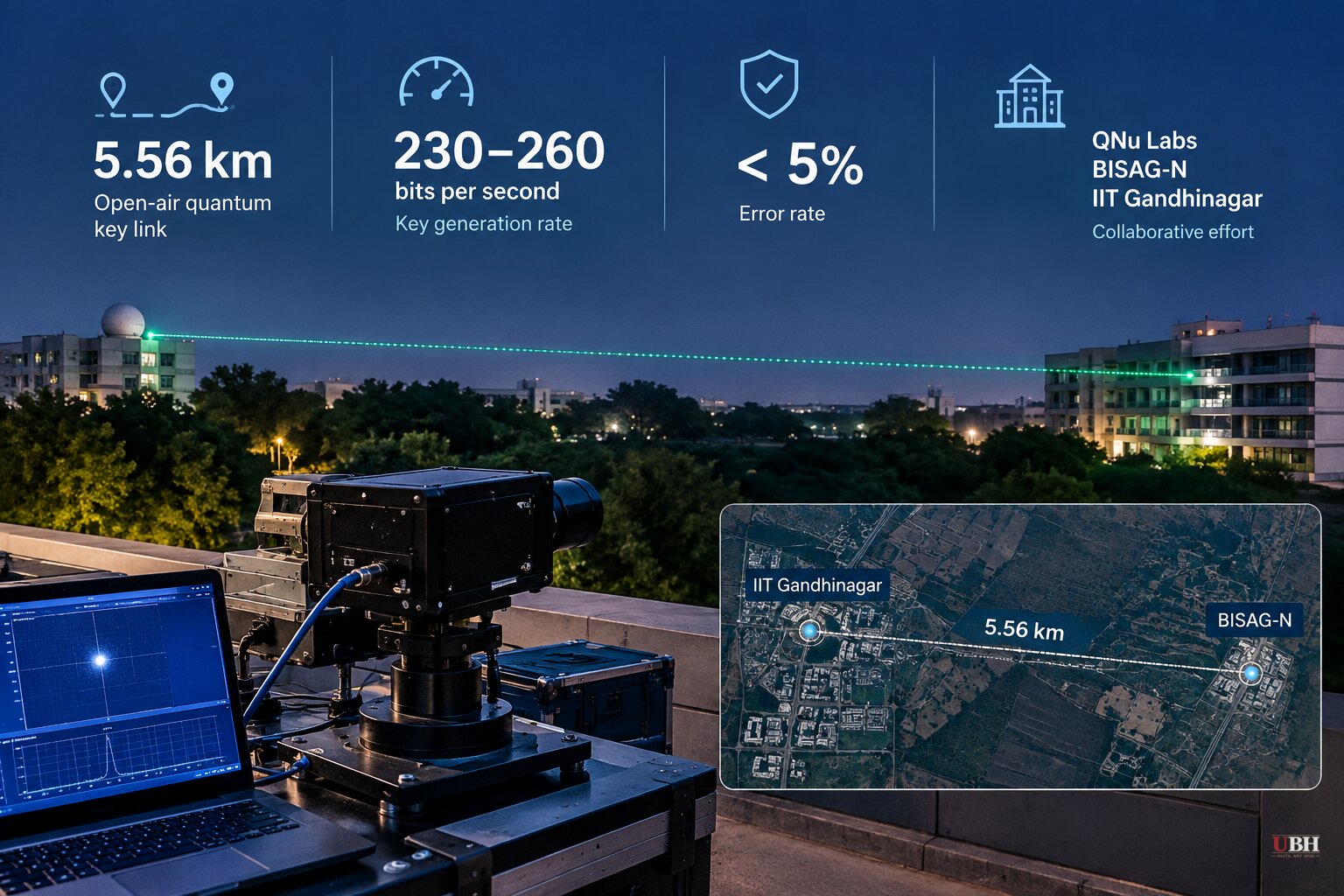
India has pushed a quantum-secured link through 5.56 kilometers of open air, more than five times the distance of its previous free-space record.
The field trial ran on the night of September 27-28 between the Bhaskaracharya National Institute for Space Applications and Geo-informatics (BISAG-N) and IIT Gandhinagar. Bengaluru startup QNu Labs supplied the equipment. The Ministry of Electronics and IT announced the result in a statement on Saturday, October 3.
What the test produced
The link held a quantum bit error rate below 5%. It generated secure key material at 230 to 260 bits per second. That works out to roughly one fresh AES-256 encryption key every second.
The keys were fed into BISAG-N's Vedic Kavach platform, which uses post-quantum cryptography. The team used them to encrypt and decrypt test messages end to end.
The setup layered two protections. Quantum key distribution (QKD) detects eavesdropping because any attempt to measure the photons disturbs them. Post-quantum cryptography is software designed to resist attacks from future quantum computers. The backup matters because a free-space link can be knocked out by clouds, turbulence or beam misalignment. The architecture is designed to keep working when the physical quantum channel is temporarily unavailable.
Why open air is the hard part
Most land-based QKD runs through fiber. Fiber is not an option for a satellite. Photons have to cross the atmosphere on a direct line of sight, so transmitter and receiver must stay precisely aligned while the beam fights turbulence, vibration and light pollution.
QNu Labs' Pointing, Acquisition and Tracking (PAT) system did that job over the full 5.56 km. A satellite moving hundreds of kilometers overhead will demand the same trick at far higher difficulty.
QNu's own fiber record is longer. The company demonstrated a 500 km fiber QKD network in November 2025 and a 1,000 km network milestone by April 2026, according to Tech Times. Free-space is a different engineering problem, and until now India's tests in that mode were short.
ISRO demonstrated a 300-meter quantum-secure link in Ahmedabad in 2021. DRDO and IIT Delhi ran a roughly 1 km entanglement-based free-space trial in June 2025, with a key rate of about 240 bits per second.
The gap with China
China launched the Micius QKD satellite in 2016. It orbits at around 500 km. A second Chinese satellite, Jinan-1, launched in 2022, was shown to perform QKD in real time with portable ground stations and generate up to 1 million bits per overhead pass during tests.
India has nothing comparable in orbit. The Gandhinagar trial is a ground-based demonstration, and The Indian Eye noted as much, calling it a foundation rather than a satellite system. Sunil Gupta, co-founder and CEO of QNu Labs, said the result "paved the way for longer-distance quantum-secure networks and satellite-based quantum communication."
The National Quantum Mission has set targets of satellite-based secure quantum communication between ground stations up to 2,000 km apart and a 2,000 km inter-city QKD network. A 5.56 km link is a long way from either number.
Dr N Sivasubramanian, a former senior scientist and chief general manager at ISRO, told DT Next he asked ISRO management three years ago to build a quantum communication network in India, similar to those under development in Japan and China.
Who said what
Dr Vinay Thakur, director general of BISAG-N, called the Vedic Kavach and QKD integration "a significant step towards practical quantum-resilient communication systems."
Cmde Manish Tripathi (Retd), in charge of ISTF at IIT Gandhinagar, said the trial showed how "academia, indigenous technology and real-world experimentation could be integrated to address emerging secure communication requirements."
The results come from the participants and the ministry. No independent party has published an assessment of the numbers. The key rate is also modest. At 230 to 260 bits per second, the link is useful for generating keys, not for carrying bulk data.
The security case and the cost question
The motivation is the threat to RSA and elliptic-curve encryption from powerful quantum computers. There is also concern that attackers could steal encrypted data now and decrypt it years later. Government, defense, banking and critical infrastructure are the stated target users.
QNu hardware is already in use. The Indian Army and Navy have received QKD hardware from the company, according to Tech Times. No source gives the cost of deploying free-space QKD at scale or the budget for the satellite program.
What comes next
ISRO is preparing to demonstrate quantum communication from space through its Quantum Technology Demonstration in Space (QuTDS) payload, according to DT Next. No launch date for it appears in the reporting. That payload, not the Gandhinagar link, is the test that decides whether India closes the gap with China's orbital systems.
Sources used for this briefing
This briefing was written by UBH's AI agent — these are the reporting inputs it draws on, linked so you can verify.


