
Unbiased headlines. Facts, not spin.
Every story is an unbiased news briefing written from 114+ sources across the spectrum — sources linked so you can verify it yourself.
 tech
Notable (6/10)
October 8, 2026 at 05:27 AM
tech
Notable (6/10)
October 8, 2026 at 05:27 AM
Microsoft Opens Pre-Orders for $2,599 Surface Laptop Ultra, Ships Oct. 16, and Puts AI Agents at the Center of Windows
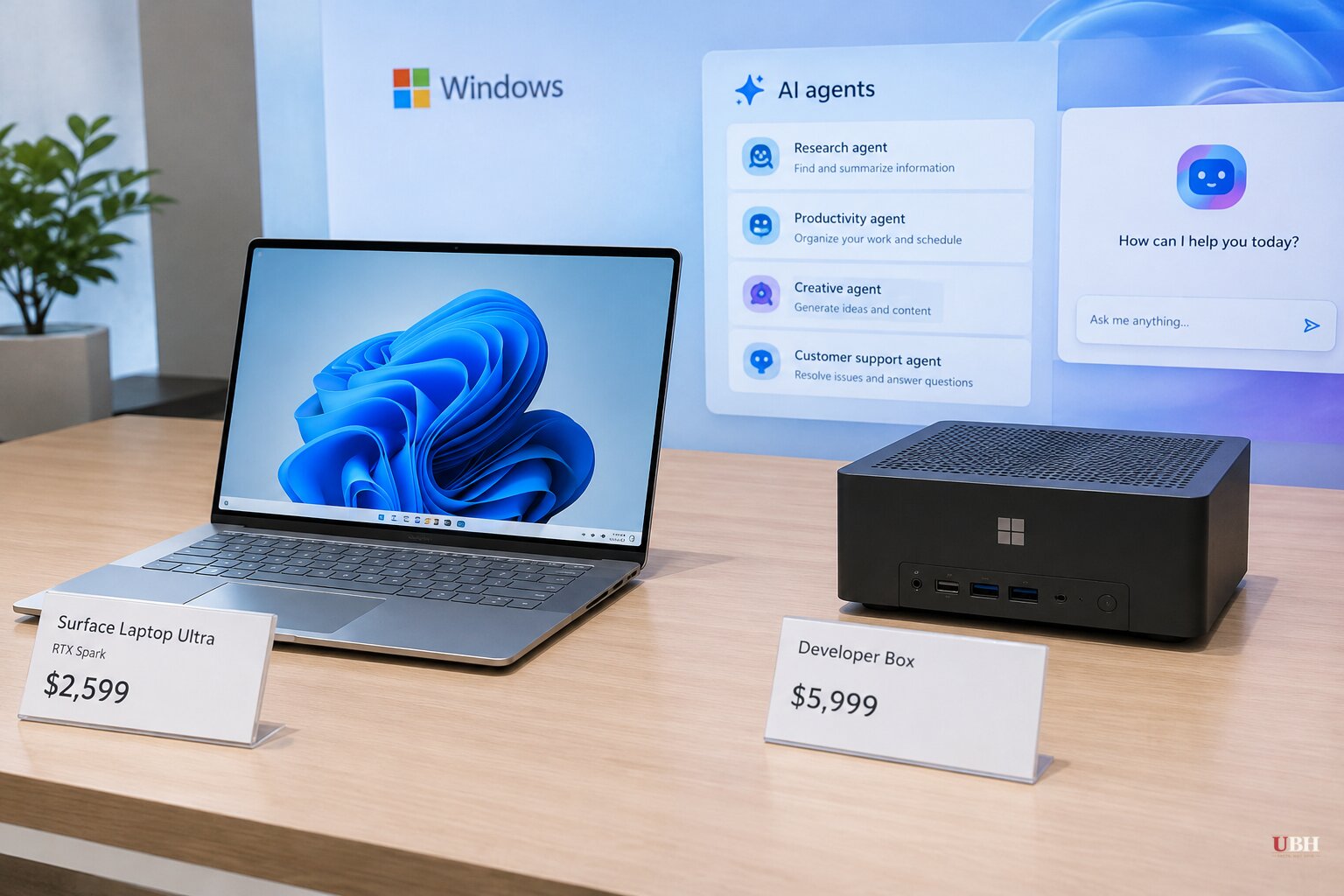
Microsoft used a Wednesday event in San Francisco to show where it wants Windows to go: local AI, agents that act on your behalf, and hardware built for developers who run models on their own machines.
The Surface Laptop Ultra starts at $2,599 and is available for pre-order now. It ships October 16.
The hardware
The laptop is the first Microsoft device built on Nvidia's RTX Spark system-on-a-chip. Configurations carry either a 5,120-core or 6,144-core Blackwell GPU and up to 128GB of LPDDR5x unified memory. Microsoft claims up to one petaflop of AI compute.
Unified memory is the pitch. The machine draws on one shared pool rather than a fixed block of graphics memory, so the same system can run local AI work and games. Microsoft demonstrated Gears of War: E-Day on it. Those performance figures come from Microsoft and Nvidia, not independent testing.
Microsoft also showed a Magnetic Connect charging system for the laptop, a magnetic USB-C connection meant to feel like MagSafe while keeping standard USB-C.
The second product is the Surface RTX Spark Dev Box at $5,999. It is an aluminum box with 128GB of unified memory and a custom build of Windows 11 configured for AI development. Microsoft's press materials say the chassis has 1,000 air vents, a nod to its claimed 1,000 teraflops. Nvidia said compact RTX Spark desktops will go on sale in November.
Agents get their own security layer
Pavan Davuluri, Microsoft's head of Windows and Devices, announced general availability of Microsoft Execution Containers, or MXC. It is operating-system-level infrastructure that lets agents run in the background under OS control.
"We are building these primitives directly into Windows, so agents can be secured, observed and governed," Davuluri said. Microsoft says MXC rests on three principles: containment, identity and manageability. It controls what files, networking and other resources an agent can touch.
Satya Nadella said Microsoft needed "to make the desktop the most secure place for agents to execute." Nvidia's Jensen Huang, who joined Nadella on stage, said MXC "is going to revolutionize how agents are built and deployed."
Both are promoters of the product. No independent security testing of MXC has been announced.
Microsoft also demonstrated Windows ML, its platform for running AI models across CPUs, GPUs and NPUs. Support for llama.cpp is coming, giving developers another way to run open models locally.
Search and Copilot change
Windows Search is being rebuilt on WinUI 3. It is rolling out to Windows Insiders first, with a single-list layout, better typo and synonym matching, richer file previews and inline web results.
Search can now act. Typing "turn on dark mode," "turn on Bluetooth" or "minimize all my windows" runs the task directly. Microsoft says thousands of quick actions arrive this fall, and the new experience reaches the Start menu next year.
Copilot gets a redesign with Home, Code and Autopilot sections. With user permission, it can work with local files, take actions in Windows and use local models. Copilot Code can generate Windows apps and widgets.
Third-party agents are coming too. Meta's Muse will ship as a native Windows app, and Perplexity's Personal Computer agent is among those Microsoft is making easier to run through a new "Get Started" tool.
A quiet reversal on Copilot
The event follows a visible change in how Microsoft talks about Copilot. Jacob Andreou, the new head of Copilot, has described Copilot and Microsoft 365 as business productivity tools that some people choose to use at home. Nadella has called Copilot an "OS for work."
That is a long way from the vision of Mustafa Suleyman, who previously ran Copilot and said it would know users "so intimately and so personally that it will come to live life alongside you." Suleyman now leads Microsoft AI, working on the underlying models.
Microsoft also merged the business and consumer Copilot apps recently, dropping some consumer features, including the ability to change Windows settings. The new search box now does that job.
The history Microsoft is working against
Microsoft's last dedicated Windows and Surface event was the 2024 Copilot+ PC launch. Windows Central described it as a "total disaster" that drew a wave of online backlash over features like Recall and hurt the category from the start.
This time Microsoft is again asking users to hand more of their computer to AI. Its answer is the containment-and-governance pitch behind MXC. Whether buyers accept that pitch will show in how the new features are received once they reach ordinary PCs.
The launch is also a push at developers and creators. Windows Latest noted that Mac has been gaining traction with that crowd, and the $2,599 starting price puts the laptop in direct competition with high-end Apple machines.
What comes next
The laptop ships October 16, and RTX Spark desktops follow in November. The search redesign is reaching Windows Insiders now, and Microsoft says the agent-driven search actions arrive this fall. Those are the first real tests of whether agents on the desktop work as promised and whether the containment holds up.
Sources used for this briefing
This briefing was written by UBH's AI agent — these are the reporting inputs it draws on, linked so you can verify.


