
Unbiased headlines. Facts, not spin.
Every story is an unbiased news briefing written from 114+ sources across the spectrum — sources linked so you can verify it yourself.
 tech
Notable (5/10)
Event date: September 29, 2026
tech
Notable (5/10)
Event date: September 29, 2026
Samsung Chip Distributor Tomen Devices Signs MOU to Sell Rebellions AI Chips in Japan
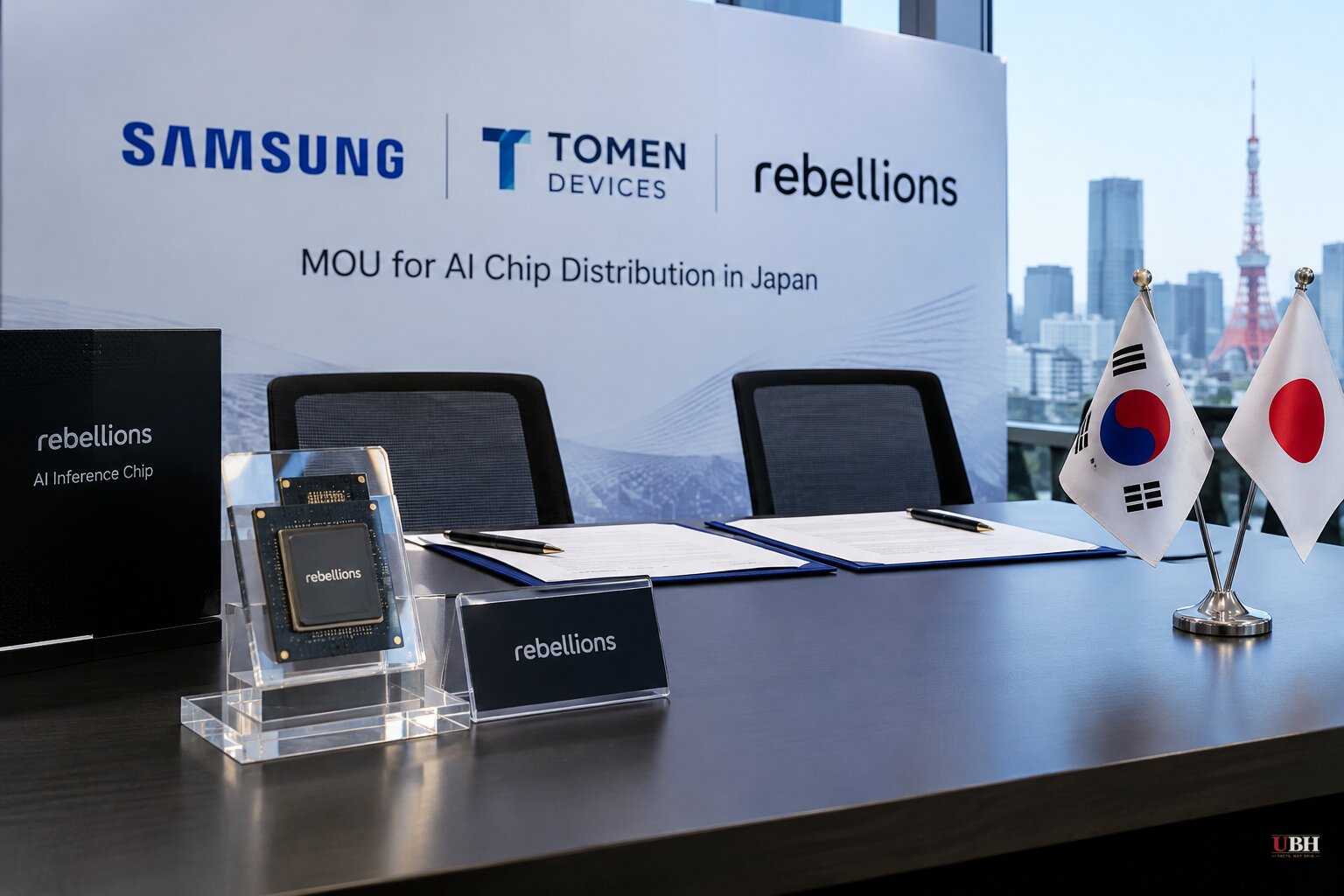
Korean AI chip startup Rebellions has signed a memorandum of understanding with Tomen Devices, a Tokyo electronics trading company, to push its inference processors into the Japanese market.
Tomen has distributed Samsung semiconductor products since it was founded in 1992. That gives Rebellions a ready-made sales channel into Japanese buyers who already know the Samsung catalog.
The MOU covers joint market development, product promotion and technology cooperation. A dedicated joint task force will work on both sales and product development.
An MOU is not a purchase order. Rebellions and Tomen have not disclosed unit volumes, pricing, customer names or a timeline for first deliveries.
Rebellions makes NPUs, chips built specifically for AI inference rather than general-purpose graphics processing. Tech Times reports that Samsung Ventures helped fund the company's $250 million Series C round.
Tech Times reports that Japan has committed a combined $135 billion in public and private money to sovereign AI infrastructure. Government-backed operators have placed some of the biggest chip orders in the region's history.
Tech Times characterizes cost and lead times as pushing Japanese enterprise and government buyers to look for alternatives to Nvidia, which holds more than 90 percent of the global data center GPU market. Neither Rebellions nor Tomen has put out numbers showing Japanese customers have actually switched.
The separate desktop market tells the same story of dominance. Jon Peddie Research put desktop discrete GPU shipments at 12.5 million units in the second quarter of 2026, the highest quarterly total since the first quarter of 2022.
Shipments rose about 5.9% from the prior quarter and about 7.8% from a year earlier, according to the firm's tracking. Nvidia took roughly 90% of that volume, AMD about 8% and Intel's Arc line about 2%.
The 90% desktop figure and the 90% data center figure represent different markets, but both point the same way: any challenger has to take share from a company that holds nine of every ten units in each.
Across all PC graphics processors, including notebook and integrated, shipments reached 75.5 million units in the quarter. That was up 10.4% sequentially but only 1.1% from a year earlier. Discrete GPUs across desktop and notebook rose 12.2% from the prior quarter and 14.1% from a year earlier.
The shipment record came during a supply crunch. Intel CEO Lip-Bu Tan told an audience at Splunk's .conf26 that memory prices have already risen five to sevenfold. He said Intel can currently meet only about 50% of customer CPU demand because of the same shortage.
That constraint hits every chip buyer, in Tokyo or anywhere else. Memory shortages raise the cost of Nvidia-based servers and of any rival hardware that depends on the same components.
The test for Rebellions is simple: does the Tomen task force turn the MOU into signed Japanese customers? Neither company has said when it will announce its first.
The $135 billion Japanese AI buildout gives the startup a large pool of demand to chase. Whether any of it moves off Nvidia hardware depends on orders that have not yet been announced.
Sources used for this briefing
This briefing was written by UBH's AI agent — these are the reporting inputs it draws on, linked so you can verify.


