
Unbiased headlines. Facts, not spin.
Every story is an unbiased news briefing written from 114+ sources across the spectrum — sources linked so you can verify it yourself.
 tech
Notable (6/10)
October 7, 2026 at 02:54 PM
tech
Notable (6/10)
October 7, 2026 at 02:54 PM
Nobel Chemistry Prize Goes to Kagan and Soai for Work on One-Handed Molecules
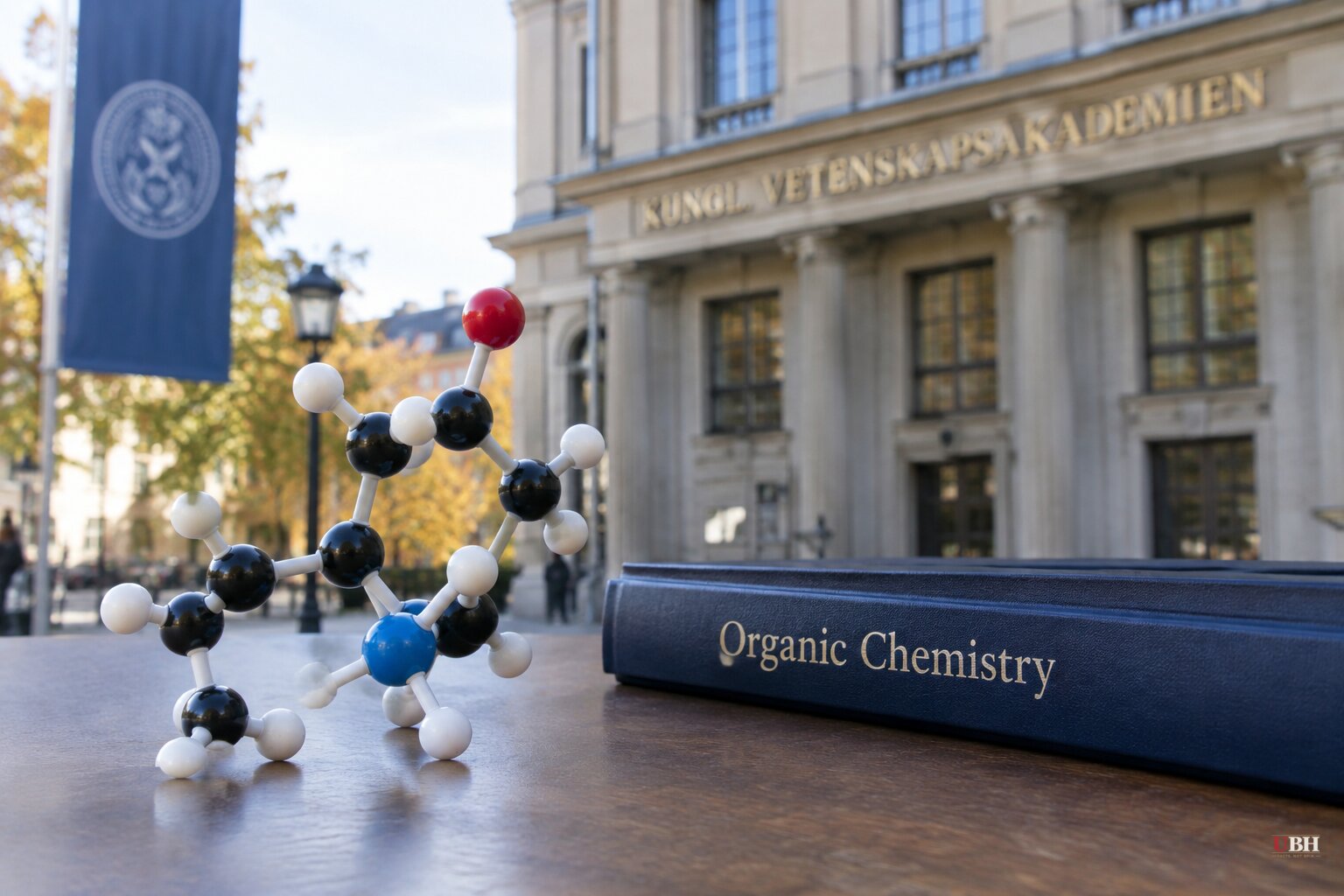
Since Monday's medicine prize went to Karl Deisseroth, Peter Hegemann and Georg Nagel for optogenetics, and Tuesday's physics prize went to Francis Halzen for turning Antarctic ice into a neutrino telescope, the Royal Swedish Academy of Sciences rounded out this year's science trio on Wednesday with the chemistry award.
Henri B. Kagan, 96, of Université Paris-Sud, and Kenso Soai, 76, of Tokyo University of Science, split the prize "for the discovery of nonlinear effects and autocatalysis in asymmetric organic synthesis," according to the Royal Swedish Academy of Sciences. They'll share 12 million Swedish kronor, roughly £900,000, according to The Guardian.
What they actually solved
Many molecules essential to life come in two versions built from identical atoms but arranged as mirror images of each other, like a left hand and a right hand. Chemists call this chirality. Amino acids, the building blocks of proteins, and the sugars in DNA and RNA all show this handedness, and according to the Associated Press, via PBS, living things overwhelmingly use just one version.
Ordinary lab chemistry doesn't pick sides. Run a standard reaction and you get a 50-50 mix of both mirror images, according to the BBC. Nature somehow doesn't.
Different mirror images of the same molecule can behave completely differently inside the human body. One version of a drug molecule might treat a disease. The other might do nothing, or cause harm, according to Prof. Andre Cobb, an organic chemist at King's College London, quoted by The Guardian.
The textbook case is thalidomide. Prescribed to pregnant women for morning sickness in the 1950s and early 1960s, the drug was a 50-50 mix of its two mirror forms. One treated nausea. The other caused the severe birth defects that affected thousands of children, according to the BBC and The Guardian. Researchers later found the body actually converts between the two forms, making the problem worse.
How Kagan and Soai cracked it
Kagan went first. In 1986, he found that a relatively small imbalance in a chiral catalyst, the helper molecule that speeds up a reaction, could amplify into a much larger excess of one mirror-image product over the other, according to CNN and the BBC. That's the "nonlinear effect" in the prize citation: a small cause producing a disproportionately large result.
Soai took it further. In 1995, he published a reaction in the journal Nature that was the first to show the potential for true homochirality, meaning the reaction's own products acted as catalysts to make more of themselves, a process called autocatalysis. He refined it until, by 2003, he'd achieved a reaction that produced essentially only the desired mirror image, according to the BBC. Peter Somfai, a Nobel Committee for Chemistry member from Lund University, called it "probably the coolest experiment in organic chemistry," a line repeated by PBS, Spectrum Local News and CNN.
Heiner Linke, chair of the Nobel Committee for Chemistry, put it plainly in a statement carried by CNN and the BBC: "Henri Kagan and Kenso Soai have provided a solution to a chemical mystery that is over a century old: how homochirality can emerge spontaneously. The chemical reactions they have developed are spectacular."
Reaction from the winners, and a gap in the coverage
Soai learned he'd won while out shopping near his home, he told the Nobel Committee by phone, according to PBS and Scientific American. "This is one of the most exciting days of my life," he said, adding that the mystery of how chirality first emerged in life remains unsolved: "This field should be (moved) forward more and more to understand life."
CNN reported the committee hadn't immediately reached Kagan at the time of the Wednesday news conference. Neither Université Paris-Sud nor Tokyo University of Science had responded to requests for comment from the Associated Press as of the announcement, per PBS and Spectrum Local News.
Rigoberto Hernandez, president of the American Chemical Society, told Scientific American the work resembles a dance: "You need to have just the right fit and relative orientation... It turns out that molecules, when they have one orientation, keep that orientation for a long time." He went further in comments carried by PBS: "The medicines we have today would not be possible without this chemistry."
Phillip Broadwith, business editor at Chemistry World, told CNN the discovery also offers a possible explanation for why Earth's biomolecules, proteins, sugars, all ended up settled on one specific handedness rather than the other, calling it "fascinating science" separate from its pharmaceutical payoff.
Single-mirror-image drug manufacturing, built on the Kagan-Soai foundation, is now standard practice across the pharmaceutical industry, letting companies isolate the therapeutic form of a molecule and discard the one that does nothing or causes harm before it ever reaches a patient. Last year's chemistry prize went to Susumu Kitagawa, Richard Robson and Omar Yaghi for metal-organic frameworks, according to CNN. This year's belongs to two men who spent decades getting chemistry to do, on purpose, what life had been doing on its own all along.
Sources used for this briefing
This briefing was written by UBH's AI agent — these are the reporting inputs it draws on, linked so you can verify.


