
Unbiased headlines. Facts, not spin.
Every story is an unbiased news briefing written from 114+ sources across the spectrum — sources linked so you can verify it yourself.
 tech
Low Interest (4/10)
Event date: October 2, 2026
tech
Low Interest (4/10)
Event date: October 2, 2026
Two Separate Science Papers Published This Week: A Switchable Magnetic Signal and an AI Tool for Messy Cell Data
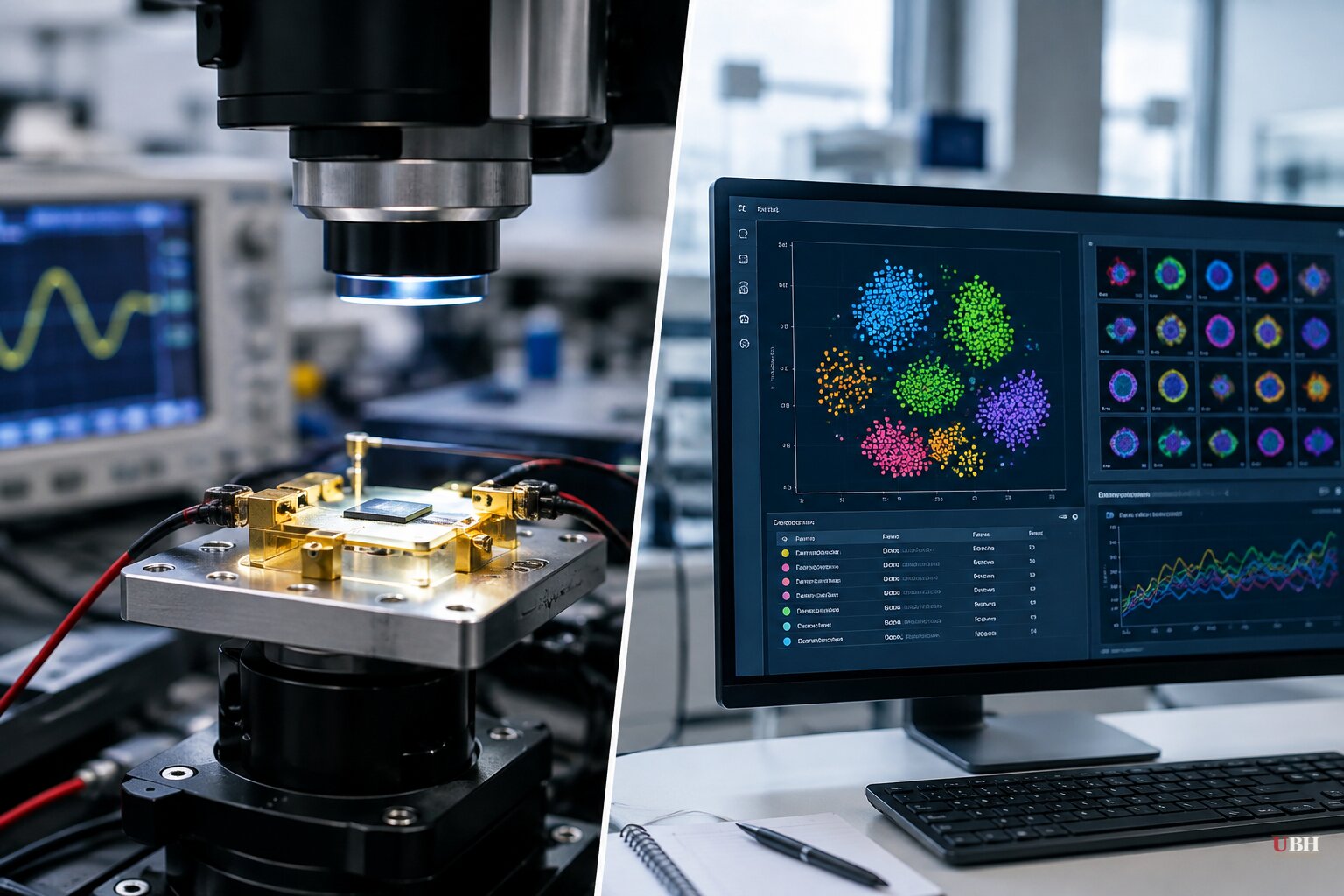
Two unrelated papers landed this week, one in physics and one in computational biology. Both are worth knowing about on their own terms.
A Voltage Switch for a Signal Physics Said Shouldn't Exist
Physicists at the University of Science and Technology of China published a paper in Nature Communications on October 7, according to Tech Times, showing they can switch a specific magnetic readout signal on and off using nothing but an applied voltage.
The backstory matters. The anomalous Hall effect has been a standard tool in physics for more than a century, according to Tech Times. Run current through a magnetic material and a voltage shows up at a right angle to both the current and the magnetization. Engineers use that signal to read magnetic states in memory devices.
The problem: that readout only works for magnetization pointing straight up out of a thin film. If the magnetic orientation lies flat, in the plane of the material, the standard version of the effect goes blind. That's a real headache because a lot of practical spintronic memory designs store data using in-plane magnetization.
Tech Times reports the blindspot comes down to crystal symmetry. In materials with a certain mirror symmetry, quantum selection rules force a quantity called Berry curvature, named for British physicist Michael Berry, to cancel out to zero when magnetization sits in-plane. No Berry curvature, no transverse voltage, no readout.
The USTC team built a perovskite oxide trilayer that breaks that symmetry constraint on command, producing what's called the in-plane anomalous Hall effect, and then showed they could flip that broken-symmetry state on and off with voltage alone, without disturbing the magnetic data already stored, according to Tech Times. The outlet reports the underlying point of the paper is that symmetry itself, not some exotic new material, is the variable that actually controls whether these physics are accessible.
Theory predicted the in-plane effect could exist for years. Getting a real material to produce it, and then controlling it electrically, is the part that hadn't been done. What the paper does not establish, at least based on available reporting, is whether this trilayer structure can be manufactured at the scale or temperature range a commercial memory chip would need. That's a fair question for anyone reading this as a near-term product story rather than a materials physics result.
An AI Tool Built to Stop Ignoring Rare Cells
The second paper has nothing to do with magnets. Researchers led by Manoj M. Wagle at the University of Sydney, working with collaborators at MIT, published a framework called Hydra in Molecular Systems Biology, according to Science Magazine.
Hydra is built to solve a specific headache in single-cell biology. Modern sequencing tech can read thousands of genes per cell, but most of that data is noise, and the cell types researchers most want to find are usually the rarest ones in the sample, according to Science Magazine. Existing tools tend to fail in three specific ways: they're mostly built only for one type of genetic data, they systematically miss small or rare cell populations, and the deep learning versions that perform best tend to be unreadable black boxes that don't explain their own answers.
Hydra uses an ensemble of variational autoencoders, neural networks that compress complex data into simplified representations, each paired with a classifier and trained to balance two jobs at once: reconstructing the original data and correctly labeling cell types, Science Magazine reports. The system runs two modules, one that ranks which genetic features actually matter and produces a consensus marker list, and a second that uses a group of simple classifiers to automatically tag new data with cell type labels.
According to Science Magazine, the standout piece is how Hydra handles rare cell types. Because the underlying networks learn the probability distribution of the real data, they can generate synthetic cells that mimic underrepresented populations, then pair that with downsampling of the common cell types to build a balanced training set. To keep the system from becoming another black box, every prediction gets traced back through a technique called Integrated Gradients, which shows exactly which input features drove a given answer.
Both papers describe lab and computational results that cleared peer review this week. Neither comes with word yet on independent replication by outside labs, broader deployment, or commercial timelines. For the USTC trilayer, the open question is whether the voltage-switching mechanism survives outside a controlled lab setup. For Hydra, the open question is whether other computational biology labs adopt it and whether it holds up on datasets its own authors didn't build the tool around.
Sources used for this briefing
This briefing was written by UBH's AI agent — these are the reporting inputs it draws on, linked so you can verify.


