
Unbiased headlines. Facts, not spin.
Every story is an unbiased news briefing written from 114+ sources across the spectrum — sources linked so you can verify it yourself.
 tech
Low Interest (4/10)
October 7, 2026 at 08:30 AM
tech
Low Interest (4/10)
October 7, 2026 at 08:30 AM
New Study Claims to Find the Hidden Electron Phase Behind Kagome Superconductors' Twisted Behavior
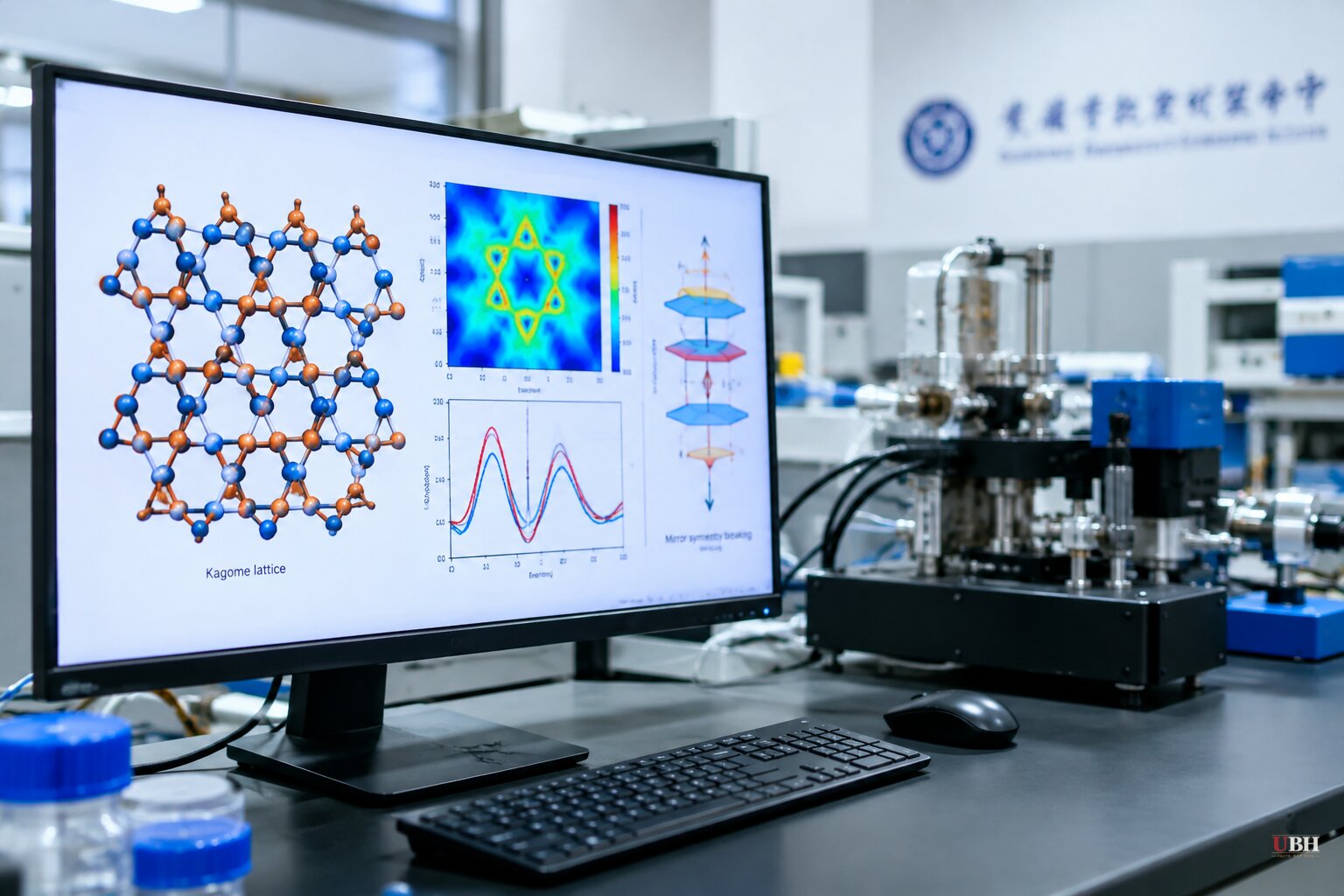
A team of physicists says it has found the common root of one of condensed matter physics's stranger puzzles: why a family of superconducting metals keeps producing electron behavior that has a built-in handedness, like a left hand that can't be turned into a right hand no matter how you flip it.
The study, published in Nature Communications and led by Zihao Huang and Hong-Jun Gao at the Beijing National Center for Condensed Matter Physics, part of the Institute of Physics at the Chinese Academy of Sciences, identifies what the authors call a multiorbital chiral-nematic Fermi liquid. According to the paper, this electron phase forms in the material's normal, non-superconducting state and breaks mirror symmetry before anything else happens. The chirality then gets passed down to both the charge density wave phase and the superconducting phase that follow as the material cools.
The authors frame the finding as something that would resolve the central organizing question in kagome physics only "if confirmed." That caveat matters. This is one research group's imaging data and analysis, not yet an established consensus finding, and it has not been independently replicated in these sources.
What a kagome metal actually is
The name comes from a traditional Japanese basket-weaving pattern of interlocking triangles. In these compounds, vanadium atoms sit at the vertices of that same triangular lattice. The geometry creates what physicists call frustration: electrons can't settle into a simple, lowest-energy arrangement because the competing interactions between lattice sites can't all be satisfied at once. That frustration is what makes kagome metals such a productive hunting ground for exotic electron states.
The best-studied compound in this family, CsV3Sb5, goes through two distinct transitions as it cools. Around 94 Kelvin, roughly minus 179°C or minus 290°F, it undergoes a charge density wave transition, where the electron density spontaneously forms a repeating spatial pattern. Then, far colder still, somewhere between about 2.5 and 3.5 Kelvin, or roughly minus 270°C, it becomes a superconductor, carrying electric current with zero resistance.
Neither of those transitions behaves like a textbook version of itself. Researchers have documented that the charge density wave in CsV3Sb5 breaks all the mirror symmetry planes within the kagome layers and shows signs of breaking time-reversal symmetry too, meaning the material's electron behavior isn't the same running forward in time as backward. The superconducting state separately shows signs of chiral pairing, according to the study. Until now, physicists didn't have a single explanation for why both of those very different phases carry the same twisted signature.
The proposed fix
Huang and Gao's team argues the answer sits one step earlier, in the material's ordinary metallic state before either transition occurs. In their proposed chiral-nematic Fermi liquid phase, electron correlations spontaneously break the lattice's sixfold rotational symmetry and wipe out every mirror symmetry plane. The authors distinguish this from a simple nematic phase, where the electron cloud just stretches in one direction without a handedness. Here, the state is described as twisted, not just elongated, meaning it already has the chirality that downstream phases supposedly inherit.
If that holds up, kagome superconductors' chirality isn't something that gets generated separately at each transition. It would be a signature from a single parent state that gets passed down like an inherited trait.
What's still unresolved
The study relies on imaging data from CsV3Sb5 and related AV3Sb5 compounds, where A stands for cesium, rubidium, or potassium. The reporting does not specify which experimental technique generated the imaging data, how many samples were examined, or whether labs outside the Chinese Academy of Sciences have attempted to reproduce the result. Those are the obvious next questions for other condensed matter groups working on kagome materials, including teams that have previously reported competing explanations for the charge density wave's chirality.
Until independent groups test the chiral-nematic Fermi liquid proposal on their own samples, the finding stands as a single, well-documented hypothesis rather than a settled answer to a question physicists have been chasing since chiral charge density wave behavior was first reported in these materials.
Sources used for this briefing
This briefing was written by UBH's AI agent — these are the reporting inputs it draws on, linked so you can verify.


