
Unbiased headlines. Facts, not spin.
Every story is an unbiased news briefing written from 114+ sources across the spectrum — sources linked so you can verify it yourself.
 tech
Major Story (7/10)
Event date: September 23, 2026
tech
Major Story (7/10)
Event date: September 23, 2026
Goldman Sachs: Chinese potato town Ulanqab has 12.5 GW of data centre capacity committed, 70% of it in the past year
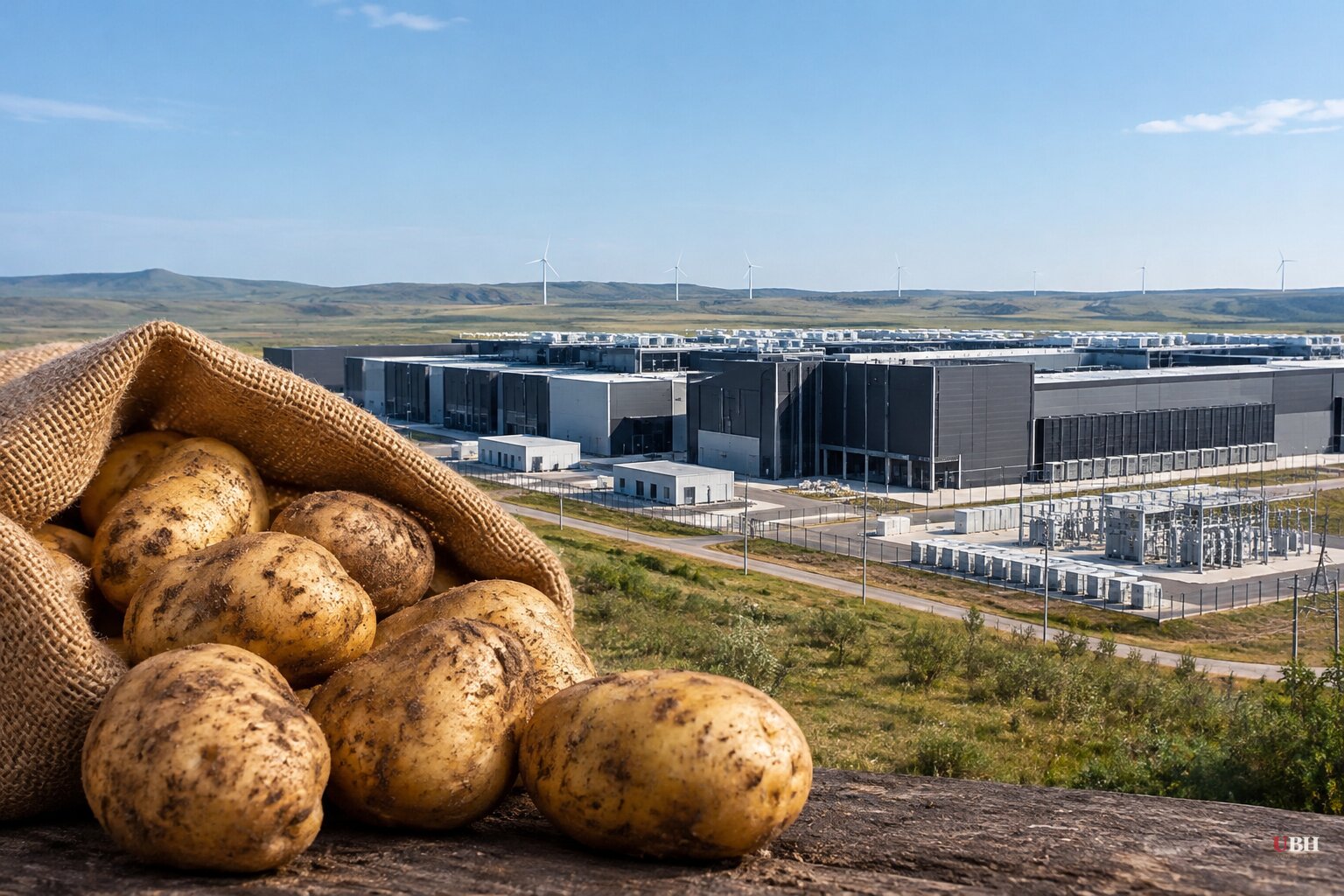
Ulanqab, in Inner Mongolia, has long called itself China's potato capital. It is now one of the country's fastest-growing AI computing hubs.
Goldman Sachs, in an August report, put the city's committed data centre capacity at 12.5 GW as of June. More than 70% of that was added in the past year. OpenAI's Stargate project launched in 2025 with an initial 10 GW of U.S. commitments.
The numbers behind the build-out
The Financial Times counted 89 data centres built or planned in Ulanqab. AsiaNews puts the figure at nearly a hundred opened or under construction since 2016. Chinese business outlet 36Kr, as relayed by tech site Progressive Robot, says the city signed about 100 data centre projects in roughly two years. The counts differ.
The city's own statistics office says electricity used by data services rose 85.2% year on year in the first half of 2026, to 4 billion kWh.
SemiAnalysis, an industry research firm, estimates China's operating data centre capacity at 24 GW. That exceeds the rest of Asia combined, but remains less than half the 56 GW it puts on the U.S. Another 50 GW is under construction or planned across China, according to SemiAnalysis.
One project is Envision's Galaxy Campus, designed to reach 2 GW and run directly on renewable power. Envision makes wind turbines. Elsewhere in the region, officials in Hohhot, the Inner Mongolian capital, announced 12 AI and computing projects worth 186.46 billion yuan (about $27.5 billion) on 22 August.
Why here
Beijing's "Eastern Data, Western Compute" programme, launched in 2021, steers data processing toward western regions where land and energy are cheaper. Ulanqab was named one of its hubs.
The cold climate cuts server cooling costs. Wind and solar are plentiful. The city is close enough to Beijing that fibre links keep latency low. Huawei, Alibaba and DeepSeek have all moved in, according to Goldman Sachs and the FT.
On the ground, the pace is obvious. "This is China speed," one construction worker told the BBC. An electrical engineer on the same site said the project runs one phase a year. "This is the second phase. There will be many more phases afterwards."
Power and water
Beijing wants major computing hubs to draw 80% of their electricity from renewables by the end of the decade. Ulanqab is not there. Research cited by AsiaNews finds roughly 37% of the city's electricity still comes from coal. Data centres need uninterrupted power, which makes that dependence hard to shake.
Water is the other limit. Ulanqab gets about 350 to 360 millimetres of rain a year and sits in one of Inner Mongolia's driest areas. Cooling demand peaks in summer, when water is scarcest.
Who benefits locally
The jobs picture is mixed. Andrew Stokols of Singapore Management University, who co-authored a 2026 study with Justin Kollar, says data centres do not automatically create large job spillovers. In neighbouring Guizhou, which has its own data centre cluster, GDP grew 7.4% a year on average over the past decade. Wage growth there lagged near the bottom nationwide, and the province carries heavy debt relative to its output, according to Taiwan-based research groups.
The South China Morning Post reports that construction work in Ulanqab is drawing young people who once left for big cities. In Guizhou, shopkeeper Shu Peihua said roads, trade and business opportunities improved as the data centres arrived.
The U.S. angle
The build-out came into focus as Xi Jinping and Donald Trump held a summit in Washington with AI safety on the agenda. "Whoever wins AI, wins," Trump said ahead of the meeting. Anthropic CEO Dario Amodei has called for keeping the U.S. ban on selling advanced chips and equipment to China, warning that a Chinese lead would "pose grave danger for the US and the world."
China's state-run Global Times rejects that framing, calling such U.S. fears part of a Cold War playbook, according to the BBC.
Talent is part of the contest. Jack Zhang of the University of Science and Technology of China, who studied at Yale and Cambridge, says that "fewer students and researchers are heading to the US, and more are returning from the US to China." He was recruited through a high-level Chinese programme.
The chip problem
The U.S. still leads in operating capacity, but its grid is a constraint. China has the opposite problem. Power, land and construction speed are in place, but advanced AI semiconductors are scarce under U.S. export controls.
No source has shown that all of Ulanqab's 12.5 GW, or the roughly 15 GW BigGo reports as confirmed for the city, will become operating compute. Committed capacity is not the same as running capacity. The open question is how many of those halls get filled with competitive chips, and whether the grid and water supply can carry them.
Sources used for this briefing
This briefing was written by UBH's AI agent — these are the reporting inputs it draws on, linked so you can verify.


