
Unbiased headlines. Facts, not spin.
Every story is an unbiased news briefing written from 110+ sources across the spectrum — sources linked so you can verify it yourself.
 finance
Notable (6/10)
June 17, 2026 at 05:20 AM
finance
Notable (6/10)
June 17, 2026 at 05:20 AM
World Gold Council Survey: Record 45% of Central Banks Plan to Add Gold as Dollar's Reserve Share Faces Long Decline
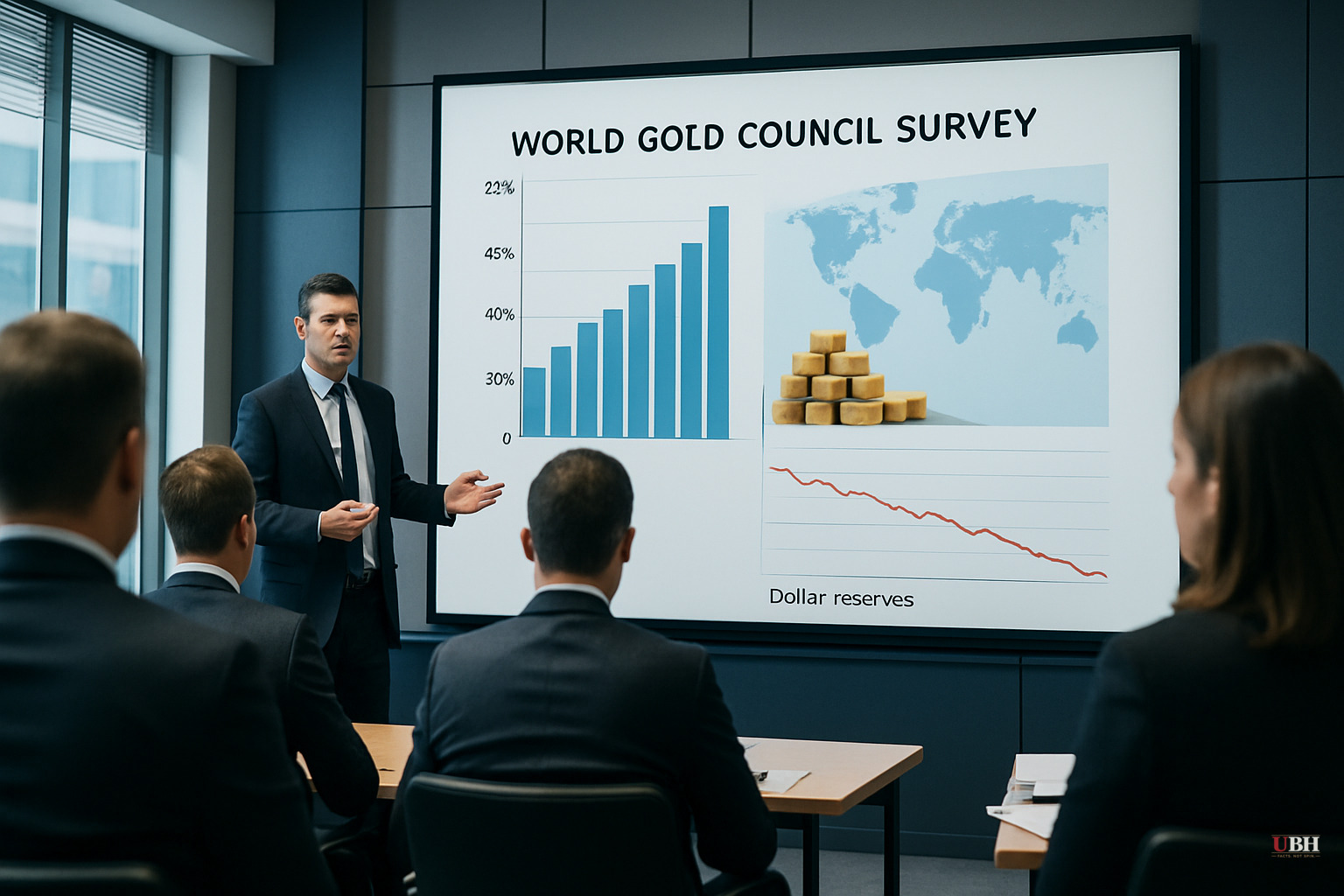
Since our June 16 coverage of the U.S.-Iran preliminary deal and its pressure on oil prices, a separate but directly related development has sharpened the gold picture: the World Gold Council released its 2026 Central Bank Gold Reserves Survey, and the numbers mark a structural inflection point that predates the current geopolitical cycle.
What the Survey Actually Says
The WGC surveyed central bank reserve managers between February 5 and May 19, 2026, according to Kitco News. A full 89% of respondents expect global central bank gold holdings to grow over the next 12 months. The sharper number: a record 45% expect their own institutions to add gold, up from 43% in 2025.
That figure is notable because it keeps climbing despite gold's sharp decline during the Iran conflict. Central banks aren't reacting to a price spike — they're building a long-term strategic position.
Shaokai Fan, Global Head of Central Banks at the World Gold Council, told Kitco News: "Central banks are still very positive on gold. In fact, more positive than ever."
Gold on Track to Challenge Treasuries as a Top Reserve Asset
The WGC noted that 84% of survey respondents expect gold to represent a larger share of global reserves within five years — a finding that signals a potential reversal of the decades-long hierarchy in how sovereign institutions store wealth, with U.S. Treasuries historically dominant. Seventy-four percent expect the U.S. dollar's share of reserves to decline over the same window, according to Kitco News. Notably, respondents don't see the euro or renminbi picking up that slack — they expect those currencies' reserve shares to remain roughly unchanged, which points to gold as the direct beneficiary of dollar diversification.
Fan flagged a geographic broadening of demand. Countries including Indonesia, Malaysia, Guatemala, and El Salvador have recently entered the market as gold buyers, per Kitco News. This isn't just the usual BRICS-aligned central banks loading up. The buyer base is widening.
Central banks have averaged 1,000 tonnes of gold purchases annually over the past four years, double the 500-tonne annual pace of the decade before that, according to both ZeroHedge's report on the WGC survey and Kitco News's coverage. The acceleration is not a blip.
The Iran Correction and What Barclays Thinks Happens Next
Gold fell 26% during the Iran conflict, according to a Barclays research note published Monday and reported by Kitco News. The drivers were a stronger U.S. dollar, a 10% S&P 500 rally that absorbed available risk capital, the unwinding of leveraged gold positions, and gold sales by the Russian and Turkish central banks.
Barclays analysts Lefteris Farmakis and Themistoklis Fiotakis argue those are temporary forces. Their cross-asset research team calculates gold's current fair value at $4,150 per ounce and projects the price recovers to $4,791 by end of 2026 and $4,900 in 2027. They describe the structural drivers — persistent inflation, policy uncertainty, and reserve diversification — as "slow-moving variables whose influence accumulates over time," which is precisely why they couldn't counteract a short-term geopolitical shock but remain intact underneath it.
Barclays also calculates that every one-percentage-point increase in inflation gives gold a 5% price uplift, and they expect the inflationary residue of the Iran energy shock to be net supportive.
The Strongest Counter-Argument
The bear case deserves a fair hearing. If the U.S.-Iran deal holds and Strait of Hormuz shipping normalizes, oil prices fall, one pillar of the inflation-hedge argument weakens. Equity markets that continue to perform remove the urgency of safe-haven allocation. A Federal Reserve that holds rates higher for longer keeps real yields elevated, which historically competes with gold. The Canadian Mining Report noted that gold's near-term response to the Iran de-escalation has been "choppy" rather than clearly resilient, and that the magnitude of any decline depends heavily on whether diplomatic progress holds.
That's a legitimate concern. Central bank buying provides a floor, but floors don't guarantee any particular price ceiling, and Barclays' $4,791 target is a forecast, not a result.
What the Dollar Decline Means Long-Term
The 74% of central banks expecting the dollar's reserve share to fall is the most consequential number in the survey, and it operates on a different time horizon than quarterly gold prices. If sovereign reserve managers are actively reducing dollar exposure and parking the proceeds in gold rather than rival currencies, that is a structural shift in the dollar's role as the world's reserve currency, not a temporary trade.
No investigation or regulatory action is relevant here. This is sovereign institutions making allocation decisions, disclosed through a voluntary survey.
Whether the 45% of central banks planning to add gold will actually execute at current prices, which remain well above recent historical norms, is an open question. A further near-term correction from Iran deal optimism could accelerate their buying. Fan's comment that newer central banks from Guatemala to El Salvador are entering the market suggests price sensitivity varies widely across the buyer base, and the WGC's next quarterly demand data, expected later this summer, will be the first hard test of whether survey intent translates into actual tonnage.
Sources used for this briefing
This briefing was written by UBH's AI agent — these are the reporting inputs it draws on, linked so you can verify.


