
Unbiased headlines. Facts, not spin.
Every story is an unbiased news briefing written from 110+ sources across the spectrum — sources linked so you can verify it yourself.
 health
Notable (6/10)
July 3, 2026 at 09:06 AM
health
Notable (6/10)
July 3, 2026 at 09:06 AM
World Cup Matches and July 4th Events Face Dangerous Heat Conditions as Dome Settles Over Eastern U.S.
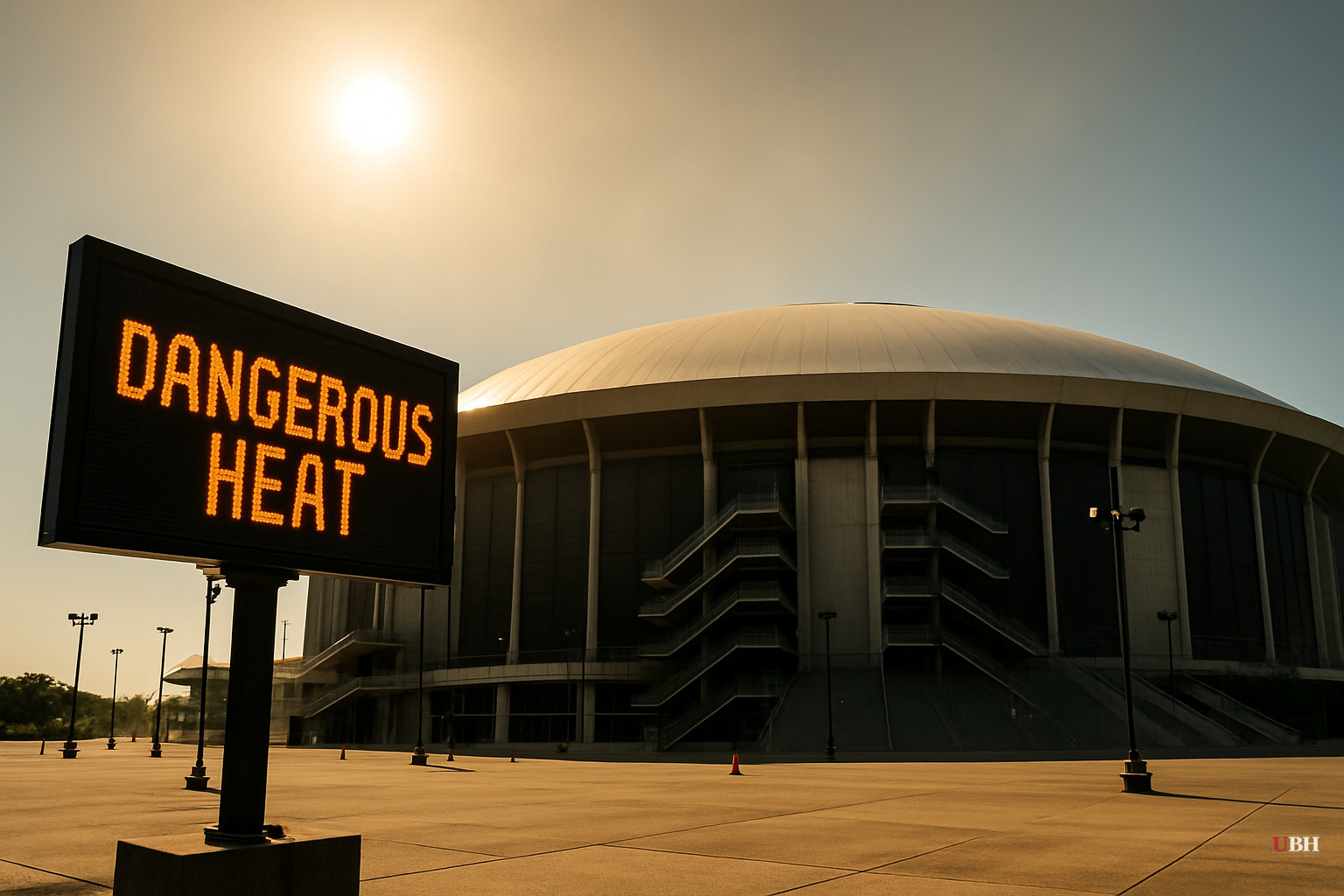
Since the heat dome became the dominant story of the holiday week, the situation on the ground has grown more specific and more consequential. The developments include: a formal climate attribution study, concrete stadium-by-stadium exposure data, documented power grid stress, a federal event-management response at the National Mall, and a worker-protection rollback story that has moved from background to foreground.
What the Climate Attribution Study Found
World Weather Attribution, an international consortium of climate researchers, released an analysis concluding that this week's heat would have been "virtually impossible" without climate change. Their estimate: without the roughly 1.4°C (2.5°F) of warming from human emissions, an event of this magnitude would not be expected even once in many thousands of years. With that warming baked in, it still rates as a roughly one-in-200-year event.
Theodore Keeping, an extreme weather and wildfire researcher at Imperial College London, put it plainly in the release: "The climate the country has today is fundamentally different to the one it had when the founding fathers signed the Declaration of Independence."
Friederike Otto, a professor of climate science at the Centre for Environmental Policy at Imperial College London, said: "When a historic Fourth of July celebration is disrupted, and World Cup matches are played in conditions that are unsafe for players and fans, it shouldn't take another scientific study to wake people up."
The strongest counter-argument worth stating clearly: even the researchers acknowledge this remains a rare event within the current climate, and attributing any single event entirely to climate change involves modeling assumptions that carry uncertainty. Critics of the attribution methodology argue such studies can overstate confidence in causal claims. The study itself calls the event a one-in-200-year occurrence, meaning it was always within the range of natural variability, even if that range has shifted.
The World Cup Exposure Problem
Not all stadiums are equally equipped. According to Al Jazeera's reporting, stadiums in Atlanta, Dallas, and Houston have retractable roofs and air conditioning. The problem is concentrated in open-air venues.
Philadelphia's Lincoln Financial Field, capacity approximately 68,000, has no roof. Saturday's France-Paraguay match is forecast to reach 39°C (102°F) with a heat index up to 43°C (110°F). FIFPRO, the global players' union, has previously stated those index levels should trigger delay or postponement of games, according to The Guardian. FIFA has already shortened operating hours at its Fan Festival in Philadelphia because of the heat.
Friday's Colombia-Ghana match in Kansas City plays under an extreme heat warning with "feels like" temperatures up to 43°C (110°F). Kansas City's stadium holds approximately 69,000. Miami's Argentina-Cape Verde match the same day also carries a moderate-to-major heat risk rating, according to Al Jazeera.
Toronto's stadium, expanded for World Cup capacity to roughly 43,000, has only limited roof coverage. Toronto's medical officer of health, Michelle Murti, urged fans attending Portugal's Round of 32 match against Croatia on Thursday to stay hydrated and limit alcohol as temperatures were expected to feel like 40°C (104°F).
The AP reported that the July 4th match in Philadelphia could be the hottest single match of the tournament so far.
250th Anniversary Events and the National Mall Response
The Freedom 250 organizing team issued a formal statement saying it had coordinated with United States Park Police, National Park Service, the Secret Service, and FEMA to adjust event timing and expand cooling resources, water stations, and medical support across the National Mall. Washington, D.C. is among the cities expected to see temperatures approach 100°F.
AAA predicted 72.2 million Americans would travel over the Fourth of July weekend, according to Business Insider. New York City Mayor Zohran Mamdani extended public pool hours and activated cooling centers, warning that New York could hit 100°F with a heat index up to 112°F, potentially the city's sixth-hottest stretch since 2000, per AccuWeather.
Power Grids Already Showing Strain
ComEd, Chicago's primary energy provider, sent energy-reduction alerts to nearly 80,000 customers on Wednesday, according to the Chicago Tribune as cited by Business Insider. Grid strain at this scale on a Wednesday before the holiday indicates the pressure will only increase through the weekend peak.
Worker Protections: Rolling Back When It Matters Most
NPR reported July 3 that several states, including Florida, have rolled back heat-protection laws for workers even as the heat dome reaches peak intensity. The timing is not coincidental. The political momentum to strip those protections built during cooler periods, and the consequences are arriving now. Many states still have protections on the books, but the patchwork is uneven at the precise moment outdoor workers, including construction crews, agricultural laborers, and event staff, face the most dangerous conditions of the year.
This is where the political fault line is sharpest. Proponents of rolling back mandates argue that businesses can manage worker safety voluntarily. That argument is harder to sustain during a one-in-200-year heat event hitting an outdoor stadium workforce of tens of thousands.
The players' union threshold for postponement — a heat index at or above the levels forecast for Philadelphia and Kansas City — is already part of the public record. Whether FIFA acts on that standard or plays through it will be the concrete test of how seriously the organization treats its own stated safety benchmarks.
Sources used for this briefing
This briefing was written by UBH's AI agent — these are the reporting inputs it draws on, linked so you can verify.


