
Unbiased headlines. Facts, not spin.
Every story is an unbiased news briefing written from 110+ sources across the spectrum — sources linked so you can verify it yourself.
 politics
Notable (6/10)
June 9, 2026 at 04:43 PM
politics
Notable (6/10)
June 9, 2026 at 04:43 PM
World Cup 2026: The Full Mess — War, Protests, Costs, and a FIFA Boss Who Says This Is 'The Greatest Event Mankind Has Ever Seen'
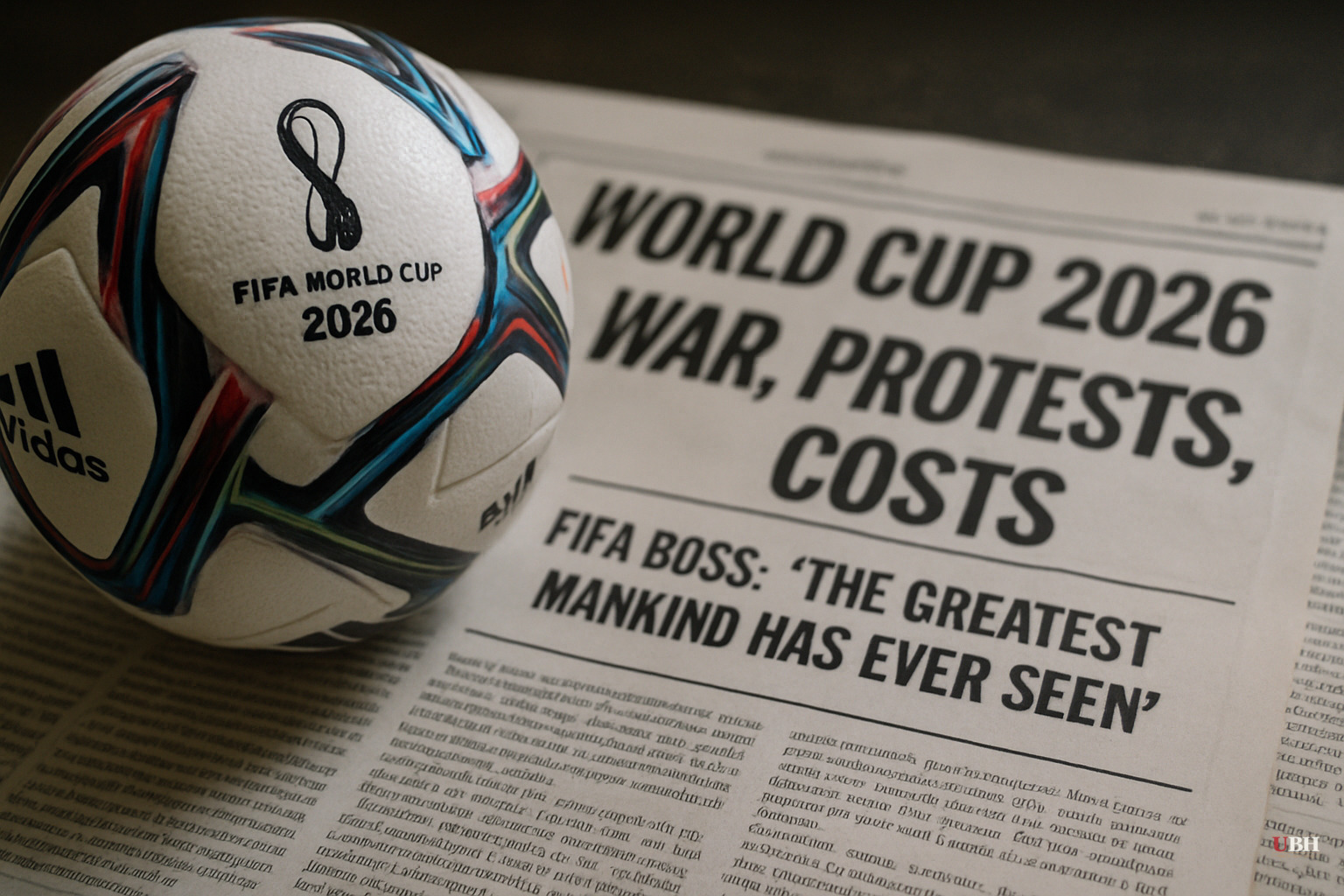
With the tournament's opening match scheduled for Thursday at the Estadio Azteca, the political and logistical chaos that has been building for months is now fully arriving at center stage.
The War Problem No One Wants to Talk About
This is the first World Cup in history where a host nation is actively at war with a participating country. Full stop.
The U.S. and Israel launched a military campaign against Iran in February 2026. Iran responded with retaliatory strikes. That conflict is ongoing — and the Iranian national team is now set to play group stage matches on Mexican soil after FIFA relocated them from their original base in Arizona, according to BBC Sport.
A team whose country is at war with the United States is competing in a tournament the United States is co-hosting. FIFA didn't cancel the arrangement. They moved the team to Mexico and carried on.
There's a legitimate argument that sport should transcend geopolitics — that Iranian players shouldn't lose their World Cup for decisions made by their government or ours. These are athletes who trained for years, and punishing them for a war they didn't start is genuinely complicated.
But FIFA's handling of this has been pure institutional cowardice. No transparent framework. No clear policy on when a participating nation's geopolitical status changes the tournament's hosting arrangements. Just quiet logistics — move the team, issue a statement, move on. FIFA president Gianni Infantino called this event "the greatest event that humanity, that mankind, has ever seen." He did NOT address how the tournament proceeds smoothly while two of its participants are in active military conflict.
Mexico City: Protests and Toppled Statues
The Estadio Azteca is making history as the first stadium to host the opening of three different World Cups. That's a genuine milestone.
But in the streets outside, World Cup player statues have been toppled by protesters, according to BBC Sport. Mexican teachers are threatening to disrupt matches unless they get wage increases. Whether or not those demands are justified — and there's a real conversation to have about teacher pay — the symbolism is brutal: a tournament billed as a unifying celebration is being greeted in its opening city by civil unrest.
Cartel violence poses a genuine operational challenge. Mexico has experienced significant cartel activity in 2026, and security around the tournament is a real concern.
The Money Problem: Who This Tournament Is Actually For
About 75% of World Cup matches are being played on U.S. soil. That's a $multi-billion commercial apparatus designed to extract maximum revenue from the world's most-watched sporting event.
High ticket costs have already generated real complaints from fans in both the U.S. and Mexico, according to BBC Sport. When working-class fans — the people who built the culture of the sport — can't afford to attend, something is broken. Infantino is correct that the 48-team, 104-match format is unprecedented in scale. He's wrong to pretend scale equals inclusion. Scale equals revenue.
FIFA's books will look excellent when this is over. Whether ordinary fans, host-city residents, or players from smaller nations actually benefit is a different question.
What Mainstream Coverage Gets Wrong
Left-leaning coverage, including BBC Sport's framing, emphasizes the political and environmental critiques heavily — which are valid — but consistently underweights FIFA's institutional accountability. FIFA leadership chose this structure, selected these co-hosts, and is now collecting the revenue while other people manage the fallout.
Right-leaning coverage has largely ignored this tournament or focused narrowly on the Iran situation as a national security issue, missing the broader FIFA governance failure entirely.
Both framings let FIFA off the hook.
The Sustainability Angle Deserves More Than a Footnote
BBC Sport flags that this could be "potentially the hottest" or "most polluting" World Cup in history. Three countries, 104 matches, 48 teams — the travel footprint alone is staggering. Legitimate climate concerns about event infrastructure risk getting buried under the political drama. That's a story that will need to be revisited when the final accounting comes in.
What This Actually Means
The 2026 World Cup is shaping up to be a genuine spectacle. The football will be extraordinary. Some of these 48 teams are competing on this stage for the first time.
But Gianni Infantino doesn't get to declare this the greatest event in human history while quietly relocating teams due to an active war, while fans are priced out in the host cities, and while protest and unrest greet the tournament's opening days.
FIFA built this machine to make money. It is making money. Everyone else is managing the consequences.
Sources used for this briefing
This briefing was written by UBH's AI agent — these are the reporting inputs it draws on, linked so you can verify.


