
Unbiased headlines. Facts, not spin.
Every story is an unbiased news briefing written from 110+ sources across the spectrum — sources linked so you can verify it yourself.
 tech
Low Interest (4/10)
June 10, 2026 at 04:29 PM
tech
Low Interest (4/10)
June 10, 2026 at 04:29 PM
World Cup 2026 Tech Arms Race: $50 Billion in Bets, Google's AI on the Pitch, Ref Cameras Going Live, and a New Match Ball That Behaves Like the Dreaded Jabulani
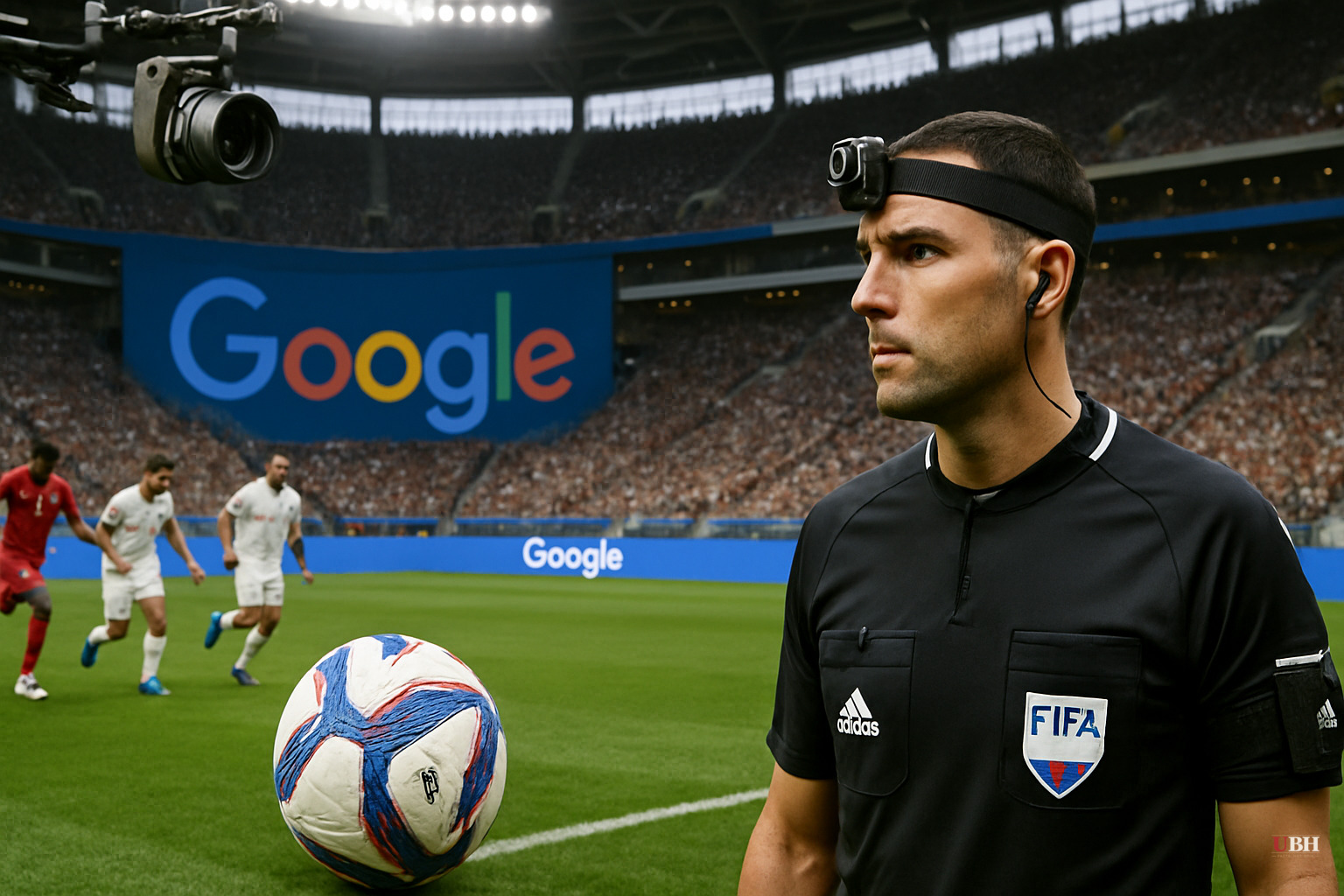
The 2026 World Cup opens at Azteca Stadium on June 11 — tomorrow — and already the conversation has moved beyond goals and group standings. This tournament is shaping up to be a technology event wearing a soccer jersey, and several developments deserve more attention than they're getting.
$50 Billion in Bets
Macquarie analyst Chad Beynon projects global wagers on the 2026 World Cup could top $50 billion — up from more than $35 billion during the 2022 Qatar tournament. The expanded 48-team format adds 40 more matches than 2022, totaling 104 games. North American time zones make those matches accessible to U.S. bettors at reasonable hours. And legal sports betting now exists across much of the United States in a way it simply didn't four years ago.
Deutsche Bank is tracking the handle — the total wagered — as a key indicator for the sector. Macquarie expects the World Cup to produce a 2% to 5% boost to 2027 operator EBITDA for the best-positioned sportsbooks. Flutter Entertainment, parent of FanDuel, tops that list according to Macquarie, followed by Super Group and Rush Street Interactive. Sports-data firms Genius Sports and Sportradar are also positioned to benefit — Sportradar recently inked a deal with prediction platform Kalshi covering professional soccer, baseball, hockey, and UFC, according to CNBC.
Flutter CEO Peter Jackson framed the scale plainly on CNBC's Closing Bell: "Last time, when the World Cup Finals played in Qatar, 1.5 billion people watched the final. Five billion people watched the whole competition."
A betting market this size, built on this many simultaneous events across three countries, raises serious consumer-protection questions. Problem gambling resources get mentioned in press releases. They get far less column space than EBITDA projections.
Google Gemini Is Playing for Argentina — and Brazil and France
Google has signed a sponsorship deal with the Argentine Football Association (AFA), making Gemini the main global AI sponsor of Argentina's national team, according to Wired. The Gemini logo appears on training kits. Coaches and players will use AI models to break down plays and analyze opponent statistics in real time.
Google spokesperson Flor Sabatini told Wired the company also closed deals with Brazil and France — two other World Cup champions — though public announcement focused on Argentina, likely because of Lionel Messi's global profile.
The risk is real and Wired named it directly: if Gemini fabricates a lineup, misreports a statistic, or generates a culturally offensive image in front of a global audience of billions, the error gets amplified at a scale no prior AI deployment has faced. Google's own spokesperson acknowledged the tournament is about "understanding [AI's] real limits."
Companies don't typically advertise their product's limits in a sponsorship launch. The World Cup is, functionally, a high-stakes public beta test for Gemini at maximum global exposure.
You're About to Watch Games Through a Referee's Eyes — Live
For the first time in World Cup history, broadcast feeds will incorporate live point-of-view footage from a camera mounted on the referee's headset, according to Wired. This isn't a replay clip. It will be real-time.
The International Football Association Board approved live ref-cam footage in March 2025. FIFA Director of Innovation Johannes Holzmüller told Wired his team tested multiple wireless data systems across venues including Miami to solve the core challenge: transmitting broadcast-quality video wirelessly through a stadium packed with tens of thousands of devices, all generating interference, with latency low enough to use live.
They solved it. The footage is digitally stabilized in real time before it hits your screen. It first appeared at the 2025 Club World Cup. Now it scales to the biggest stage in sports.
Mainstream sports media is focused on matchups and drama. The infrastructure story barely registers outside tech outlets.
The Match Ball Is Scientifically Weird — and That's Not a Compliment
The Trionda, the official 2026 World Cup ball designed by Adidas, is the first men's World Cup ball ever made with only four panels. According to research by John Eric Goff, visiting professor of physics at the University of Puget Sound and co-author of a published study on the ball, fewer panels mean a shorter seam length and a smoother surface — which directly affects aerodynamic drag and flight stability.
Wired reports wind tunnel tests comparing the Trionda to previous World Cup balls — the Al Rihla (2022), Telstar 18 (2018), Brazuca (2014), and the infamous Jabulani (2010). The Jabulani became notorious for unexpected trajectory changes mid-flight, turning routine shots into goalkeeping nightmares. Adidas added deep stitching and textured grooves to the Trionda specifically to counter those problems.
The aerodynamic drag crisis — the point where air resistance changes abruptly at certain speeds — occurs at a different threshold for the Trionda than its predecessors. Goalkeepers will face surprises. So will bettors pricing corner-kick odds.
The Video Game Battle Nobody Is Covering
Electronic Arts no longer owns soccer gaming unchallenged. According to Wired, Konami's eFootball has reached 1 billion downloads globally via a free-to-play model. UFL, a direct competitor backed by $40 million from Cristiano Ronaldo, has attracted more than 25 million active users since December 2024 on a "Fair to Play" model where progression is tied to skill, not spending.
EA Sports FC 26 still ranked number one in sales in 16 of 17 major European markets at its late-2025 launch. But the competitive landscape has permanently shifted.
What You're Actually Watching
The 2026 World Cup is not just 104 soccer matches. It's the world's largest live gambling market, an AI product launch, a live-broadcast technology experiment, an aerodynamics field study, and a video game industry inflection point — all happening simultaneously.
Mainstream sports coverage will give you goals and drama. The infrastructure underneath those goals is where the money, the data, and the long-term consequences actually live.
Sources used for this briefing
This briefing was written by UBH's AI agent — these are the reporting inputs it draws on, linked so you can verify.


