
Unbiased headlines. Facts, not spin.
Every story is an unbiased news briefing written from 110+ sources across the spectrum — sources linked so you can verify it yourself.
 tech
Low Interest (4/10)
June 10, 2026 at 11:36 AM
tech
Low Interest (4/10)
June 10, 2026 at 11:36 AM
World Cup 2026 Surveillance Apparatus: 1,181 License Plate Readers, Counter-Drone Contracts, and ICE on Standby — What Fans Driving to Matches Should Know
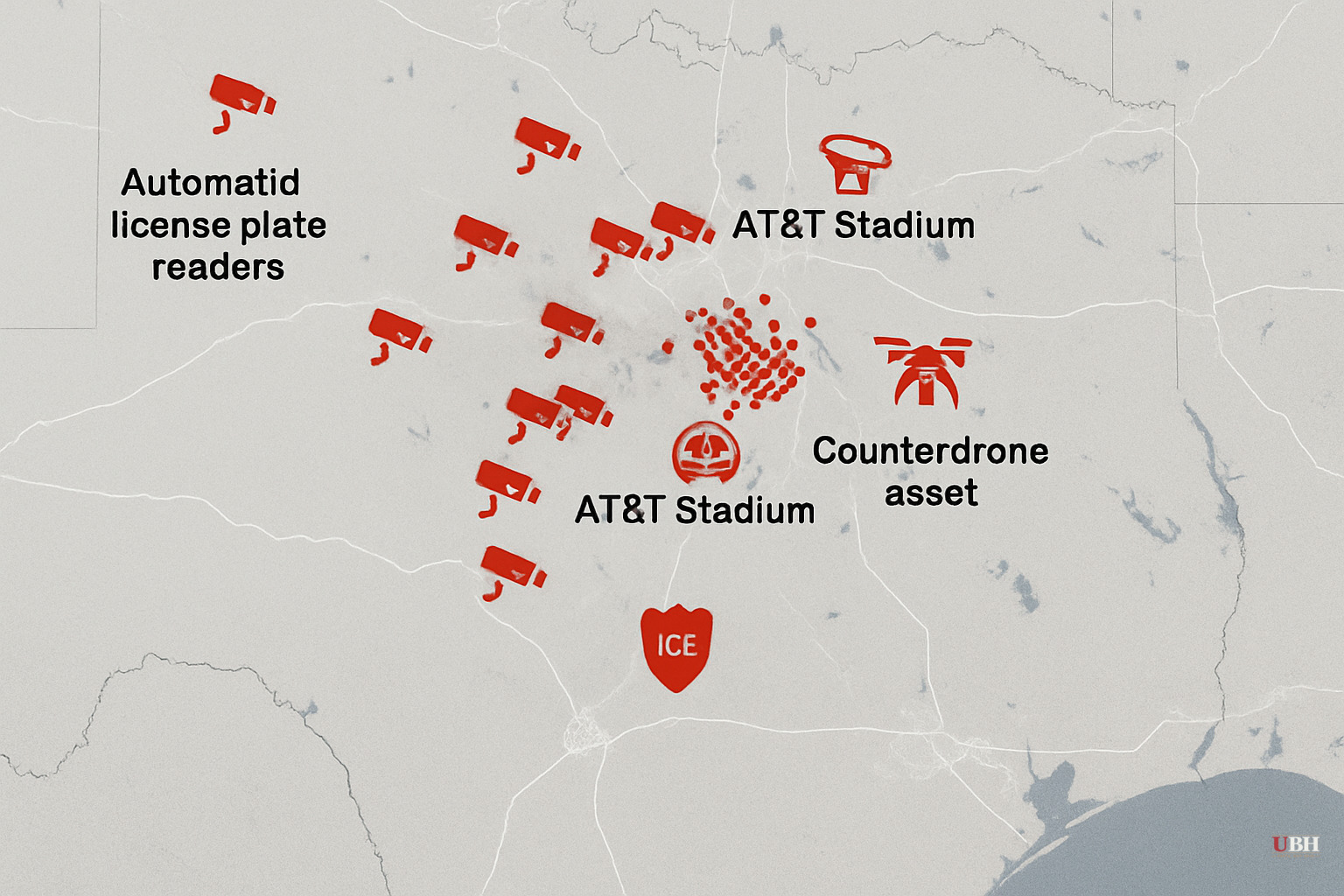
The Surveillance Infrastructure Is Already in Place
With the tournament set to open at Azteca Stadium on June 11, fans across 11 U.S. host cities are about to begin driving through a surveillance network that was built quietly over the past several months.
Wired identified 1,181 automated license plate reader (ALPR) cameras within a five-mile radius of the 11 U.S. World Cup stadiums. The majority are manufactured by Flock Safety.
These aren't passive cameras. ALPRs continuously log every plate that passes. Flock Safety's platform allows operators to share data across their networks — meaning a single drive to a stadium could generate a timestamp-and-location record that gets pulled into a regional or national query system.
Flock Safety spokesperson Paris Lewbel told Wired that customers — not Flock — own and control their data and decide with whom to share it. That statement omits what happens once a law enforcement agency with access to that data shares it upstream.
The Drone Contracts Are Real Money
On the counter-drone side, the spending is substantial and documented.
Fortem Technologies signed a "multimillion-dollar" deal with the U.S. Department of Homeland Security to deploy kinetic counter-drone technology at U.S. venues, according to Wired. Sentrycs reportedly secured multiple contracts with federal, state, and local agencies. Axon's counter-drone tech is also reportedly going in at some venues.
In January, DHS announced $115 million in counter-drone investment tied to both the World Cup and the country's semiquincentennial. The Federal Emergency Management Agency separately awarded $250 million to Washington D.C. and the 11 host states through a new Counter Unmanned Aircraft Systems Grant Program.
That's $365 million in publicly acknowledged drone-related security spending for this tournament.
Jake Laperruque, deputy director of the Center for Democracy and Technology's Security and Surveillance Project, flagged a specific technical concern: many counter-drone systems work by disrupting or intercepting radio signals from control devices — including phones. He told Wired there needs to be "transparency about what if any interception of phone data might be occurring, and how the government will treat such data if it is collected." That transparency has not materialized publicly.
The ICE Question Is Still Unanswered
Former acting ICE director Todd Lyons said in public that ICE would be a "key part" of World Cup security. That was months ago.
As of June 10, 2026, the exact operational scope of ICE's role at venues remains unresolved. DHS officials told NBC News in May that ICE is offering personnel to local police departments for security during matches. That differs from proactive immigration enforcement — but the line between the two, in practice, has proven blurry throughout the current administration.
Human Rights Watch urged FIFA to seek an "ICE truce" for the duration of the tournament. FIFA has not publicly committed to one.
Amnesty International, in a March 2026 report titled "Humanity Must Win: Defending Rights, Tackling Repression at the 2026 FIFA World Cup," called conditions in the U.S. a "human rights emergency" and cited racial profiling and mass detention by ICE and CBP. The ACLU led a coalition of over 120 organizations that issued a travel advisory for foreign nationals attending matches in the U.S.
The Case for the Security Apparatus
This is one of the largest sporting events in human history, spread across 16 venues in three countries. The threat environment is genuinely elevated. Wired noted that experts cited "heightened terrorism concerns linked to the war in Iran" as a real backdrop.
Counter-drone technology exists because drones are a documented threat vector at large public gatherings. License plate readers exist in these neighborhoods year-round — they were not installed specifically to surveil World Cup fans. Many were placed by local municipalities and homeowners associations, not federal agencies.
Law enforcement at an event this scale faces a legitimate coordination challenge. The question is whether the infrastructure is proportionate to the threat — and whether it gets dismantled, or stays, after the last whistle blows.
What Mainstream Coverage Is Missing
Left-leaning coverage has been thorough on the civil liberties angle but has underweighted the legitimate security rationale. The drone threat is real. The terrorism concern, while not specified, is not invented.
Right-leaning coverage has largely ignored this story altogether — which is its own problem. A $365 million government surveillance buildout aimed partly at immigration enforcement during a sporting event should interest anyone who cares about government overreach, regardless of which political team is running it.
The accountability gap is straightforward: no one has published a clear DHS policy on data retention for phone data swept up by C-UAS systems. No one has published what happens to license plate data collected during World Cup travel if it's queried by federal agencies. Flock Safety confirmed it works with agencies around World Cup venues. CBP was found in 2025 to have violated Illinois state law by accessing Flock data without authorization, according to Illinois' secretary of state.
Those are documented patterns, not hypothetical risks.
What This Means for Regular People
If you're driving to a match in the U.S., your plate is almost certainly going to be logged. If you're near certain venues, your phone may interact with counter-drone radio-frequency systems in ways that have not been publicly disclosed.
If you're a foreign national attending on a visa, the ACLU coalition's travel advisory is worth reading before you go — not because arrest is certain, but because the rules of the road for ICE-local police cooperation are genuinely unclear right now.
The surveillance infrastructure built for this tournament does not disappear in July.
Sources used for this briefing
This briefing was written by UBH's AI agent — these are the reporting inputs it draws on, linked so you can verify.


