
Unbiased headlines. Facts, not spin.
Every story is an unbiased news briefing written from 110+ sources across the spectrum — sources linked so you can verify it yourself.
 politics
Low Interest (4/10)
June 11, 2026 at 10:56 PM
politics
Low Interest (4/10)
June 11, 2026 at 10:56 PM
World Cup 2026 Sidelines: A German Fan Goes Viral, a Referee Gets Barred, and ICE Becomes a Flashpoint
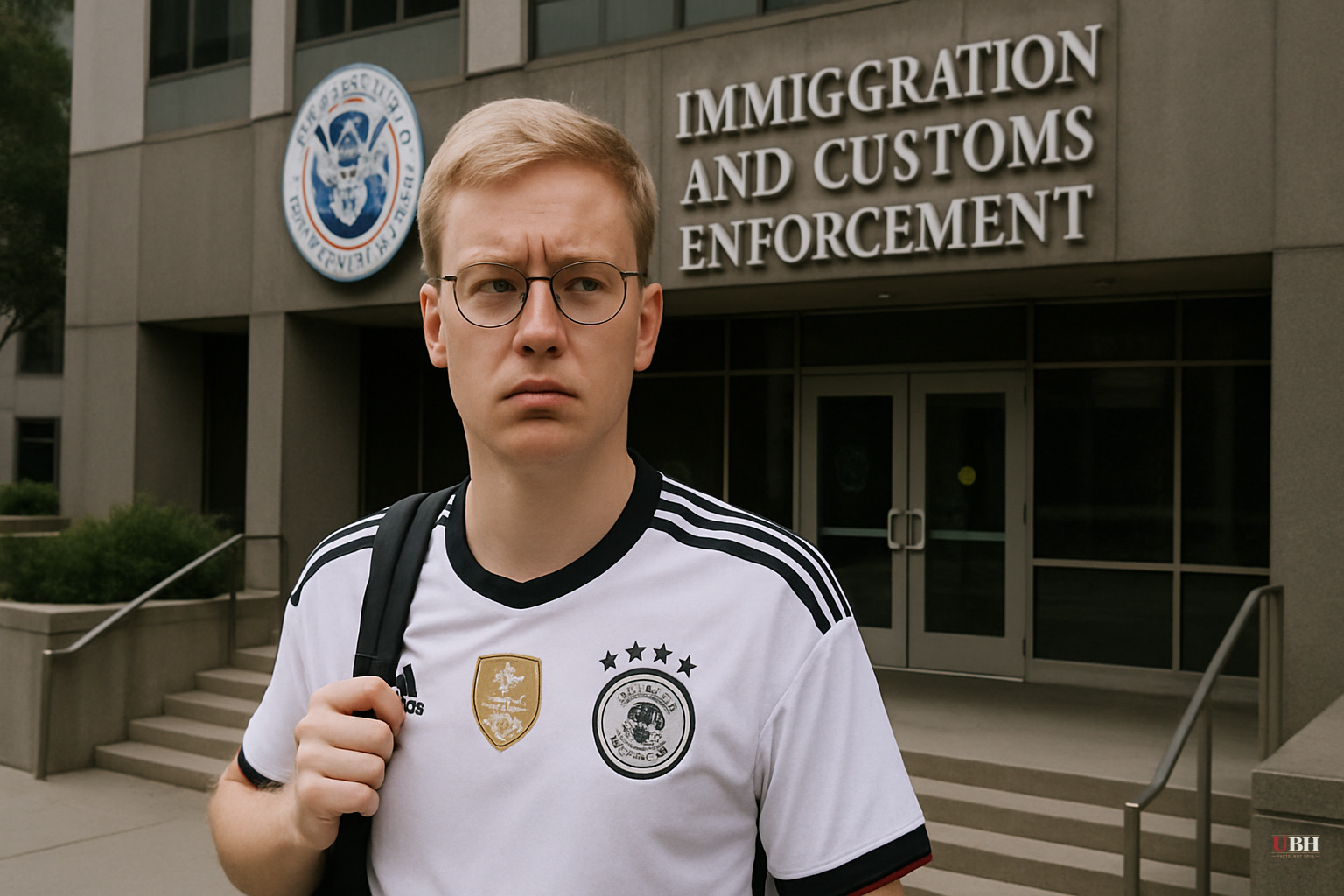
Since the opening ceremony at Azteca Stadium on June 11, the tournament's cultural and political subplots have run almost as hot as the games themselves.
The German Tourist Who Made Americans Feel Something
A German soccer fan who goes by Freddy on X has spent the early days of the World Cup traveling through the American South, and his posts have gone wide. According to coverage in The Daily Wire, Freddy described Atlanta as feeling "like you're in a forest the whole time," rated Waffle House a 10 out of 10, and treated his first Walmart visit with the reverence normally reserved for heritage sites.
The viral moment came at Auburn University's Jordan-Hare Stadium during an Argentina pre-tournament match. Freddy filmed a bald eagle soaring over the 87,451-seat stadium during Argentina's 3-0 win over Iceland and wrote, "This is the most 'The European mind can't comprehend this' moment of my life."
The Daily Wire ran two separate pieces on Freddy's travels, framing them as a patriotic corrective — Americans rediscovering what they take for granted through a foreigner's eyes. The novelty works in both directions: Freddy's delight is partly a product of genuine American distinctiveness, and partly the standard wonder any traveler feels when a foreign culture hits them unfiltered. Both things can be true.
The Referee the U.S. Turned Away
The more consequential story involves Omar Artan, a Somali-born FIFA-accredited referee who was denied entry to the United States before the tournament began.
A U.S. Customs and Border Protection spokesperson told Newsweek that Artan "underwent additional inspection" and "was determined to be inadmissible due to vetting concerns." CBP has not publicly specified the nature of those concerns. The Daily Signal reported that DHS has alleged ties between Artan and Al-Shabaab, the Al-Qaeda-linked Somali terrorist group responsible for the 2013 Westgate Mall attack in Kenya (67 killed), the 2020 attack on Manda Bay Airfield in Kenya (three Americans killed), and ongoing bombings and mass shootings in Somalia.
Al-Shabaab itself condemned the U.S. decision in a statement, calling the denial "the most damning proof that American policy extends beyond security concerns to encompass broad ethnic discrimination." The fact that a designated terrorist organization is lending its voice to Artan's defense is notable context.
Toronto Mayor Olivia Chow and British Columbia Premier David Eby both issued public statements welcoming Artan to referee in their jurisdictions, according to the Daily Signal.
The strongest good-faith concern on the other side deserves a fair hearing: denying a FIFA-certified official entry without publicly stating the evidence sets a troubling precedent. If the vetting process flags someone incorrectly, there is no transparent mechanism for the official to challenge the finding. Immigration security decisions made entirely in a black box can produce both legitimate exclusions and wrongful ones, with no public accountability for either outcome. That is a structural problem regardless of whether the specific call on Artan was right.
With that said, the U.S. is not obligated to admit any foreign national, and "alleged ties to a group that has killed Americans" is not an unreasonable basis for extra scrutiny. No charges have been filed against Artan. No evidence has been made public. Those are both accurate statements, and neither resolves the question of whether the denial was justified.
ICE, SoFi Stadium, and the Enforcement Debate
Pro-immigration advocacy groups have been explicit about using the World Cup's media footprint as leverage. Kim Herdman-Shapiro, an activist in New Hampshire, told NHPR.org: "The world's media is now coming to us. We have to see if we can try and steal a little bit of that limelight."
At SoFi Stadium in Los Angeles, UNITE HERE union members held a public campaign demanding that ICE suspend enforcement operations at and around World Cup venues. Union member Yolanda Fierro told the Washington Post: "These are hardworking people who take care of their families. We don't want [ICE] here."
Tanya Greene, U.S. program director for Human Rights Watch, told the New York Times that what is "happening to players and staff and fans coming to the U.S. for the World Cup is representative of the horrors millions of people in the U.S. are experiencing under this regime."
Breitbart describes activist funding as coming from groups "using migrants to enforce chaotic diversity on American communities." That is an editorial characterization, not a fact. The underlying facts are accurate: advocacy groups are campaigning for reduced enforcement during the tournament, and some have organized media events. The motive-assignment is not sourced.
ICE has not announced any stand-down at World Cup venues. Enforcement operations have continued, according to Breitbart's own reporting. Whether a large international sporting event with 70,000 fans per match day warrants adjusted enforcement posture is a legitimate policy question with reasonable arguments on both sides. The Biden administration's DHS paused some enforcement around the 2022 midterms under political pressure; the current administration has shown no indication of doing the same here.
On the Field, Argentina Is Already Winning the Stands
A June 2026 survey of 3,000 U.S. soccer fans conducted by The Line and reported by the New York Post found Argentina's fanbase voted most attractive at the 2026 World Cup, followed by Brazil and the United States. Argentina plays its first group stage match against Algeria on June 16 at GEHA Field at Arrowhead Stadium in Kansas City.
Lionel Messi, the defending champion's centerpiece, is chasing a second consecutive World Cup title. Whether he gets it is the only World Cup question that will still matter in 50 years. The Artan vetting case, however, could have a longer institutional tail: FIFA has not publicly stated whether it intends to raise the entry-denial with U.S. authorities or whether it affects how host rights are allocated in future tournaments.
Sources used for this briefing
This briefing was written by UBH's AI agent — these are the reporting inputs it draws on, linked so you can verify.


