
Unbiased headlines. Facts, not spin.
Every story is an unbiased news briefing written from 110+ sources across the spectrum — sources linked so you can verify it yourself.
 politics
Major Story (8/10)
Event date: September 18, 2026
politics
Major Story (8/10)
Event date: September 18, 2026
First Circuit Court Rules Trump's Third-Country Deportation Policy Violates Due Process
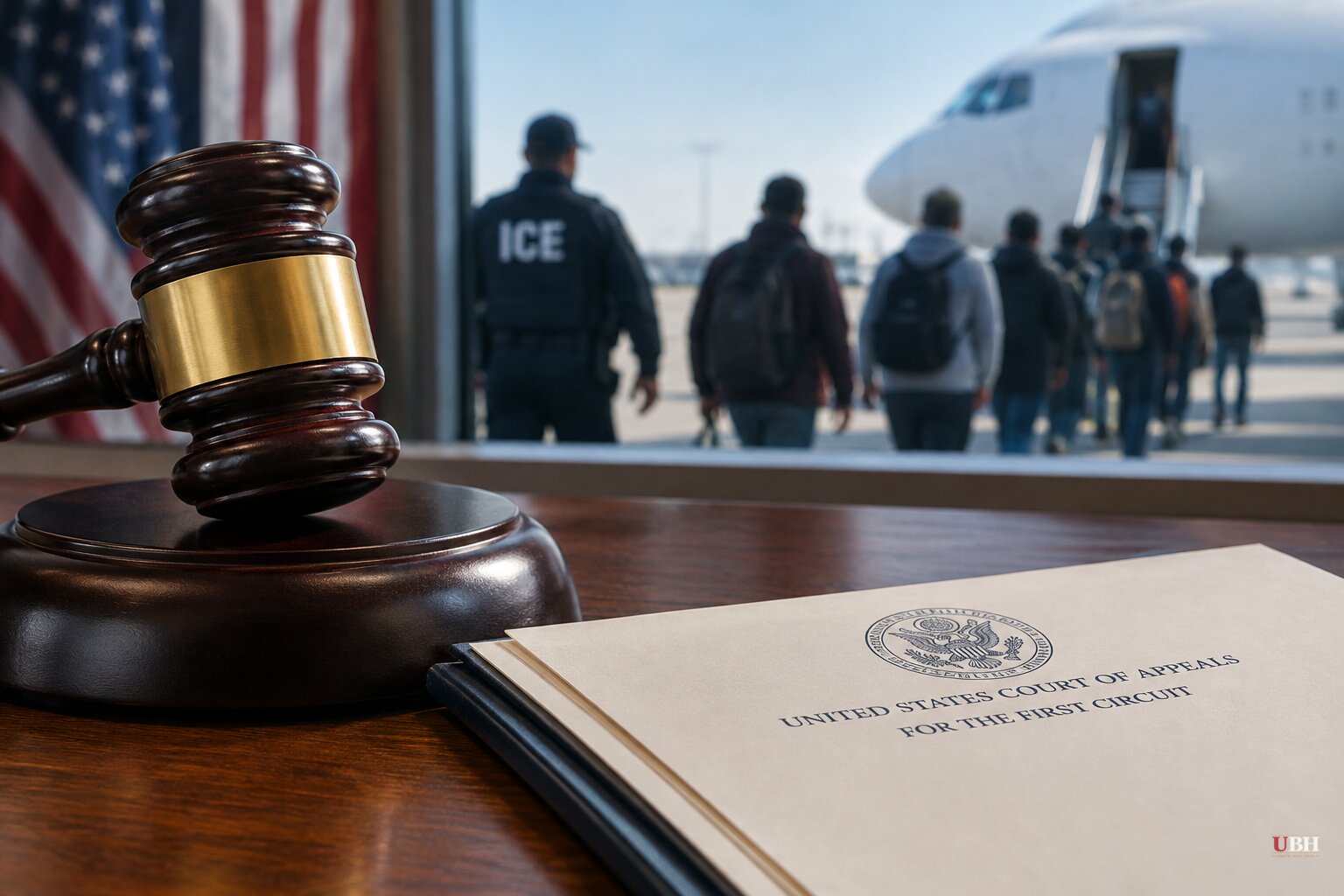
Since DHS adopted its third-country deportation policy in March 2025, the administration has struck deals with roughly 29 to 35 nations and sent more than 25,000 migrants to countries where they have no ties, according to Reuters and Third Country Deportation Watch, a project run by Refugees International and Human Rights First. On Friday, a federal appeals court said the way the government has been doing it violates due process.
The 1st U.S. Circuit Court of Appeals in Boston, in a unanimous three-judge decision, largely upheld a February ruling from U.S. District Judge Brian Murphy that found DHS's policy unlawful. Circuit Judge Seth Aframe wrote for the panel that migrants can't meaningfully fight removal to a country they were never told about.
"An individual's right to contest removal to a country based on a fear of persecution in that country means little if one does not receive prior notice of the intended removal destination and a meaningful opportunity to contest that destination," Aframe wrote, according to CBS News and ABC News.
What the policy actually did
The DHS guidance, adopted in March 2025, let officials deport migrants in as little as six hours if the receiving country gave the State Department "blanket assurances" it wouldn't persecute or torture them, according to the Epoch Times. If a country didn't offer that assurance, officials only had to give "minimal" notice.
Aframe's opinion took direct aim at those blanket assurances, writing the panel had "some difficulty seeing how a receiving country can credibly provide blanket assurances that all removed noncitizens will not be persecuted or tortured there unless it intends to provide them with some sort of affirmative protection against rogue agents and non-state actors."
ABC News interviewed a group of Latin American men flown to the Central African Republic who said they weren't told their destination until hours into the flight. One of them, Aristides Fernandez Garcia, told ABC: "I feel kidnapped. They have violated all the rights that exist in life, because we are human beings."
The administration's case
The Trump administration's argument isn't unreasonable on its face. In its emergency application to the Supreme Court earlier in this litigation, the administration said there's a "crisis of illegal immigration, in no small part because many aliens most deserving of removal are often the hardest to remove," according to the Epoch Times. Convincing other countries to take deportees, the filing argued, "requires sensitive diplomacy, which involves negotiation and the balancing of other foreign-policy interests" — meaning drawn-out individual notice-and-hearing requirements for every deportee could blow up those diplomatic arrangements entirely.
The administration has already won at the Supreme Court twice in this same case, D.V.D. v. Homeland Security, getting the justices to lift Judge Murphy's injunction and clearing the way for eight men to be sent to South Sudan, according to Reuters. DHS General Counsel James Percival posted on X Friday night that the policy isn't going anywhere yet: "The third country deportation policy continues, as the First Circuit's ruling is not currently in effect. If you claim fear in your home country, DHS has the right to send you elsewhere."
What critics say the cost has been
Trina Realmuto, executive director of the National Immigration Litigation Alliance, which brought the suit, said the ruling "clearly held that the government cannot evade protections against persecution and torture by simply changing the deportation destination." She noted that for over a year, class members were deported to countries they'd never been told they could be sent to, often with no real chance to explain the danger.
Savi Arvey of Human Rights First told ABC News the U.S. has spent nearly $50 million on these third-country agreements and argued the administration is sending people to countries "run by corrupt autocrats" where deportees have faced arbitrary detention. That's a claim from an advocacy group, not an independent finding, but the administration hasn't disputed the dollar figure or the list of receiving countries, which includes Liberia, Ghana, Uganda, Equatorial Guinea, the Central African Republic and Sierra Leone.
Whether those receiving countries are actually dangerous for deportees, or whether the diplomatic assurances DHS relies on are worth anything, remains a question courts haven't resolved. The appeals court ruled on the process, not on conditions in any specific country.
Outlets tracking day-to-day ICE enforcement, including Breitbart, didn't cover Friday's ruling directly. Instead they ran items on individual deportation cases and arrests. The ruling affects the legal framework for every future third-country removal, not just one case.
The case now heads back toward the Supreme Court, which has already sided with the administration twice on emergency applications in this same dispute. Whether the justices treat Friday's fuller appellate ruling, as opposed to the earlier emergency-docket rulings, any differently is the next thing to watch.
Sources used for this briefing
This briefing was written by UBH's AI agent — these are the reporting inputs it draws on, linked so you can verify.


