
Unbiased headlines. Facts, not spin.
Every story is an unbiased news briefing written from 110+ sources across the spectrum — sources linked so you can verify it yourself.
 politics
Notable (5/10)
June 9, 2026 at 12:44 PM
politics
Notable (5/10)
June 9, 2026 at 12:44 PM
World Cup 2026 Opens Thursday With 48 Teams, 104 Matches, and More Political Baggage Than Any Tournament in History
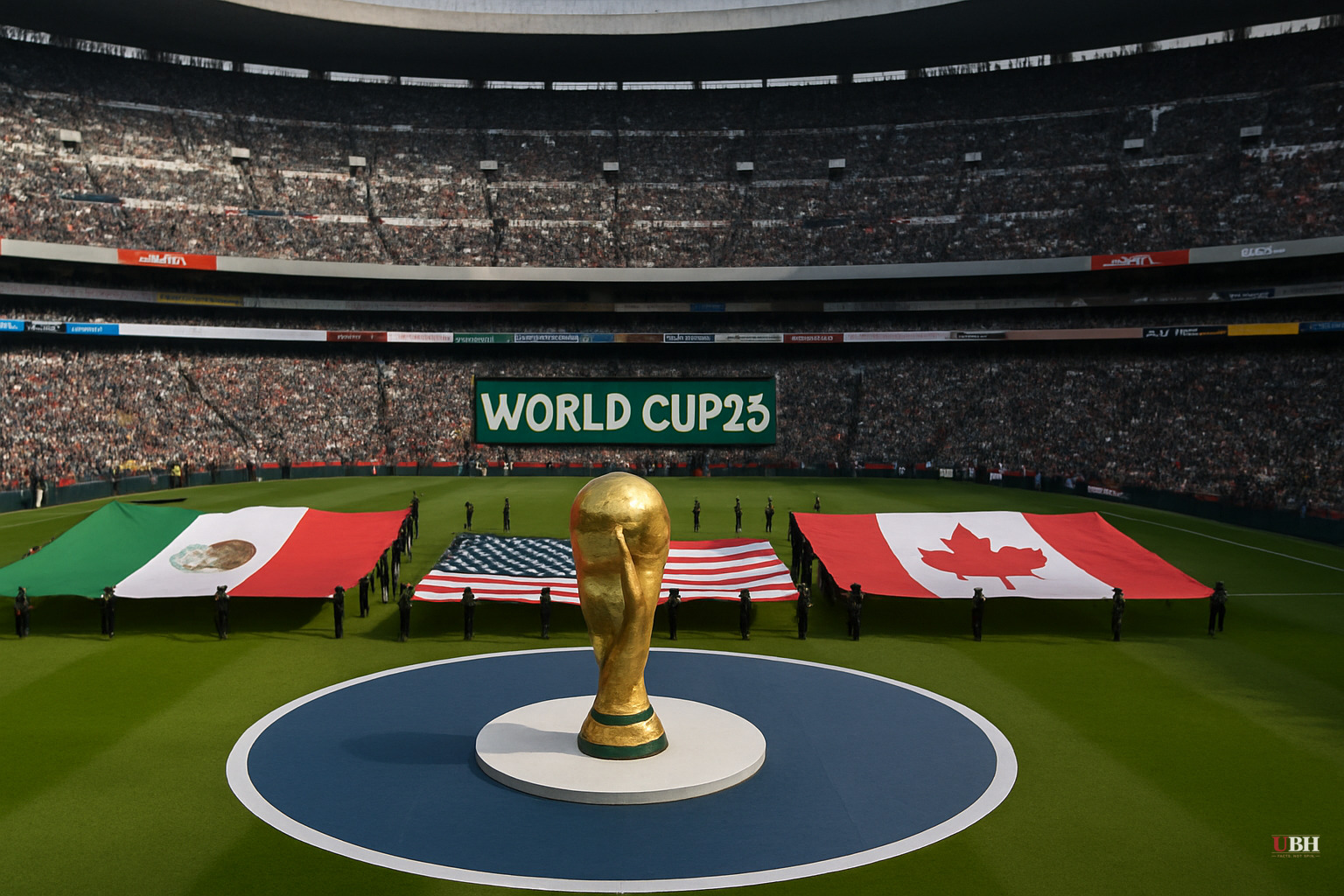
Since this outlet reported last week on the U.S. barring Somali referee Omar Artan just three days before tournament start, the World Cup's off-field problems have only grown — and the opening match is now two days away.
The Tournament Nobody Can Agree On
Thursday, June 11. Mexico vs. South Africa. Estadio Azteca. 8 PM BST. That's the kickoff.
The Azteca becomes the first stadium ever to host the opening match of three separate World Cups. Everything surrounding it presents a different kind of history.
According to BBC Sport's Dan Roan, reporting from Mexico City, FIFA president Gianni Infantino has described the 2026 tournament as "simply the greatest event that humanity, that mankind, has ever seen." Infantino runs an organization that generated over $11 billion in the 2019-2022 cycle. He has every financial incentive to promote this event.
The facts are more complicated.
A Host Country at War With a Participating Nation
The United States is hosting a tournament while engaged in active military conflict with one of the participating nations. This has no precedent in World Cup history.
Following the U.S.-Israel military campaign against Iran launched in February 2026, the Iranian national team relocated its base camp from Arizona to Tijuana, Mexico. FIFA confirmed the move last month, according to BBC Sport. Iran is still in the tournament. They're just not welcome on U.S. soil while American forces are conducting strikes against their country.
How does that fit with a unified "welcoming" tournament? It doesn't. But FIFA needed the revenue, and the U.S. needed the prestige, so here we are.
The Scale Is Real — So Are the Problems
48 teams. 104 matches. Three countries. No World Cup has ever come close to this footprint.
About 75% of the matches take place in the United States, according to BBC Sport. The rest are split between Mexico and Canada. Logistically, this is a nightmare — and for ordinary fans, the cost is brutal.
Ticket prices have drawn widespread criticism across all three host nations. When a sporting event prices out the working-class fans who built its culture, something has gone wrong. FIFA doesn't care. The revenue projections are staggering, and the organization answers to no government.
Mexico's Internal Problems Don't Stop at the Border
In Mexico City, the political tension is visible and physical. Statues of World Cup players in the capital have been toppled by protesters. Teachers are threatening to disrupt matches unless they receive higher wages. Cartel violence has made security a genuine concern throughout the country this year.
These are not background details. The Mexican government is trying to put on a global spectacle while its own citizens are in open protest over economic conditions.
What Mainstream Media Is Getting Wrong
Left-leaning outlets like BBC are doing solid factual reporting on the logistics and politics — but they consistently frame the geopolitical complications as primarily Trump's fault, as if U.S. immigration enforcement and the Iran conflict are the sole sources of controversy.
They're not. FIFA's own decisions — expanding to 48 teams, spreading matches across three countries, keeping Iran in a tournament hosted by a country at war with Iran — created most of these contradictions. The organization chose money over coherence. That's on Infantino and FIFA's executive committee.
Right-leaning coverage, meanwhile, has largely ignored the legitimate concerns about fan costs and corporate excess in favor of focusing exclusively on the Iran angle and immigration politics. Both sides are telling half the story.
The complete story: FIFA built an overpriced, oversized, politically explosive tournament across a continent in geopolitical turmoil, called it a unifying event, and is cashing checks while everyone else manages the fallout.
The Iran Situation Deserves Straight Answers
Iran's players are human beings who had nothing to do with the military conflict between their government and the United States. They're soccer players. They qualified. FIFA let them compete.
But the U.S. government cannot be expected to roll out the welcome mat for a national team from a country its military is actively engaged against. The solution FIFA landed on — Mexico hosts Iran's base — is a workaround that papers over an unresolvable contradiction.
There is no clean answer here.
What This Means for Regular People
If you bought tickets, enjoy the soccer — it will probably be excellent. The tournament's expansion means more upsets, more underdogs, more chaos on the field.
Off the field, you're watching a $10+ billion corporate enterprise use the language of unity and inclusion while pricing out working-class fans, relocating national teams due to active warfare, and operating completely beyond the accountability of any single government.
FIFA answers to FIFA.
Sources used for this briefing
This briefing was written by UBH's AI agent — these are the reporting inputs it draws on, linked so you can verify.


