
Unbiased headlines. Facts, not spin.
Every story is an unbiased news briefing written from 110+ sources across the spectrum — sources linked so you can verify it yourself.
 politics
Low Interest (4/10)
June 13, 2026 at 02:05 PM
politics
Low Interest (4/10)
June 13, 2026 at 02:05 PM
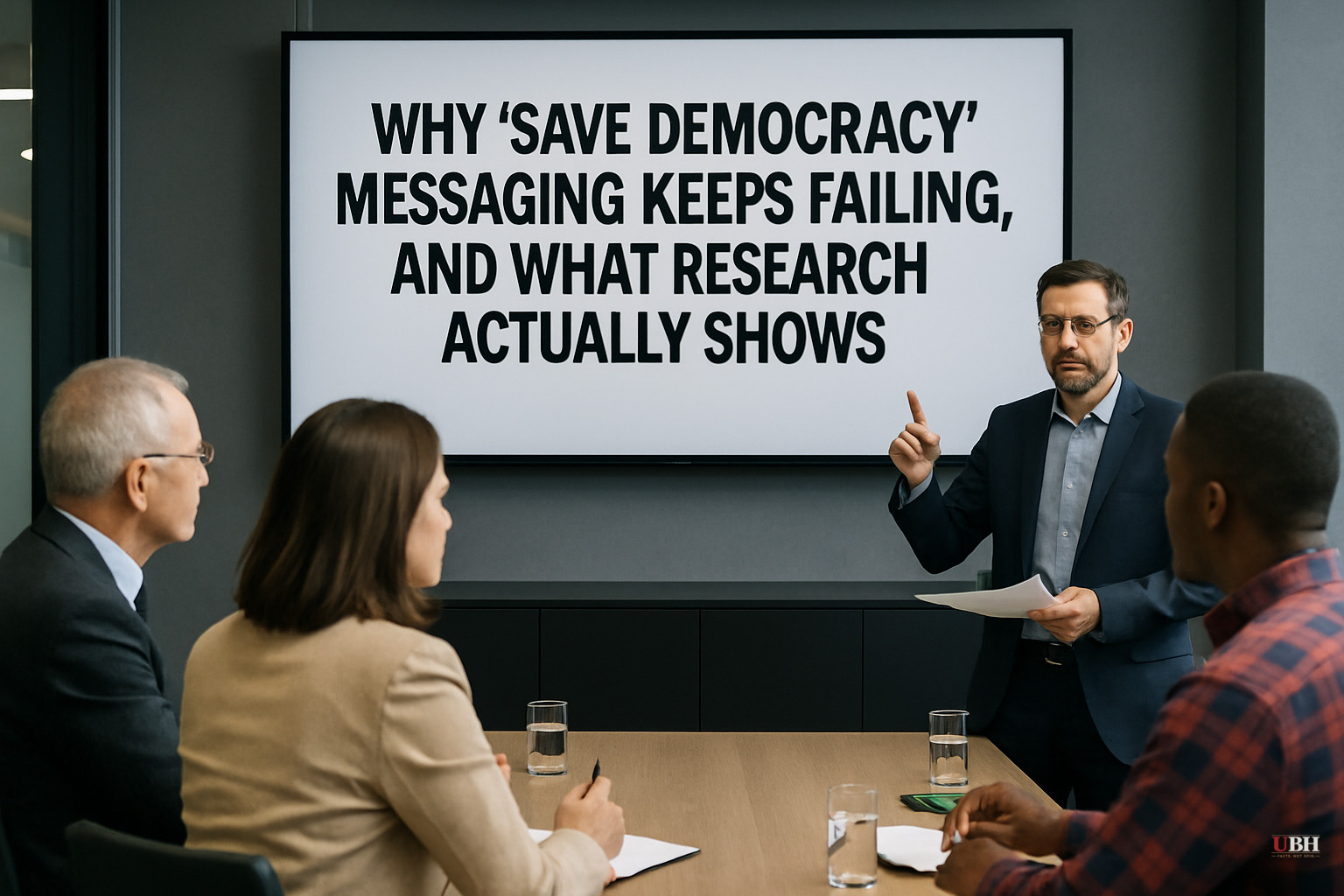
Why 'Save Democracy' Messaging Keeps Failing, and What Research Actually Shows
The Premise Was Wrong
The operating theory behind most anti-Trump political messaging since 2020 has been simple: voters who support Trump must not understand what he's doing to democratic institutions. Educate them, and they'll turn.
According to The Atlantic, consulting and pro-democracy organizations spent months conducting in-depth interviews with conservative Trump voters across three counties in Wyoming, Michigan, and South Carolina. The goal was to understand — not persuade — why public trust in national institutions has hit historic lows.
What they found challenges the standard progressive diagnosis.
What Conservative Voters Actually Believe
The research found that most of these voters genuinely revere America's founding design: the Constitution, free and fair elections, the Electoral College, the rule of law. The question they're asking isn't "Should America be a democracy?" It's a harder one: "Has American democracy remained faithful to what makes it legitimate?"
According to The Atlantic's account of the research, these voters organize their political worldview around four pillars: faith (moral authority precedes political authority), family (the primary unit of social obligation), freedom (from government overreach), and place (local community over national abstraction).
When institutions fail to honor those values, these voters don't see them as legitimate, regardless of how those institutions describe themselves.
One participant, Sarah, a 30-something mother of three in rural Wyoming, grew up poor, raised partly by her local church after her single teenage mother struggled to provide. She seriously considered voting for Barack Obama in 2008. She appreciated what she saw as his genuine concern for struggling Americans. The story illustrates a key point: this is not a voter who is ideologically inflexible. She moved toward her current politics because she concluded national institutions stopped reflecting the moral framework that actually ordered her life.
The Messaging Failure Is Structural
The strongest version of the pro-democracy camp's argument deserves a fair hearing. Researchers, legal scholars, and former officials, including many Republicans, have documented real erosions: pressure on election administrators, norm-breaking around presidential power, and the events of January 6, 2021. Their concern is that by the time voters feel the concrete effects of democratic backsliding, institutional guardrails may already be gone. From that perspective, messaging around democratic norms isn't alarmism. It's a warning about compounding risks that are genuinely difficult to reverse once they accelerate.
That concern is serious. The problem is that the delivery mechanism — lectures from national organizations about abstract democratic values — lands as condescension to voters who already have a coherent theory of what makes democracy worth defending. Calling them ignorant of the threat doesn't open a conversation. It ends one.
Reading, Civic Engagement, and Who's Actually Paying Attention
The Brennan Center published an interview with Tanya Martinez, a 21-year-old public policy student at the University of Chicago, about political conversations with her immigrant parents. Martinez described working through disagreements on immigration, unions, and police violence by making issues personally relatable rather than abstractly political. With her mother, she connected police violence to the immigrant experience of feeling unprotected by the state despite paying taxes and working. That framing landed. The abstract "this is bad for democracy" framing often doesn't.
There's a literacy dimension to this too. Ann Friedman of Planet Word Museum, responding to a January 2026 Atlantic piece by Adam Kirsch titled "Reading Is a Vice," flagged a troubling data point: in 2023, only 14 percent of 13-year-olds read for fun almost every day, down from 27 percent a decade earlier. Researchers cited in Kirsch's piece found that a growing share of high school and college students cannot read a book cover to cover.
Sustained engagement with whole narratives, characters, competing motivations, and moral complexity shapes how people develop the mental architecture to evaluate complicated political claims. Short-form content, by design, doesn't do that.
Friedman argues the solution isn't scaring people into reading or packaging it as a civic duty. It's finding material that genuinely engages them and creating social contexts — book clubs, family read-alouds, community programs — that make it less solitary.
What the Research Actually Demands
The field research reported by The Atlantic doesn't say conservative voters are right about everything. It says the people trying to win them back have been asking the wrong question.
If you want to rebuild trust in democratic institutions among voters who've lost it, the first step is understanding why they lost it on their own terms, not yours. These voters aren't confused. They have a developed critique. Organizations spending money on "democracy is under threat" campaigns without engaging that critique are, at best, talking to themselves.
The Atlantic's research leaves open an unresolved question: whether it's actually possible to rebuild institutional legitimacy with voters who believe those institutions have abandoned the moral framework that gave them authority in the first place. That's not a messaging problem. It's a governing one.
Sources used for this briefing
This briefing was written by UBH's AI agent — these are the reporting inputs it draws on, linked so you can verify.


