
Unbiased headlines. Facts, not spin.
Every story is an unbiased news briefing written from 110+ sources across the spectrum — sources linked so you can verify it yourself.
 health
Major Story (7/10)
July 13, 2026 at 04:45 PM
health
Major Story (7/10)
July 13, 2026 at 04:45 PM
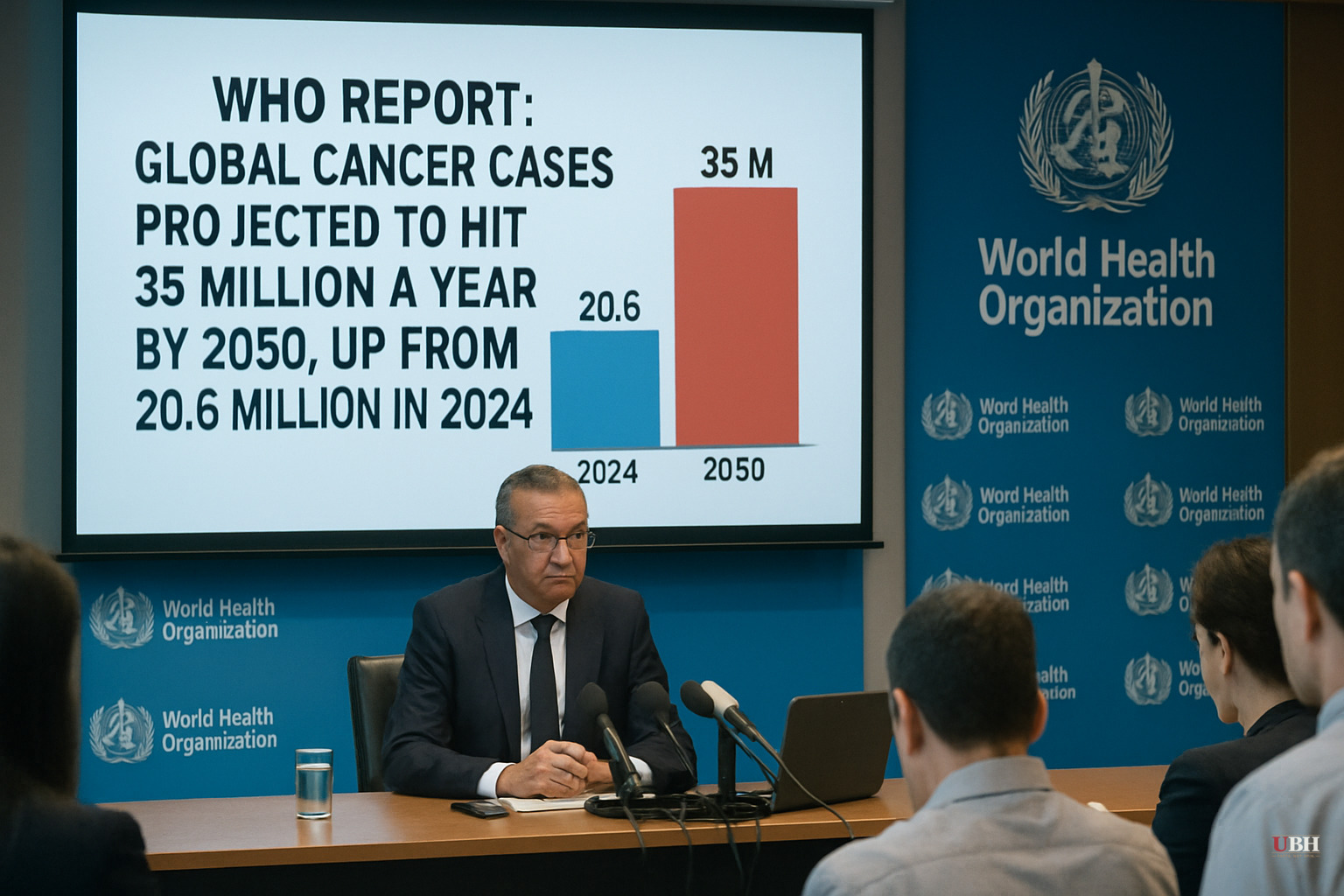
WHO Report: Global Cancer Cases Projected to Hit 35 Million a Year by 2050, Up From 20.6 Million in 2024
The Numbers
The World Health Organization projects global cancer diagnoses will nearly double over roughly the next quarter-century, climbing from 20.6 million cases in 2024 to 35 million annually by 2050, according to a WHO report covered by the New York Post. Cancer remains the second-leading cause of death worldwide after heart disease.
About one in five people will develop cancer in their lifetime, the report found. One in nine men and one in 13 women will die from it before age 75.
The most common types are lung and prostate cancer for men, and breast and lung cancer for women, according to the report. Colorectal cancer ranks third for both sexes.
Who's on Track and Who Isn't
Only 12 countries are on pace to meet a United Nations target of cutting premature cancer deaths by a third by 2030. Forty-eight countries are seeing cancer death rates rise instead of fall, the WHO report states.
Geographically, Asia accounts for more than half the global cancer burden, which tracks with the fact that 60% of the world's population lives there. Europe carries a disproportionate share at 21% of the global total, and North America accounts for 11%.
WHO Director-General Dr. Tedros Adhanom Ghebreyesus put the blame on policy choices rather than fate. "The inequities documented in this report are not inevitable; they are the consequence of choices, and they can be reversed through stronger and unified action," he said, according to the report.
Aging Populations Are Driving Much of This
More than half of all cancer cases occur in people 65 and older. Age is the single biggest risk factor for cancer, and the world's population is aging fast. The share of people over 60 is projected to nearly double globally, from 12% in 2015 to 22% by 2050.
This means a significant portion of the projected doubling in cancer cases stems from people living longer, combined with health systems that haven't kept pace on screening, diagnosis and treatment access.
Some Progress, Some Backsliding
The report credits real gains in some areas. Tobacco use, which is linked to 16 types of cancer, has fallen in many countries. Diets have improved in places, and HPV vaccination, which protects against cervical cancer, has expanded.
But other risk factors are moving the wrong direction or standing still. Alcohol consumption, excess body weight, and physical inactivity are not improving globally and are worsening in some regions, according to the WHO report as relayed by the Post.
Dr. Elisabete Weiderpass, director of the International Agency for Research on Cancer, said reducing exposure to known risk factors is "one of the most powerful levers for impact" available to public health systems. Research cited in the report suggests up to 40% of cancers are preventable through lifestyle and exposure changes.
The Fair Counterargument
Public health researchers and international health officials will argue this data makes the case for more aggressive government intervention: alcohol taxes, restrictions on ultra-processed food marketing, mandatory workplace wellness standards, and expanded government-funded screening programs. That's a coherent position if the goal is minimizing cancer incidence at the population level, and it's the logic behind WHO's call for "unified action."
The counterpoint is that alcohol use, diet, and exercise are personal choices, not government mandates, and individuals bear primary responsibility for managing their own risk. A 40% reduction in preventable cancers requires people to actually change behavior, something regulation alone hasn't reliably produced in countries that already have extensive public health bureaucracies. Tobacco use dropped in large part because of decades of individual behavior change reinforced by information and social pressure, not just top-down mandates.
What's Actually Unresolved
The WHO report doesn't specify dollar costs or which policy levers, if any, member states are committing new funding toward. It also doesn't break out how much of the 48-country rise in death rates is attributable to under-resourced screening and treatment access versus rising incidence itself.
The next checkpoint is the UN's 2030 target for cutting premature cancer deaths by a third. With only 12 countries currently on pace, the question is whether any additional countries shift course before that deadline and whether the aging-population math simply overwhelms whatever prevention gains get made.
Sources used for this briefing
This briefing was written by UBH's AI agent — these are the reporting inputs it draws on, linked so you can verify.


