
Unbiased headlines. Facts, not spin.
Unbiased Headlines is an independently owned news organization. We bring you the facts, not opinions, written fresh from 110+ named sources. Sources linked so you can verify it yourself.
 defense
Major Story (7/10)
Event date: November 11, 2026 ·
Western Intelligence Estimate: Iran Has 1,700 Ballistic Missiles Left and Builds About 50 a Month, as Hegseth Cites 80% Industrial Damage
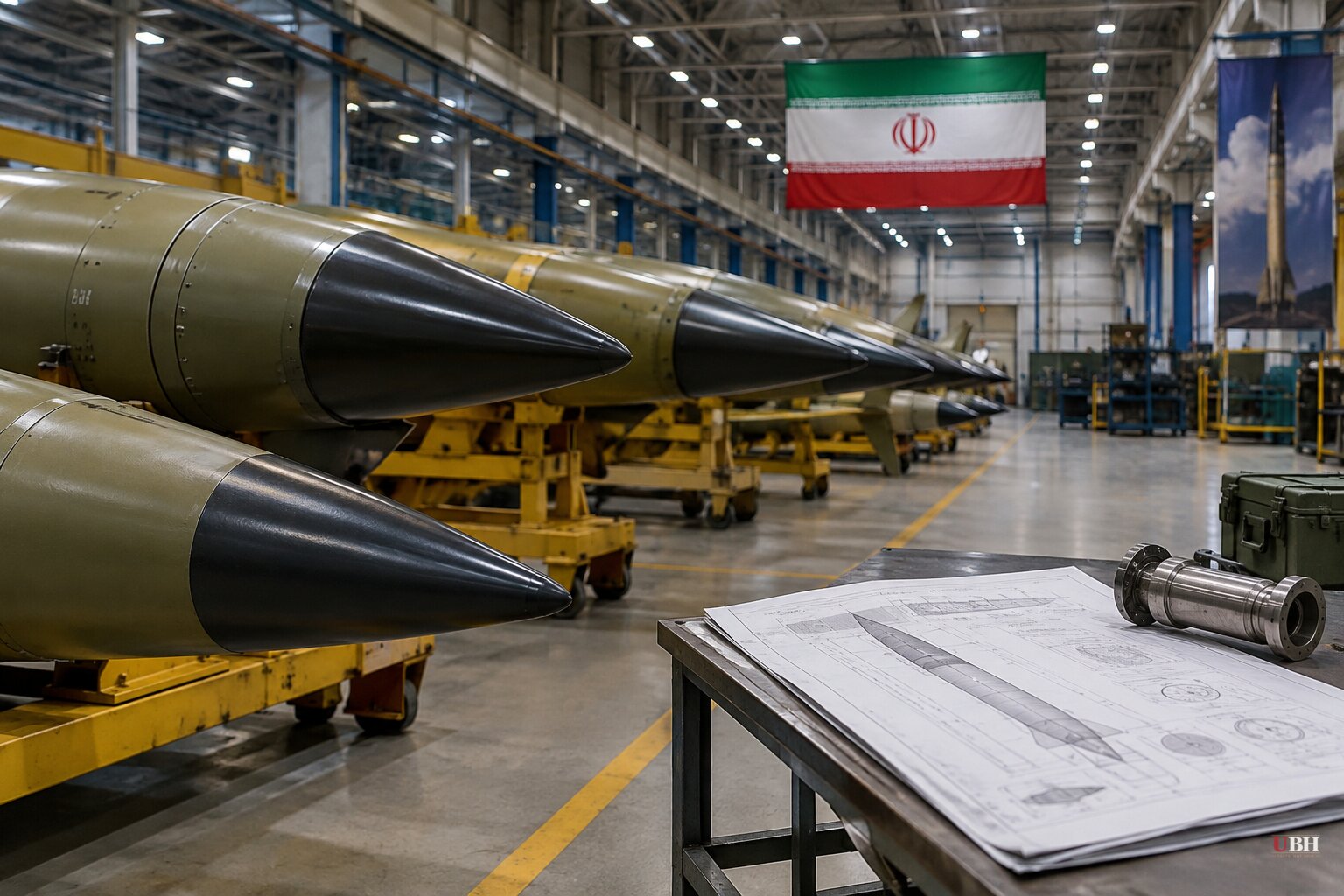
Months of U.S. and Israeli airstrikes have not stopped Iran from building ballistic missiles. They have slowed it.
A Western official citing military intelligence reports says Iran can produce about 50 ballistic missiles a month, roughly half what it could before the war began on Feb. 28. The same official says Iran likely has at least 1,700 ballistic missiles in stock. The estimate was disclosed in a Bloomberg report on Wednesday, Nov. 11.
What Washington says
Hegseth said on Tuesday, Nov. 10, that 80% of Iran's industrial base had been destroyed. President Donald Trump said Nov. 9 that nearly 85% of Iran's manufacturing capability has been destroyed.
The U.S. has made the same argument since the early days of the war. Prime Minister Benjamin Netanyahu went further in March, claiming that "after 20 days, I can tell you, Iran today has no ability to enrich uranium, and no ability to produce ballistic missiles."
The intelligence estimate does not square with that last claim. Production at half the prewar rate is not zero production.
It is also not obvious how "80% destroyed" fits with output at 50% of prewar levels. Neither Hegseth nor Trump has explained the gap.
The numbers
Bloomberg's tally puts Iran's launches since Feb. 28 at no fewer than 2,200 ballistic missiles and more than 4,900 strike drones. Israel estimated Iran's prewar arsenal at about 2,500 ballistic missiles.
Those figures do not reconcile cleanly. Add 2,200 fired to 1,700 remaining and you get 3,900, well above Israel's prewar estimate. That implies either a larger starting stockpile or substantial wartime production. Neither the actual size of Iran's prewar stockpile nor the quantity of weapons produced since the war began is known.
The 1,700 figure is also a raw count from one unnamed official. The reports provide no breakdown by missile type and no assessment of launcher availability. It does not mean all 1,700 missiles are ready for immediate use.
Jim Lamson, a research fellow at the Department of War Studies at King's College London and former CIA Middle East analyst, told Bloomberg there could be thousands of Shahed-type strike weapons remaining as well.
The interceptor bill
Defense is where the arithmetic hurts. Bloomberg Economics calculated that at least 1,000 Patriot PAC-3 interceptors were used to repel attacks involving more than 6,000 Iranian missiles and drones.
Iran fires relatively cheap weapons. The U.S. and its allies answer with expensive interceptors. Western intelligence sources also told Bloomberg that Russia is supplying Iran with offensive weapons. The types and quantities have not been specified.
Tehran shows its hand
Iran is advertising what it has. The Islamic Revolutionary Guard Corps released footage on Tuesday, Nov. 10, of what it described as the unveiling of a new underground "missile city," with ballistic missiles, cruise missiles and launchers. Fatah-1 medium-range ballistic missiles appeared to fill the site.
The IRGC also presented its Fatah-2 hypersonic missile, a day after Israel's Rafael Advanced Defense Systems unveiled a new cruise missile called "Super Ice." Some analysts quoted by the Jerusalem Post fear Iran could pair space-launch technology with its ICBM infrastructure to reach the U.S. mainland. That is a concern, not a demonstrated capability. Al Jazeera notes that Iran currently does not have intercontinental ballistic missiles in its arsenal.
Armed Forces Chief of Staff Maj. Gen. Ali Abdollahi said: "If the enemy makes another move against us, our response will extend beyond the region."
At a news conference in Tehran on Saturday, IRGC spokesman Brig. Gen. Hossein Mohebbi announced that Iran's self-imposed 2,000 km missile range limit "has been lifted for us." He did not say whether Iran already has missiles that exceed the cap. The Institute for the Study of War reports that Iran has also begun threatening to strike U.S. bases in Europe should attacks be launched from them.
For Gulf states already inside the 2,000 km radius, the announcement changes little. Al Jazeera notes it could help Iran position some launchers in the country's east, from where a bigger range is needed to reach Israel.
Shipping and money
The fighting at sea has not eased. The Washington Institute for Near East Policy counted 37 ships struck in October, the highest monthly total since the war began. The U.S. maintains a naval blockade of Iranian ports, and the status of the Strait of Hormuz remains volatile.
On the economic front, Treasury Secretary Scott Bessent has moved out of his home and onto a military base after Iranian threats, a senior administration official told Fox News Digital. A Treasury spokesperson confirmed the move and said Bessent will "not be deterred by the Iranian regime's threats." The official said the threats "reached more than an advanced stage." Bessent launched operations Economic Epic Fury and Economic Outcast to isolate Iran financially through sanctions and restrictions on trade routes.
Diplomacy
Trump said Monday, Nov. 9, there is "positive momentum" toward ending hostilities after meeting Qatari Prime Minister Sheikh Mohammed bin Abdulrahman bin Jassim Al Thani in Washington. Iran's Supreme Leader Mojtaba Khamenei has said Tehran needs to end the "no war, no peace" situation.
No agreement has been announced. If talks collapse, Iran's capacity to rebuild at about 50 missiles a month, against at least 1,000 Patriot interceptors already spent, is the number that will matter.
Sources used for this briefing
6 links from 6 independent newsrooms (syndicated copies of the same report count once)
These are the sources it draws on, linked so you can verify.


