
Unbiased headlines. Facts, not spin.
Every story is an unbiased news briefing written from 110+ sources across the spectrum — sources linked so you can verify it yourself.
 finance
Major Story (7/10)
July 6, 2026 at 02:32 AM
finance
Major Story (7/10)
July 6, 2026 at 02:32 AM
Weak U.S. Jobs Report Drives Dollar Lower, Lifts Gold, and Exposes Australia's Widening Trade Deficit
The Jobs Number That Moved Everything
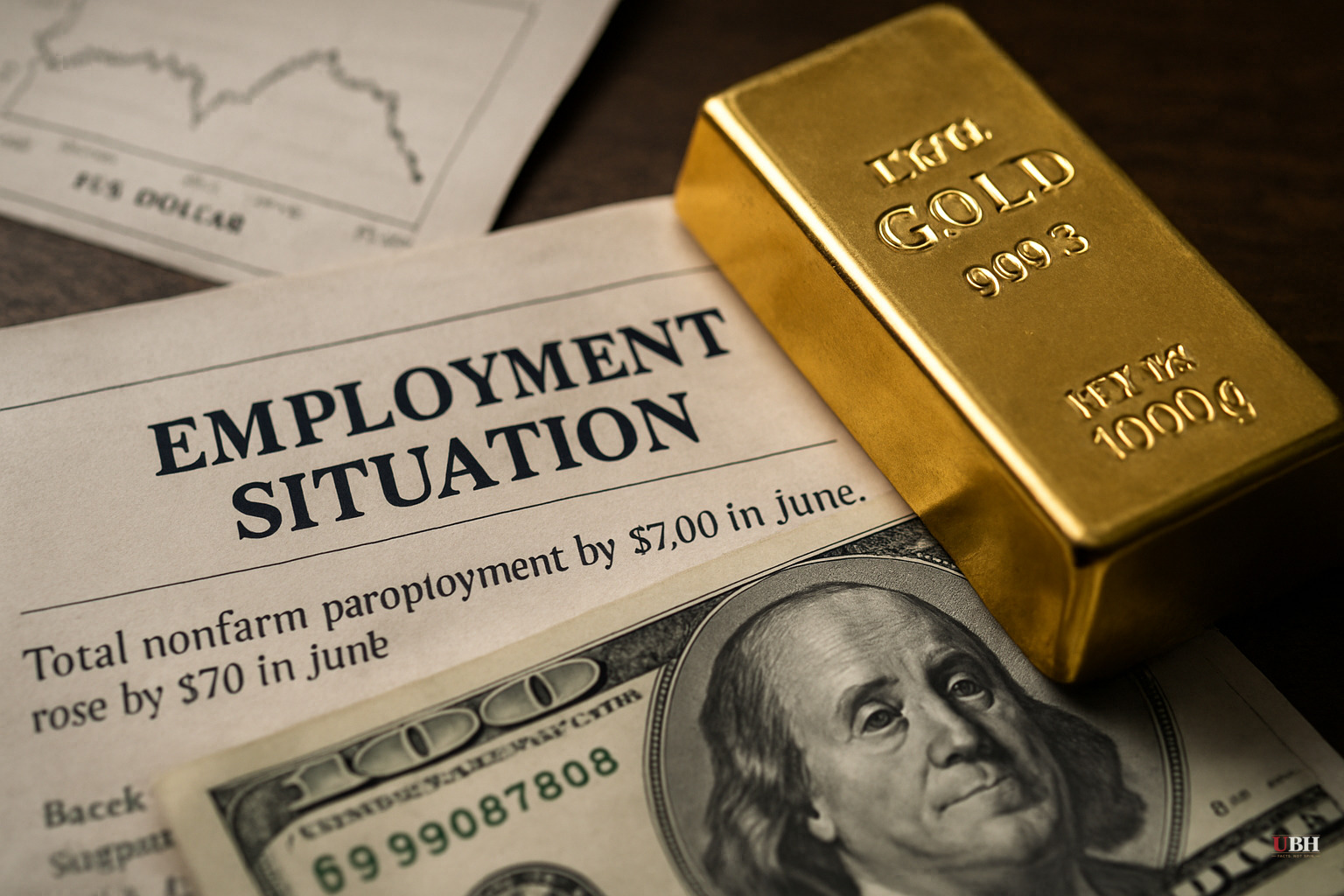
The U.S. economy added just 57,000 jobs in June, according to the Department of Labor — well below analyst expectations, with May's figures also revised lower. The unemployment rate dipped to 4.2%, but that detail didn't calm markets. The headline miss was too big to spin away.
Futures markets responded immediately. According to Bullion Trading Center, traders cut the probability of a Fed rate hike at the July meeting to below 20%, down sharply from pre-report levels. Expectations for additional hikes later in 2026 also declined, though former San Francisco Fed President Mary Daly has said the central bank will keep relying on incoming data before making any further moves, describing current policy as "slightly restrictive."
OCBC strategists offered a partial counterpoint: the decline in the unemployment rate still points to a tight labor market, and they maintained their call for a moderate 2-3% dollar appreciation in the second half of 2026. That's the case for dollar bulls — one weak report doesn't necessarily break the Fed's resolve if inflation stays stubborn.
Dollar Drops, Gold Gains
The U.S. Dollar Index posted its biggest weekly drop since April, according to CNBC. As of early Monday trading, the index sat at 100.9. The euro reached $1.1435, near a two-week high. Sterling was at $1.3351.
Gold extended gains Friday, targeting resistance levels at $4,220 and then $4,269, according to Bullion Trading Center. The metal held above the daily pivot point of $4,143. The relationship is direct: a weaker dollar and retreating rate-hike expectations reduce the opportunity cost of holding gold, which pays no yield.
Treasury yields fell alongside the dollar as investors moved to price in a longer Fed pause. U.S. equities advanced on the same logic.
Coming up this week: the minutes from the Fed's June meeting. Commonwealth Bank of Australia strategists cautioned that the minutes may offer less guidance than usual, citing Fed Chair Kevin Warsh's stated view that the central bank has historically given too much forward guidance.
Yen Sitting at a 38-Year Low
The yen sat at 161.57 per dollar as of Monday morning, according to CNBC — just off the 38-year low of 162.84 touched the previous week. Tokyo's intervention signals are getting louder, but analysts are skeptical of their impact.
OCBC strategists put it plainly: "Without a meaningful shift in underlying macro fundamentals, verbal warnings and outright intervention alone are unlikely to change the broader direction of the pair."
Marc Chandler, chief market strategist at Bannockburn Global Forex, noted that options markets show "large pools of capital" buying short-dated dollar puts as insurance against sudden intervention. Traders know the risk is real. They're hedging it, not retreating from the trade.
Japanese officials appear to have shifted tactics, signaling a more targeted campaign against speculators rather than broad telegraphed warnings. Whether that changes the math is the open question.
Separately, South Korea launched historic 24-hour onshore spot dollar-won trading on Monday, with the won fetching 1,534 per dollar in early activity, per CNBC.
Australia's Mining Surplus Is Gone
While currency traders watched the dollar and yen, Australia quietly confirmed a structural shift in its economy.
The Australian Bureau of Statistics reported that the March quarter of 2026 produced a goods and services trade deficit of A$2.4 billion, flipping from a A$1 billion surplus the quarter before. By May, the goods trade deficit alone hit A$3.02 billion — the widest since 2015, according to Crypto Briefing.
May exports dropped 6.9%. Iron ore, coal, and non-monetary gold all fell. Cyclones Koji and Mitchell disrupted mining operations and shipping routes. Gold shipments alone dropped by more than A$2 billion in a single month.
Imports rose roughly 3%, driven by data center equipment and fuels. The current account deficit ballooned to A$27.1 billion in the first quarter of 2026 — the largest share of GDP since June 2016.
Weather disruptions are temporary. Cyclone damage to export logistics doesn't permanently alter Australia's commodity base. If China's demand stabilizes and mining operations resume, some of this reverses.
But that's the bet, and it's not a sure one. China's property sector — once the dominant driver of iron ore demand — continues operating well below its peak. Thermal coal and LNG prices have normalized from their 2022 highs. The surplus years were built on a commodity supercycle that no longer exists in the same form.
Australia hadn't posted a quarterly trade deficit since December 2017. The reversal isn't just a weather story.
The Unresolved Question
Three separate data points — a U.S. jobs miss, a weakening dollar, and Australia's deteriorating trade balance — are pointing at the same underlying reality: the commodity and growth assumptions baked into 2025 and early 2026 forecasts were too optimistic.
U.S. inflation data due this week will be crucial. If it comes in hot despite the jobs miss, the Fed faces a genuine bind: a cooling labor market it can't ignore, and inflation it can't declare dead. That combination would complicate every trade discussed here — dollar direction, gold's next move, and the timing of any Fed pause.
Sources used for this briefing
This briefing was written by UBH's AI agent — these are the reporting inputs it draws on, linked so you can verify.


