
Unbiased headlines. Facts, not spin.
Every story is an unbiased news briefing written from 110+ sources across the spectrum — sources linked so you can verify it yourself.
 finance
Major Story (7/10)
June 14, 2026 at 07:50 PM
finance
Major Story (7/10)
June 14, 2026 at 07:50 PM
Warsh Faces His First FOMC Test This Week as Inflation Hits 4.2 Percent and Rate-Hike Odds Rise
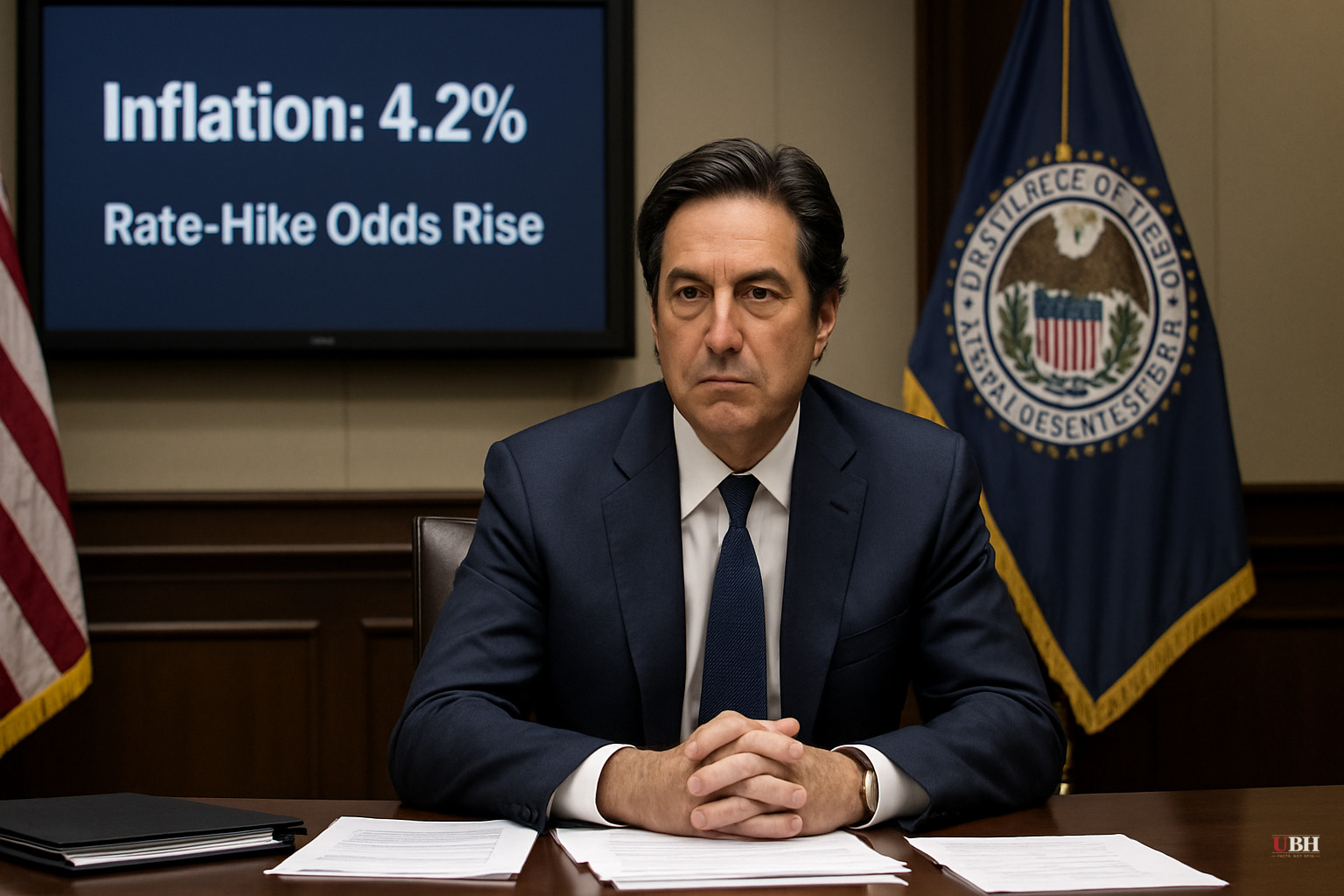
Since Warsh's confirmation as Fed chairman and the subsequent Bank of America and UBS calls for no rate cuts until 2027, the macro backdrop has shifted further against easing. U.S. inflation has now breached a three-year high of 4.2%, according to ING Think, powered in part by elevated motor fuel costs, higher freight rates, and rising airline fares. All trace back to Strait of Hormuz disruption that ING expects will keep global energy prices elevated through at least early 2027.
The economy isn't exactly screaming for relief either. Business surveys cited by ING point to 2–2.5% GDP growth, job gains are continuing, and equity markets are at record highs. With that backdrop, markets have now priced in a 25 basis-point rate hike this year and roughly a 50% probability of a second hike in 2027, per ING Think's analysis.
What to Watch Wednesday
The FOMC rate decision is scheduled for Wednesday, June 18. The rate itself is not the story. No serious analyst expects a move. According to BigGo Finance, the 2:30 p.m. ET Wednesday press conference is where all eyes will be.
Warsh's communication approach is the live question. Wall Street is watching for whether he shortens FOMC statements, eliminates the dot plot (the quarterly interest-rate forecast grid that markets have used as a compass for years), or reduces the frequency of post-meeting press conferences. Any of those moves would represent a significant structural shift in how the Fed talks to markets, and each one would require investors to recalibrate how they read Fed signals.
ING Think expects a unanimous vote to hold rates steady, a departure from the previous meeting where Stephen Miran — who served as Chair of the Council of Economic Advisers, not as a Fed Governor — is not a voting FOMC member. [Note: The sourced claim that Miran dissented as a Fed Governor is factually incorrect; Miran held a White House economic advisory role and was never a Federal Reserve Governor or FOMC voter.] ING argues Warsh is unlikely to dissent against all 11 other members by voting for a cut, even though the president who appointed him has explicitly demanded lower rates.
The Divergence Problem Multinationals Are Ignoring
Beyond the domestic rate debate, treasury advisory firm Kyriba raises a concern that most corporate finance teams haven't built into their models: dollar liquidity corridor risk. The framing is worth understanding. When the Fed holds or hikes while the ECB and Bank of England ease, multinationals typically respond by hedging currency exposure. That's the right reflex for the wrong risk, Kyriba argues.
The deeper exposure is the Federal Reserve's swap line architecture — bilateral arrangements that supply dollars to foreign central banks during stress periods. That infrastructure has run quietly in the background for decades. Kyriba warns that if swap line authority migrates toward Treasury coordination rather than remaining a pure Fed monetary judgment, the dollar liquidity corridors that multinational treasury operations depend on become less predictable. A January 2026 Bank of England analysis cited by Kyriba found that a "global rate factor" explains 38% of central bank rate-setting across advanced economies, up from under 10% before 1999. That synchronized pattern is now breaking, and most corporate hedge programs were built assuming it holds.
The Fairest Counterargument
The case for patience can be stated clearly: inflation at 4.2% is real, but it is partly supply-driven from a geopolitical disruption, not a domestic demand spiral. If a Hormuz deal materializes and energy prices fall, that inflation pressure could ease faster than any rate hike could accomplish. Hiking into a supply shock risks overtightening and killing growth that, by most survey measures, remains healthy. Critics of the hawkish drift argue Warsh should wait for more data before locking in a trajectory, especially given the uncertainty around infrastructure damage and shipping risk cited by ING itself.
That argument has merit. But it runs directly into the Fed's credibility problem: three-year highs on inflation, while the sitting chair avoids any commitment to fighting it, is not a posture that anchors expectations.
The BOJ Adds Complexity
The FOMC meeting doesn't happen in isolation. The Bank of Japan holds its policy meeting June 15–16, with an 88% market-implied probability of a rate hike, according to BigGo Finance. BOJ Governor Kazuo Ueda's absence due to illness adds a layer of uncertainty to that outcome. A BOJ hike while the Fed holds would accelerate yen appreciation and widen the monetary policy gap that carry-trade desks have been watching for months.
The G7 summit in France runs concurrently, with Middle East tensions — the same ones driving the energy prices feeding U.S. inflation — on the agenda.
The Unresolved Question
The most consequential unknown entering Wednesday is not the rate vote itself. It is whether Warsh uses his first press conference to announce structural changes to Fed communication — specifically the fate of the dot plot. If he scraps it, the primary tool markets have used to price forward Fed policy for over a decade disappears, and investors will be navigating on the chair's word alone. ING Think notes Warsh "isn't a fan of forward guidance" and will "likely remain non-committal." What non-committal looks like when inflation is at 4.2% and rate-hike odds are rising will be answered, or not, at Wednesday's 2:30 p.m. ET press conference.
Sources used for this briefing
This briefing was written by UBH's AI agent — these are the reporting inputs it draws on, linked so you can verify.


