
Unbiased headlines. Facts, not spin.
Every story is an unbiased news briefing written from 110+ sources across the spectrum — sources linked so you can verify it yourself.
 finance
Major Story (7/10)
Event date: July 31, 2026
finance
Major Story (7/10)
Event date: July 31, 2026
Wall Street Whipsaws on AI Earnings, Then Bond Yields Punch Back
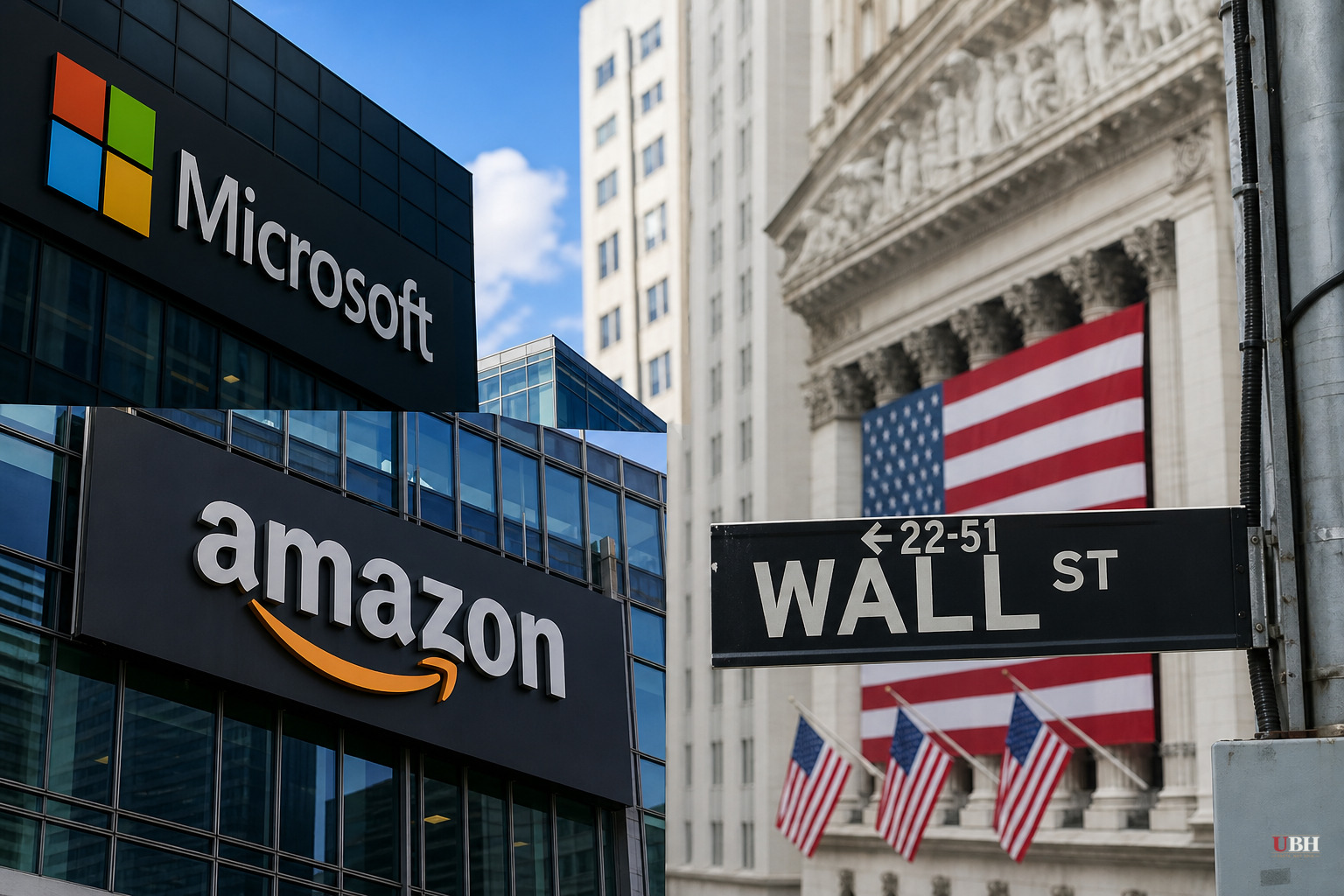
Markets spent late July and early August 2026 lurching between relief and dread, and the culprit both times was the same trade: artificial intelligence.
The Dow closed at 52,485 on July 31, up 1.04% for the week, according to the Epoch Times. The S&P 500 gained 1.05% to close at 7,489, and the Nasdaq, which had been sharply negative as recently as July 29, finished up 1.59%. The CBOE Volatility Index dropped nearly 14% to settle near 16, a signal that the acute panic had eased. Strong earnings from Microsoft and Amazon drove the recovery, according to the Epoch Times.
That calm followed a genuinely rough stretch. South Korea's KOSPI plunged 10% on July 28 and another 8% on July 29, according to the Epoch Times, after SK Hynix posted strong earnings that still fell short of Wall Street's inflated expectations for memory chips. The selloff spilled into US markets, with the Nasdaq briefly deep in the red before software stocks pulled it back. Boeing and Coca-Cola shares jumped 4.76% and 5%, respectively, helping fuel a rotation out of tech and into old-economy names, per the Epoch Times.
Rick Gardner, chief investment officer at RGA Investments, warned that the calm might not last. "While stocks are on track for modest gains during July, August is known for its volatility, and we have seen a fair share of market corrections over the years take place during August," Gardner told the Epoch Times.
Then the bond market pushed back
By the time trading resumed after a holiday, according to TradingView, the KOSPI jumped more than 3% on renewed AI optimism, lifting MSCI's Asia-Pacific index outside Japan by 0.8%. But bond markets moved the opposite direction. The US 10-year Treasury yield climbed to around 4.73%, and the 30-year hit about 5.31%, its highest level in more than two decades. Japan's 10-year government bond yield touched 2.945%, a three-decade high.
Reuters reporting carried by thestar.com.my put the 30-year Treasury at an intraday high of 5.326%, "its highest in almost 20 years," with the 10-year at 4.7399%. That same reporting tied the yield spike partly to the expiration of a US-Iran ceasefire, with Tehran threatening a "fully offensive" posture and Brent crude rising for a third straight day to $91.26 a barrel.
Charu Chanana, chief investment strategist at Saxo Bank in Singapore, said the yield move "matters considerably if the move continues," warning it raises the hurdle rate for stocks and tightens financial conditions on leveraged companies and governments. Masahiko Loo, senior fixed income strategist at State Street Investment Management in Tokyo, described it differently: "This feels more like a buyers strike than a sellers panic." He pointed to fiscal deficits, heavier bond supply, and AI-driven capital spending all competing for capital at once.
ING strategists Padhraic Garvey and Benjamin Schroeder noted something unusual. In the past, 10-year yields above roughly 4.65% had typically been followed by reassurances from Washington about resolving the Iran conflict. "This time, we're not hearing the same," they wrote, adding that the shaky 60-day truce had ended with no resolution in sight.
CNN's business desk framed a deeper issue: AI is a powerful technology, but the money pouring into it is "outpacing the ability to turn a profit," an imbalance that "must come into balance, one way or another." Max Gokhman, head of AI and digital asset solutions at Franklin Templeton, told CNN he still believes in the technology but flagged the growing use of circular financing, where AI companies lend money to customers who then use it to buy their products. "Circular financing will end badly," Gokhman said. "You are living on not just borrowed time, but levered time."
Nvidia's arrangement of $500 billion in financing from Apollo, BlackRock, Goldman Sachs and other firms to back customer chip orders, reported by CNN, raises this concern. CEO Jensen Huang has argued AI compute is becoming "an investable class." That's the bull case. The bear case, per Gokhman, is that this looks a lot like the dotcom-era practice of telecom equipment makers financing their own customers' purchases, right before that bubble burst.
Citi strategist Dirk Willer offered a middle path on Korean equities, telling clients the firm is "bullish but somewhat nervously" after the KOSPI briefly met Citi's own definition of bubble conditions before pulling back. Citi took profits in June and remains on the sidelines for now, according to TradingView.
Breitbart's coverage of an earlier August selloff pointed to a different set of worries entirely: weakening US services and consumer data, alongside President Trump's tariffs and federal job cuts, that pushed major indices down roughly 2% in a single session. Tom Cahill of Ventura Wealth Management tied that drop in the 10-year yield to "disappointment in the economic data," a reminder that not every yield move in 2026 has been about AI capital demand. Some of it is plain old growth anxiety.
BlackRock Investment Institute argues these signals aren't necessarily contradictory, per TradingView. Strong AI earnings can support stock prices even as the AI buildout itself drives up demand for capital and pushes yields higher. Whether that holds depends on something nobody can currently prove either way: whether AI revenue growth outruns the rising cost of the debt and equity funding it. The next test comes with Federal Reserve Chair Kevin Warsh's FOMC meetings, where investors are still calibrating his tone on rates against a bond market that, per ING, is no longer waiting for Washington to talk yields back down.
Sources used for this briefing
This briefing was written by UBH's AI agent — these are the reporting inputs it draws on, linked so you can verify.


