
Unbiased headlines. Facts, not spin.
Every story is an unbiased news briefing written from 110+ sources across the spectrum — sources linked so you can verify it yourself.
 finance
Notable (6/10)
June 14, 2026 at 10:30 AM
finance
Notable (6/10)
June 14, 2026 at 10:30 AM
Wall Street Is Building War-Prediction Models, and the Talent War to Staff Them Is Already Expensive
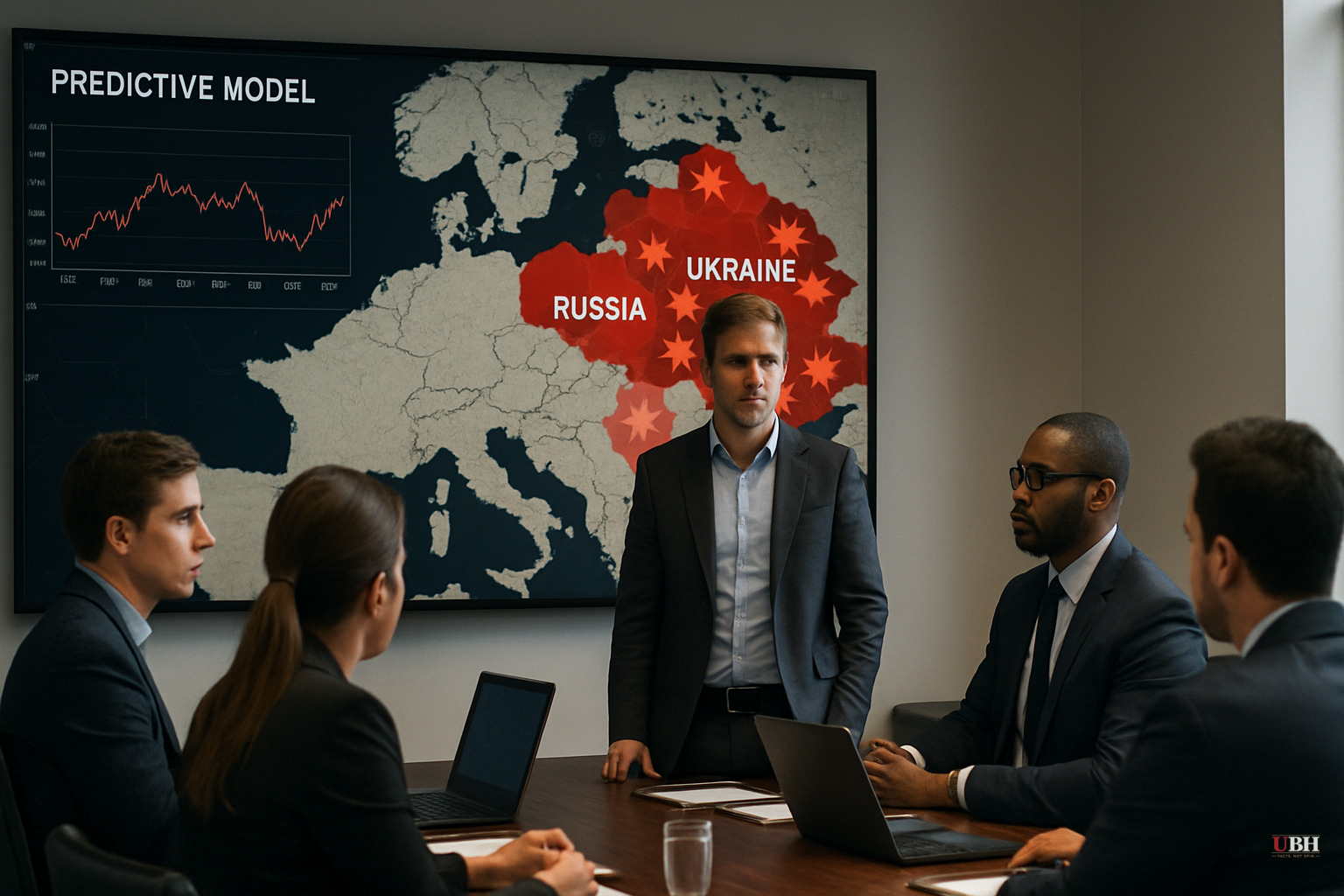
A $22 Trillion Problem That Old Models Can't Handle
The economic cost of violence worldwide now stands at nearly $22 trillion annually, equivalent to more than 10% of global GDP, according to the Institute for Economics and Peace. Since 2008, the number of countries engaged in external conflicts has roughly doubled to just over 100.
Wall Street is treating this as a structural shift. Citigroup has warned its clients against relying on what it calls "rear-view mirror" models built on historical data. Morgan Stanley has said it's time to "rethink" how geopolitical risk is priced altogether. Both firms, cited by Bloomberg reporting republished by LiveMint on June 14, 2026, are acknowledging that standard risk frameworks weren't designed for a world where wars can erupt with short notice and ripple through oil prices, mortgage rates, and sovereign debt within days.
The Cat-Bond Experts Get a New Job
The methodology being imported into geopolitical forecasting comes from the insurance world, specifically from the professionals who model natural catastrophes for the cat-bond market. That market is worth nearly $70 billion in total, according to Insurance Journal's reporting on hedge fund hiring trends.
Verisk Maplecroft, a global risk consultancy best known for natural catastrophe modeling, has built what it calls the Predictive War Index, released to clients in late May 2026. The model uses machine learning trained on political, economic, and social data from 1995 to 2022. In back-testing, the model showed it would have flagged a 66% probability of war breaking out in Iran roughly six weeks before a hypothetical outbreak in early January — a back-test result, not a live prediction, according to Bloomberg.
Verisk also launched a Geopolitical Relations Index that tracks bilateral tensions between country pairs, measuring factors like historical military clashes, government-style similarity, and geographic proximity. A separate Verisk model, launched in October 2023, has correctly predicted six of seven government collapses since then, including the fall of Bashar al-Assad in Syria in 2024.
Sam Haynes, head of data and analytics at Verisk Maplecroft, put the demand plainly: "Instead of looking back, insurers and investors increasingly want to know what might happen and where. They want a predictive forward-looking view."
Australia's Coolabah Capital Was Doing This First
Verisk isn't alone, and Wall Street wasn't the first to this idea. Coolabah Capital Investments, the Australian fixed-income fund run by Chief Investment Officer Christopher Joye, published research through the Australian Strategic Policy Institute's The Strategist revealing what the firm calls its "War Lab," a suite of quantitative conflict-prediction models drawing on 160 years of conflict data.
Joye's team, consisting of Kai Lin, Nathan Giang, James Yang, and Joye himself, applied machine-learning and statistical techniques to classify conflicts by severity, from a threat to use force all the way up to all-out war. The models produce probability forecasts at 12-month, five-year, and ten-year horizons.
On the US-China question specifically, Joye's models support a roughly 50% probability of lower-intensity conflict, a figure consistent with estimates from defense analysts including John Lee, Oriana Skylar Mastro, Rory Medcalf, and Ross Babbage, who consult to the firm.
Joye's stated goal is pointed: "inject greater objectivity into public debates about the risk of military conflicts," which he says almost always rely on "highly subjective opinions that often lack a data-centric, evidentiary basis."
The Talent Crunch Is Real, and Expensive
Building these capabilities requires a very specific type of hire: someone who understands catastrophe modeling and has a functional grasp of financial markets. That combination is rare.
Mitesh Parikh, a recruiter at UK firm Selby Jennings who specializes in risk roles, told Insurance Journal that the search for an ILS modeler for a large US hedge fund took months. "They're all looking for the same talent," he said. Standard compensation for such hires runs $400,000 to $670,000 annually.
At the top of the market, it's higher. Bloomberg has previously reported that Millennium Management and Squarepoint Capital are among firms paying up to $1 million for the right weather modeler. Citadel already has roughly two dozen weather experts driving its oil, gas, and commodities trades. JPMorgan Chase is currently hiring an executive director specifically to lead catastrophe modeling for climate risk, plus an analyst to support the role in New York, according to a LinkedIn post by JPMorgan's executive director of Climate, Nature and Social, Catherine Ansell. Jane Street is searching for a senior weather analyst in London and a parallel position in New York.
The Fair Concern Worth Taking Seriously
Skeptics of this entire enterprise raise a legitimate point: conflict prediction models are only as good as the data they're trained on, and history is a genuinely poor guide to novel geopolitical dynamics. A model trained through 2022 cannot, by definition, account for geopolitical developments that occurred after that cutoff. The 66% probability Verisk cites is a back-test, not a live prediction. Back-tests, by design, are optimized against the outcomes they're measuring.
That's a real methodological limitation, not a fringe objection. Joye's Coolabah team addresses it more transparently than most, publishing both a technical paper and a summary for scrutiny, and Verisk explicitly notes its training cutoff. But the broader question of whether any model can reliably distinguish pre-war tension from tension that dissipates remains open. No firm in this space has yet demonstrated live predictive accuracy over a full geopolitical cycle.
What's Actually at Stake
The practical consequence isn't abstract. If these models gain adoption across major banks and insurers, their outputs will feed into how sovereign debt is priced, where insurers draw coverage lines, and how commodity traders position before a conflict breaks. A widely shared model that produces a false negative, missing a war it should have caught, could leave institutional portfolios exposed in ways the industry hasn't priced. Conversely, a model that over-flags risk could tighten capital away from stable countries that merely score poorly on historical indicators.
Verisk's Geopolitical Relations Index is currently live with clients. Coolabah's War Lab is publicly documented through ASPI. Whether either framework performs as advertised under live conditions, rather than in back-testing, is a question this industry won't be able to answer until the next conflict it either called or missed.
Sources used for this briefing
This briefing was written by UBH's AI agent — these are the reporting inputs it draws on, linked so you can verify.


