
Unbiased headlines. Facts, not spin.
Every story is an unbiased news briefing written from 110+ sources across the spectrum — sources linked so you can verify it yourself.
 finance
Notable (5/10)
July 5, 2026 at 06:23 PM
finance
Notable (5/10)
July 5, 2026 at 06:23 PM
Wall Street Enters Q3 With Light Calendar, Key Earnings Due Next Week
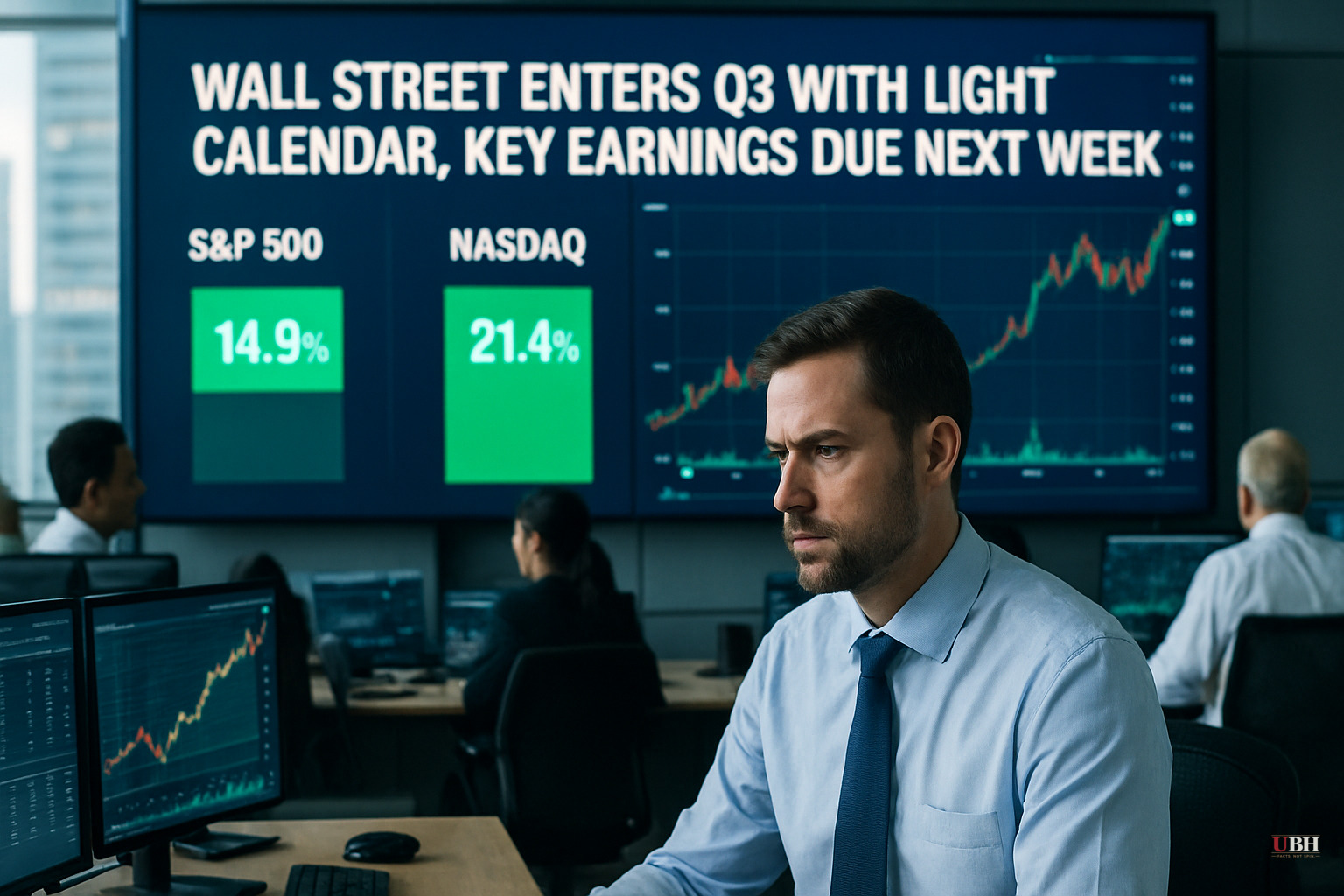
The stock market wrapped up a solid second quarter of 2026, with the S&P 500 ending the period nearly 15% higher and the Nasdaq Composite surging 21.4% for its best quarterly performance since 2020. Wall Street has now shifted to positioning for Q3, a period that starts quiet but accelerates fast.
The first full trading week of July is light on catalysts, according to CNBC. The June jobs report and the Honeywell Aerospace spin-off are already in the rearview. The next major cluster of market-moving events arrives the week of July 13 to July 17, when the largest U.S. banks begin reporting Q2 earnings alongside June inflation data.
Three earnings reports are on the docket this week: Levi Strauss on Wednesday, PepsiCo on Thursday, and Delta Air Lines before the bell on Friday. Each serves as an economic gauge. Levi's will give a read on discretionary consumer spending. PepsiCo will offer a window into food-sector inflation and whether GLP-1 drug adoption is reshaping food demand. Delta will reflect the state of travel budgets. None of these are small questions.
On the inflation backdrop, CNBC data from AAA as of Thursday showed WTI crude oil down 27% from a month ago. But the national average for a gallon of regular gasoline has only fallen 10.5% over the same stretch. The gap between wholesale oil prices and pump prices, and whether consumers still feel burned enough to cut spending, is one of the unresolved tensions Levi and Pepsi commentary will help clarify.
What the Analysts Are Buying
Goldman Sachs analyst Kate McShane highlighted O'Reilly Automotive as undervalued. The stock is down 1% in 2026, but McShane said Goldman's data checks suggest O'Reilly had a stronger Q2 than its auto-parts retail peers and faces minimal direct competition within five to ten miles of most of its store locations. "We believe O'Reilly remains well positioned to outperform while experiencing less potential demand volatility," McShane wrote.
Goldman analyst Lincoln Kong flagged NetEase, the Chinese internet gaming company, as a "compelling 'non-AI' compounder." The stock is down more than 7% year-to-date, but Kong sees a new game launch in July as a near-term catalyst and argues the market is mispricing it by grouping it with AI-heavy Chinese internet names facing margin pressure.
Goldman also upgraded Tradeweb to buy from neutral. Analyst Alexander Blostein called concerns about revenue sustainability and tokenization risk "overdone" and described shares, down more than 4% in 2026, as "too attractive to ignore."
Bank of America's Q3 List
Bank of America put Spotify at the top of its Q3 picks. Analyst Jessica Reif Ehrlich rates it a buy with a price target of $685, implying roughly 41% upside from Thursday's close. Shares are down more than 16% year-to-date. Ehrlich cited new subscription tiers, price increases, and Spotify's AI-driven remix tool, which allows users to legally remix songs from licensed catalogs, as specific catalysts.
Visa also made the list. Analyst Matthew O'Neill set a $410 price target, suggesting about 13% upside. Visa's shares touched a new 52-week high on Thursday and are up more than 3% in 2026. O'Neill described it as "a durable double-digit revenue/teens-EPS compounder" with $33 billion in buyback capacity. Walmart rounded out the Bank of America picks, with the firm arguing its push toward higher-income consumers is starting to produce measurable results.
The Permian Play
Evercore analyst Chris Baker initiated coverage of Permian Resources with a buy rating and a $25 price target. Baker argued the market is undervaluing the company's "acquire and exploit" model, which continuously adds high-quality acreage rather than drawing down a fixed inventory. He also cited improving U.S. shale demand dynamics following the Iran conflict. Permian Resources pays a quarterly base dividend of $0.16 per share, yielding roughly 3.5% annualized. Baker ranks 862nd among more than 12,300 analysts tracked by TipRanks and has a 75% success rate with an average return of 48.3%.
The Legitimate Counterpoint
Skeptical investors have a fair argument: all of these recommendations come from sell-side firms that profit from trading activity and have institutional relationships with many of the companies they cover. Goldman upgrading Tradeweb, Bank of America pitching Spotify in a down year, Evercore initiating on Permian Resources. None of these are independent research. Conflicts of interest in sell-side analysis are structural, not exceptional. That doesn't make the calls wrong, but investors treating these as neutral, disinterested assessments are missing how the business works.
Valero Energy's Q2 earnings, scheduled for July 30, will be the first real test of whether Goldman analyst Neil Mehta's revised EPS estimate of $31.42 for 2026, up from a prior $29.42, holds up. That report will also give the market a cleaner read on refining margins in a post-Iran-conflict oil environment, which underpins several of the energy-sector calls made this week.
Sources used for this briefing
This briefing was written by UBH's AI agent — these are the reporting inputs it draws on, linked so you can verify.


