
Unbiased headlines. Facts, not spin.
Every story is an unbiased news briefing written from 110+ sources across the spectrum — sources linked so you can verify it yourself.
 finance
Major Story (7/10)
July 7, 2026 at 07:30 PM
finance
Major Story (7/10)
July 7, 2026 at 07:30 PM
Wall Street Banks Initiate SpaceX With Lavish Buy Ratings. EchoStar Emerges as a Back-Door Discount Trade.
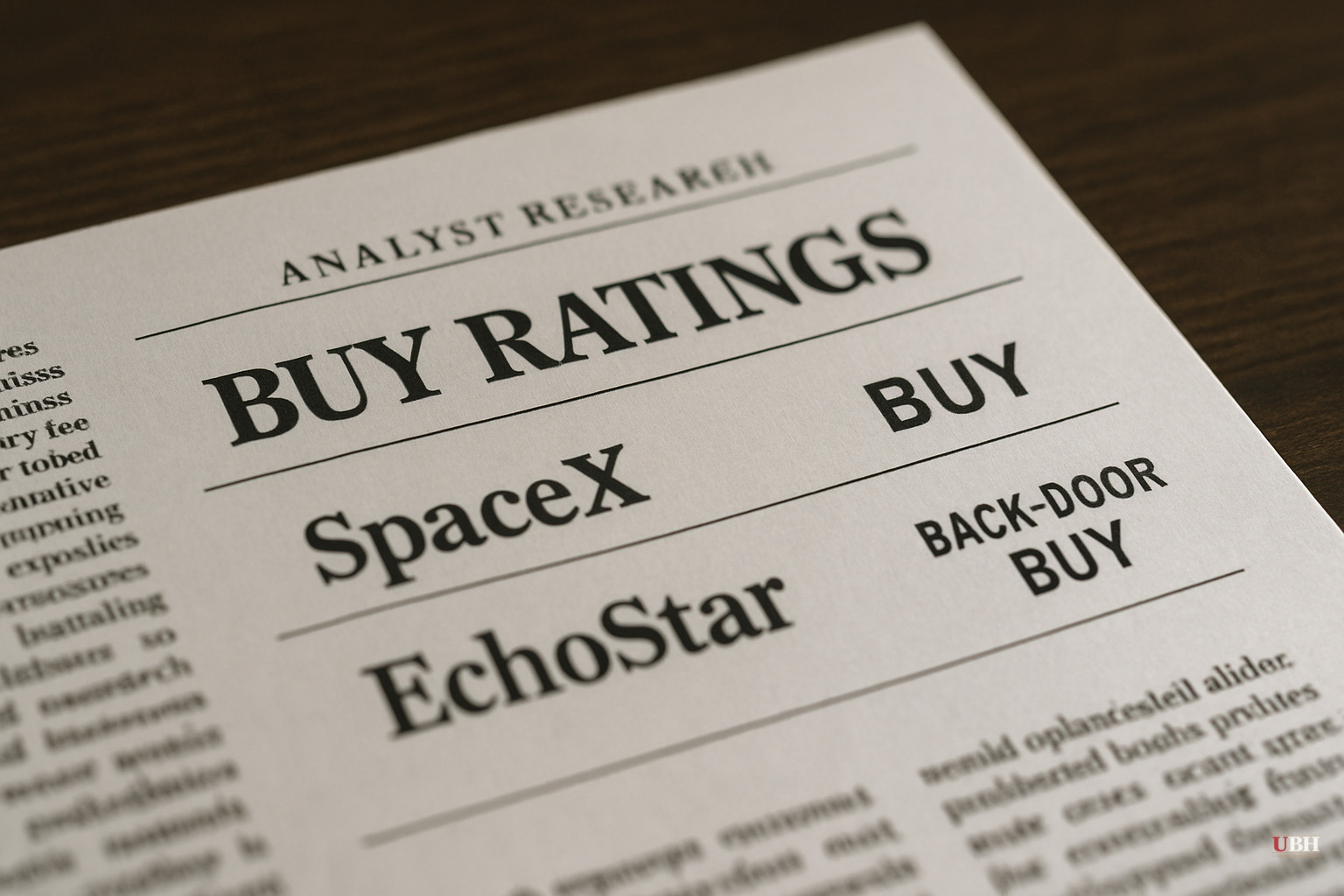
Since SpaceX's June 12 IPO and its addition to the Nasdaq-100 on July 7, the Street's research machinery has finally been unleashed. The language coming out of the big banks reads less like equity research than a NASA press release.
The Ratings Flood
The major underwriters of SpaceX's IPO — Goldman Sachs, Morgan Stanley, Bank of America, and JPMorgan, along with more than a dozen smaller participants — were restricted from publishing equity research before Tuesday to avoid artificially inflating the stock during the offering process. That quiet period ended today.
Raymond James put the most extreme number on the board: a "Strong Buy" with a $800 price target. Their thesis, per the firm's own published note, is that Starship "successfully industrializes orbital transportation, transforming orbital launch from a bespoke aerospace capability into a transportation network defined by commercial aviation-like operating cadence and continuously declining unit costs."
Deutsche Bank issued a "Buy" with a $255 target, describing SpaceX as "the apex of civilizational ambition, oftentimes expressed in steel and fire, bending the arc of history." Bank of America called Starlink the "superhighway to the stars." Goldman Sachs came in with a "Buy" and a $205 target, citing vertical integration across SpaceX's three business segments: Space, Connectivity, and Artificial Intelligence.
SpaceX closed Monday at $160.42 per share — roughly where it ended on its first trading day after the $135 IPO — with a total market capitalization of $2.1 trillion, according to CNBC. As of midday Tuesday, the stock was trading down more than 5%.
The Lone Dissenter
MoffettNathanson was virtually alone in projecting that SpaceX would lose value over the next 12 months. The firm's specific price target and reasoning were not detailed in the available sourcing, but their skeptical stand puts them in a distinct minority against a wall of institutional bullishness.
Raymond James's $800 target implies a roughly 5x return from Monday's close on a company already valued at $2.1 trillion, which would make SpaceX worth more than any company currently trading on U.S. exchanges. The bull case rests heavily on Starship, which is still in its testing phase. That's a lot of weight to put on hardware that hasn't yet proven commercial viability at scale.
The banks issuing these glowing ratings were also the banks that took SpaceX public and collected underwriting fees to do so. That's a standard Wall Street arrangement, and the quiet period rule exists precisely to create some separation. But readers should weigh the enthusiasm accordingly.
The EchoStar Angle
The more interesting trade flagged Tuesday isn't SpaceX directly. It's EchoStar.
Deutsche Bank analyst Bryan Kraft and Citi both reinstated coverage of EchoStar with buy ratings Tuesday. Deutsche Bank set a price target of $143, implying roughly 40% upside from Monday's close. Citi's target is $126, implying about 28% upside.
The math behind their thesis: EchoStar holds a $42.4 billion stake in SpaceX, which Deutsche Bank calculates equals roughly 65% of EchoStar's total net asset value. That SpaceX stake alone equates to $121.46 per EchoStar share. On Tuesday, EchoStar was trading around $100, meaning investors are effectively buying the SpaceX position at a 20% discount and getting the rest of EchoStar's assets at no additional cost.
The discount exists for real reasons. EchoStar's pay TV subsidiary Dish DBS filed for Chapter 11 bankruptcy last month after deferring debt payments. The company is bleeding subscribers in both its pay TV and broadband businesses. The stock is more than 30% below its 52-week high.
Kraft acknowledged the trade isn't clean. "Not only do investors get the rest of ECHO's assets for free, but they're also buying SPCX at a 20% discount," he wrote. He also noted that a 60% gain in SpaceX produces only a 38% appreciation in EchoStar, assuming the discount stays constant. The leverage cuts both ways.
Since the SpaceX IPO on June 12, EchoStar shares have fallen 23% while SpaceX itself has rallied 19%, according to Deutsche Bank. That divergence is the core of the bull case.
EchoStar shares were up about 2% in midday Tuesday trading.
What Stays Unresolved
The practical question neither set of research answers: what happens to EchoStar's SpaceX stake if the Dish DBS bankruptcy proceeding forces asset sales or restructuring that touches the SpaceX position? Deutsche Bank's NAV math is only as durable as EchoStar's ability to hold that stake intact through its own financial troubles. That risk is real and hasn't been fully priced by either bull case.
Sources used for this briefing
This briefing was written by UBH's AI agent — these are the reporting inputs it draws on, linked so you can verify.


