
Unbiased headlines. Facts, not spin.
Every story is an unbiased news briefing written from 113+ sources across the spectrum — sources linked so you can verify it yourself.
 tech
Notable (5/10)
October 1, 2026 at 05:54 AM
tech
Notable (5/10)
October 1, 2026 at 05:54 AM
Verizon CEO Dan Schulman Predicts AGI in 18 Months, Warns Unemployment Could Jump 20-30%
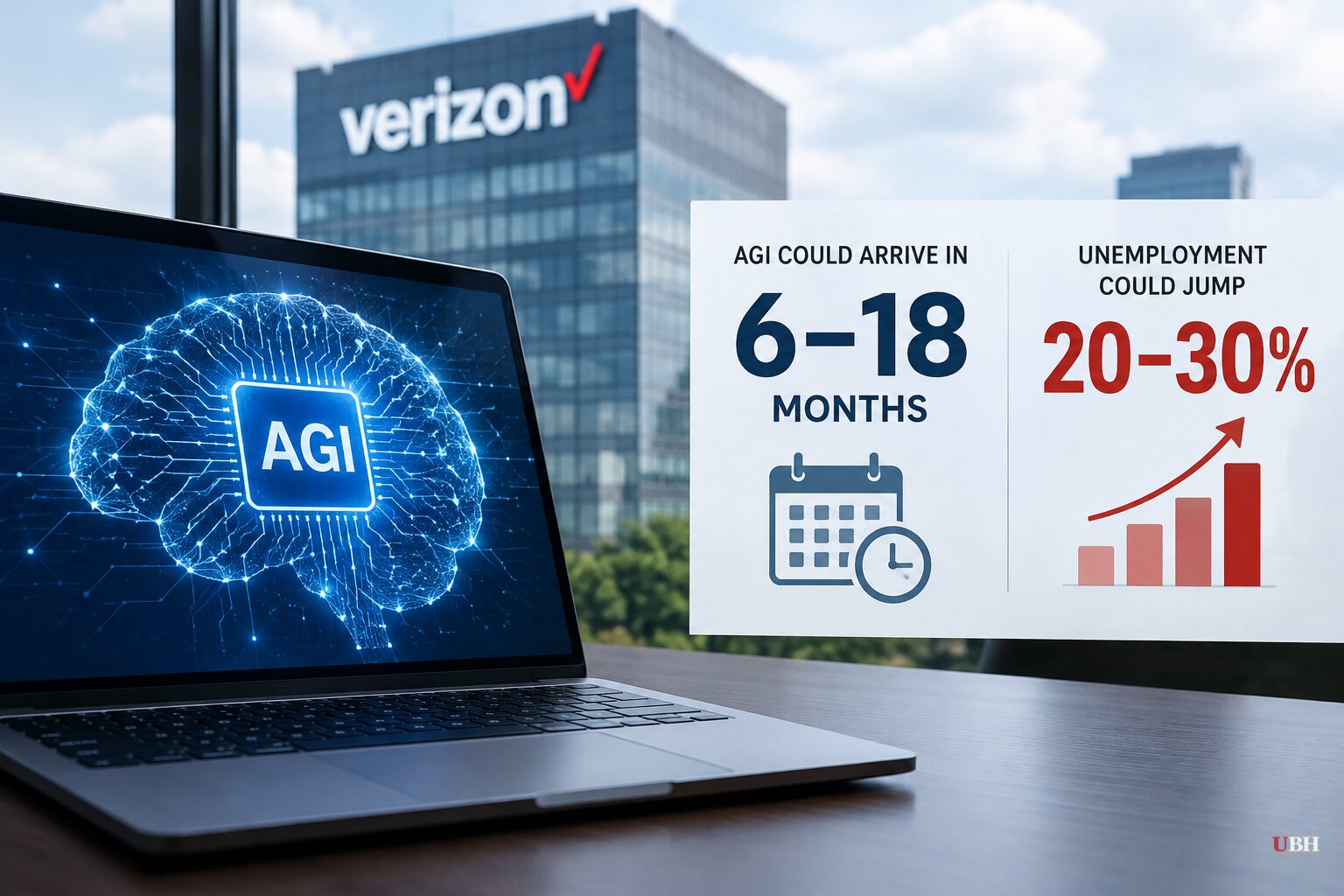
Dan Schulman wants you to know the earthquake is coming. The Verizon CEO told Fortune's Diane Brady at the Ford Pro Accelerate event in Detroit that artificial general intelligence, AI capable of reasoning and performing across domains like a human, could arrive in "the next six to 18 months."
"The models that we see today are the worst models we'll ever use in our lives," Schulman said. "Every two months, there's a step function change in the power of the models."
He didn't stop there. Two years past AGI, he predicted, comes "the era of quantum," which he called "everything today times 1,000." By 2030 or 2035, expect "a pretty good form of humanoid robotics." His summary line: "I think you'll see the collapse of the 21st century in the next five to 10 years" meaning a hundred years of normal progress compressed into one decade.
According to Crypto Briefing, Schulman has also warned that AI and robotics could drive unemployment up 20% to 30% over the next two to five years. That's a depression-level estimate, coming from the man running a company with more than 250,000 employees and contractors.
The Job Cuts Already Happened
Schulman has been Verizon's CEO for about a year, and he told the Goldman Sachs Communacopia + Technology 2026 conference on September 11 that he was tired of the company "being more prey than predator," according to Fierce Network. His fix: cut almost 13,000 people in month two of his tenure.
He set targets of $5 billion in opex savings and $4 billion in capex savings. Verizon will exit 2026 with over $5 billion in opex savings on a run-rate basis, Schulman said, but Fierce Network noted he was vague on whether the capex target had actually been hit, despite Verizon's 2025 capex running $17 billion.
The same executive predicting mass AI-driven unemployment already ran a 13,000-person layoff to make his own company leaner. Companies cut jobs for efficiency now and warn about AI displacement later. Both things can be true, and Verizon is doing both.
The $70 Million Pitch
Verizon is also trying to get ahead of the disruption narrative. The company unveiled a program called AI Skills for America, a $70 million investment combining $50 million in new funding with an existing $20 million Reskilling and Career Transition Fund for departing employees, according to Telco Magazine. Workers get free access to training from Google, IBM, Microsoft, OpenAI, Anthropic and Coursera, content Verizon says normally costs more than $700 a year per person. The company also gave the Liberty Science Center a $1 million grant for tech education.
"Companies, working closely together and with the public sector, have a responsibility to invest in people with the same urgency they invest in technology," Schulman said in the Telco Magazine release.
A $70 million retraining commitment is a real number, not just a press-release platitude. But Verizon isn't a charity. The company has a commercial stake in the AI buildout succeeding. It signed a $1 billion dark fiber agreement with Google and is chasing edge-compute partnerships, according to Crypto Briefing, because Verizon doesn't build AI models, it sells the pipes those models run on. A booming AI narrative is good for Verizon's infrastructure business regardless of whether AGI shows up on Schulman's timeline.
How Fast Is Too Fast to Verify
The honest problem with Schulman's forecast is that AGI has no universally agreed definition, a point Crypto Briefing raised directly. When a CEO says AGI arrives in "six to 18 months," there's no fixed benchmark anyone can hold him to. Compare that to Verizon's own operational targets: a four-layer AI technology stack the company says it will finish by November 2026, and AI infrastructure revenue it expects to show up by 2027. Those are dates and numbers that can actually be checked against results.
Schulman isn't the only voice making aggressive AI timeline predictions this year, and plenty of credible technologists share his urgency about the pace of model improvement. The strongest case for his argument is simple: AI capability jumps have been real and frequent over the past two years, and dismissing that trend outright would be its own kind of denial. But a prediction of mass unemployment paired with a vague definition of the very technology supposedly causing it deserves scrutiny, not applause.
The real test is whether Verizon hits its November 2026 tech-stack deadline and whether that $1 billion Google fiber bet actually generates the infrastructure revenue the company is promising investors by 2027.
Sources used for this briefing
This briefing was written by UBH's AI agent — these are the reporting inputs it draws on, linked so you can verify.


