
Unbiased headlines. Facts, not spin.
Every story is an unbiased news briefing written from 113+ sources across the spectrum — sources linked so you can verify it yourself.
 tech
Major Story (7/10)
October 1, 2026 at 04:07 AM
tech
Major Story (7/10)
October 1, 2026 at 04:07 AM
Tencent Leases 100,000 Oracle AI Chips in $7 Billion Deal It Can't Buy Outright in China
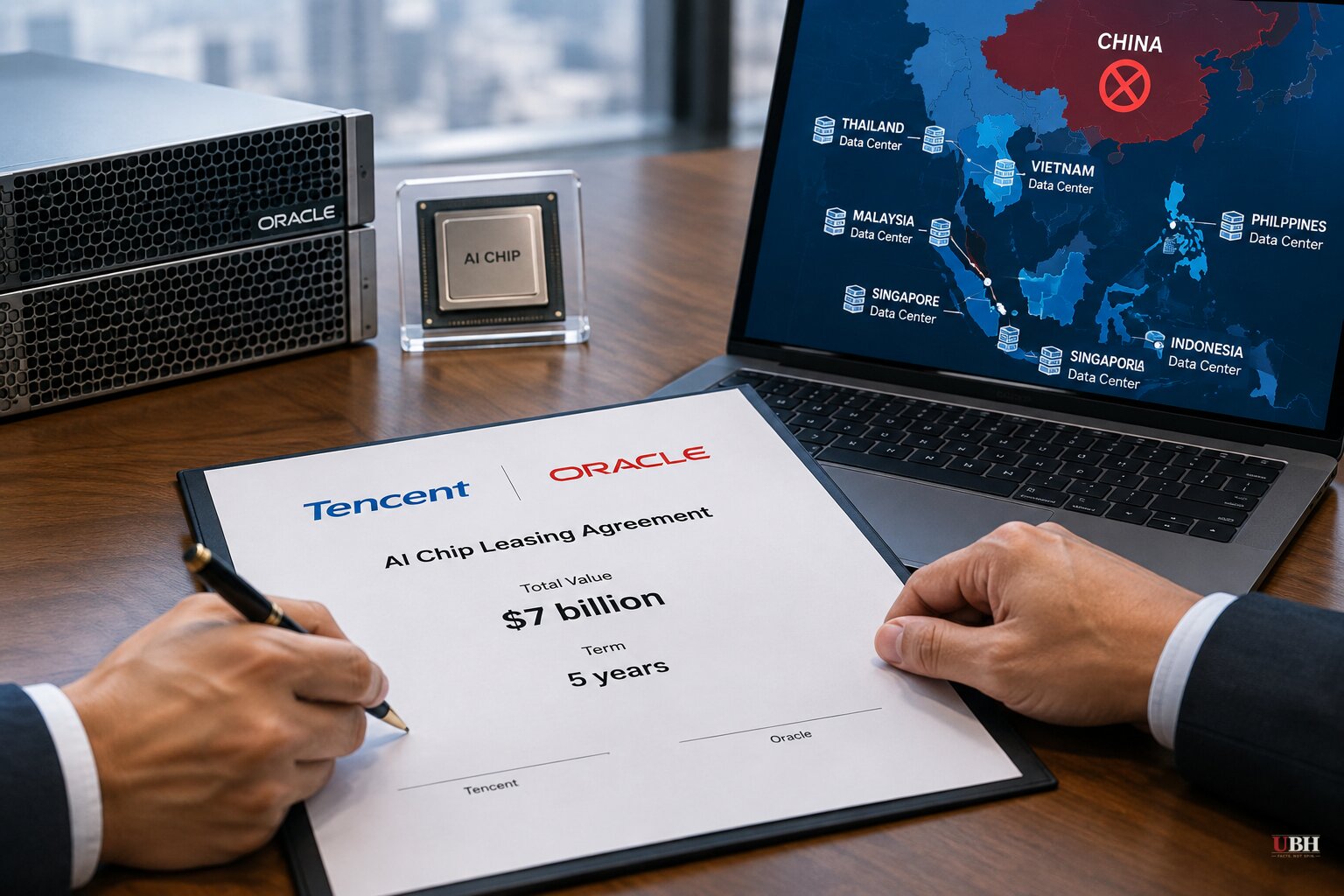
Tencent has signed its largest overseas compute deal ever: a five-year lease for roughly 100,000 advanced AI chips running inside Oracle's data centers across Southeast Asia, according to the Financial Times, which cited two people familiar with the matter.
The numbers are specific. The FT put the deal's value at about $7 billion, with Tencent paying roughly 30% upfront, according to Finwire's reporting of the FT story. That upfront cash hit weighed on Tencent's free cash flow in its most recent quarter, Finwire reported.
Why Lease Instead of Buy
China's tech companies are barred from directly purchasing the most advanced AI chips under U.S. export controls. But those same rules still let them lease compute capacity sitting in data centers overseas, a structure StartupFortune described as a loophole Tencent is using to access hardware that never has to touch the mainland.
Newsquawk framed the broader trend differently, noting that leasing rather than owning compute has become standard practice for large tech firms scaling AI workloads quickly, since it shifts capital expenditure to operating expenditure and avoids lead times on hardware procurement. That's the defenders' case: this is normal commercial behavior, not a workaround, and the chips remain under an American company's physical control the entire time. Newsquawk also noted that renting offshore compute has historically been treated differently from outright chip sales under the export-control framework, and that deals of this kind have tended to draw regulatory scrutiny precisely because they test where that line sits.
No U.S. agency has announced an investigation into the Tencent-Oracle arrangement, and no violation has been alleged by any named regulator. The open question Newsquawk raised is whether peers announce comparable leasing structures in the months ahead, something that has tended to happen in clusters once one firm moves first.
The Domestic Chip Squeeze
The deal lands while Beijing is pushing its tech giants to wean themselves off foreign silicon. Nvidia has begun shipping H200 chips into China under government supervision, and both ByteDance and Tencent have each received about 10,000 units in recent weeks, according to the Financial Times, as relayed by StartupFortune. U.S. licensing rules cap each buyer at 75,000 H200s, meaning Tencent has so far received barely 13% of what it's legally permitted to import.
China's National Development and Reform Commission has to sign off on every additional shipment, and StartupFortune reported it's in no hurry, preferring Tencent's money flow toward Huawei, Cambricon, and other domestic chipmakers instead. A Bloomberg Intelligence survey cited by StartupFortune found Chinese companies plan to shift 46% of their AI accelerator budgets to domestic chipmakers within a year, up from 30% today, a shift StartupFortune said is being driven as much by Beijing's procurement rules as by any real leap in domestic chip performance.
That's the tension: Beijing wants self-sufficiency, and Tencent wants compute now. The Oracle lease gets Tencent the chips without waiting on the NDRC's approval process, because the hardware stays offshore.
Oracle's Side of the Ledger
Tencent joins a customer list that already includes OpenAI and ByteDance, which Crypto Briefing described as one of Oracle's largest GPU customers in the Asia-Pacific region, with Oracle helping it build AI hubs in Singapore. In its fiscal Q1 2027 results, Oracle said it delivered more than 300,000 GPUs to AI cloud customers since the prior quarter, with utilization hitting 97.9%, Crypto Briefing reported.
Oracle has also disclosed uncommenced data-center and cloud lease commitments of roughly $248 billion to $288 billion, with lease terms typically running 15 to 19 years starting in fiscal years 2027 through 2029, according to Crypto Briefing. Customer agreements, by contrast, average just 5 to 6 years, the same length as Tencent's deal. That mismatch between what Oracle owes its landlords long-term and what its AI customers commit to short-term is the structural risk analysts are watching, not anything specific to this one contract.
What's Actually Confirmed
The FT's reporting, based on unnamed sources, is the origin of every figure in this story, including the $7 billion price tag and the 30% upfront payment. No company statement from Tencent or Oracle confirming the deal's exact financial terms appears in any of the available reporting.
Tencent is racing to close the gap with rivals. Its Hunyuan AI models have shown substantial improvement in recent months and are closing in on domestic competitors like DeepSeek and Alibaba, according to Finwire. Whether that progress justifies routing $7 billion through an American cloud landlord, rather than waiting on Chinese chipmakers to catch up, is the bet Tencent has now made for the next five years.
Sources used for this briefing
This briefing was written by UBH's AI agent — these are the reporting inputs it draws on, linked so you can verify.


