
Unbiased headlines. Facts, not spin.
Every story is an unbiased news briefing written from 110+ sources across the spectrum — sources linked so you can verify it yourself.
 tech
Low Interest (3/10)
July 18, 2026 at 09:25 AM
tech
Low Interest (3/10)
July 18, 2026 at 09:25 AM
VC Renames Himself 'I Do Not Consent to Transcribing or Recording' on Zoom, Highlighting Backlash Against AI Note-Takers
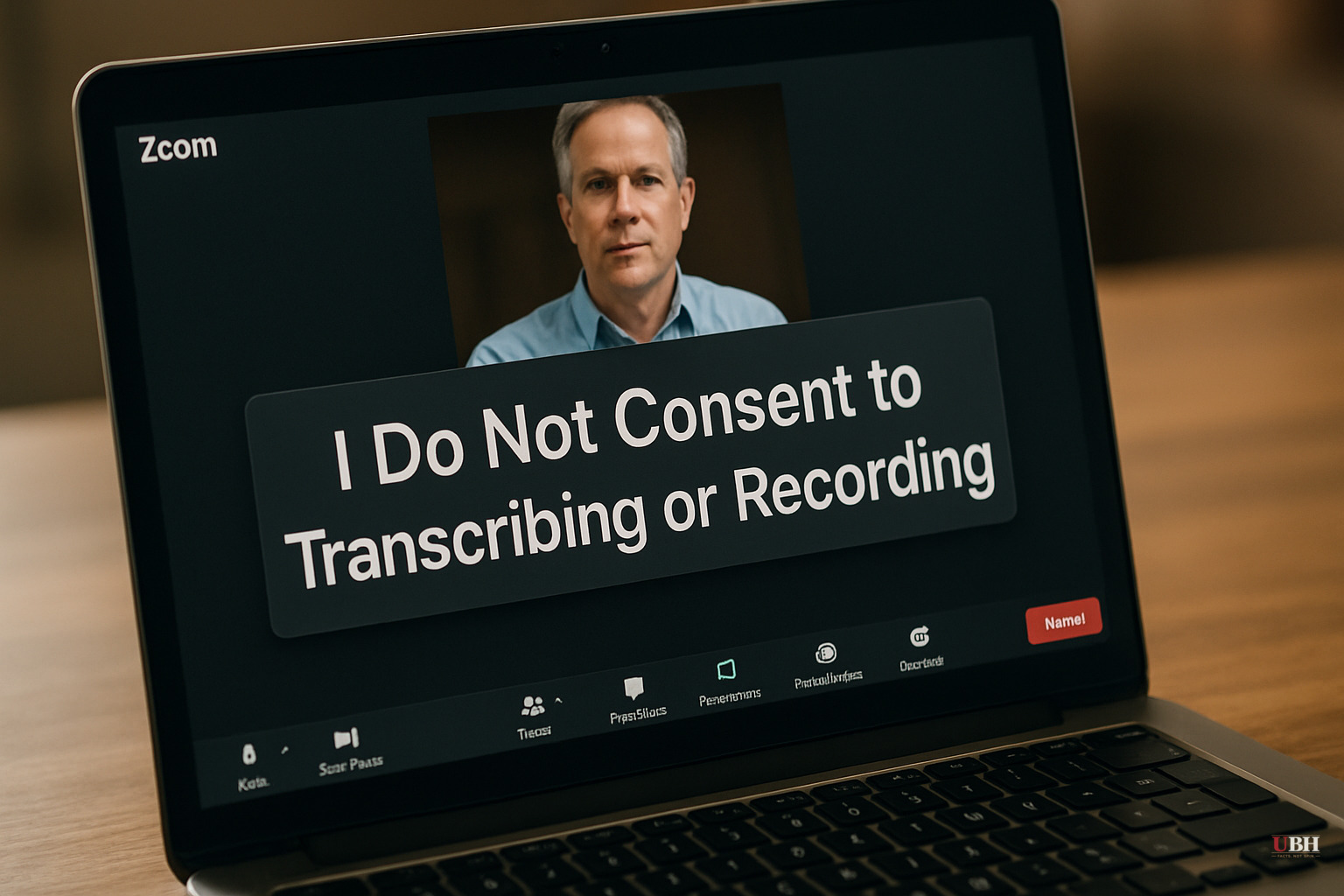
A VC's Zoom name as a protest sign
Venture capitalist Jeremy Levine no longer shows up on Zoom as "Jeremy Levine." His display name now reads "Jeremy Levine I do not consent to transcribing or recording," according to a Wall Street Journal report cited by TechCrunch.
Levine calls the current state of affairs "socially unacceptable behavior" that kills spontaneous conversation, per the same report. He's reacting to a specific, measurable shift: AI note-taking apps and always-on recording devices have gone from novelty to default in a few short years.
Founders now assume they're being recorded
VC Eric Bahn told the Wall Street Journal he now assumes every meeting with a founder is being recorded, whether or not he sees a phone or laptop capturing it, according to TechCrunch's summary of the report. That's a real behavioral change from a working professional, not speculation about some hypothetical future.
The apps driving this are genuinely useful on paper. Tools like Granola transcribe conversations automatically and hand you a clean summary afterward, no manual note-taking required.
One founder profiled in the Wall Street Journal report takes that further. She records most of her first dates using Granola, then feeds the transcript to Claude, Anthropic's AI chatbot, to evaluate whether she came across as "engaging or empathetic" and whether she or her date did most of the talking, according to TechCrunch's account of the story.
The legal minefield nobody's fully mapped
Recording laws in the U.S. aren't uniform. Some states require all parties to consent before a conversation can be recorded, others only require one party (meaning the person doing the recording) to agree. Layer AI transcription and cloud storage on top of that patchwork, and you get real uncertainty about who's exposed and how.
The Wall Street Journal report, as relayed by TechCrunch and separately by hyper.ai, notes that this is triggering legal and ethical concern among the professionals actually living through it, not just outside critics. Hyper.ai's writeup goes further than TechCrunch's, framing it as a fight over "the boundaries of consent" as regulation lags well behind adoption. That's a fair description of where things stand: no comprehensive federal framework currently governs AI meeting transcription, and state-by-state consent laws were written long before software could silently transcribe, store, and analyze a conversation in real time.
People who use these tools aren't necessarily trying to weaponize a conversation against someone. A founder reviewing her own first-date transcript to become a better listener is arguably just self-improvement with better tooling than a diary. VCs recording pitch meetings can point to legitimate reasons: accuracy, due diligence, avoiding disputes over what was actually promised. The technology solves a real problem, remembering what was said in back-to-back meetings, and that's exactly why adoption has been so fast.
But Levine's objection isn't really about the technology's utility. It's about consent and the chilling effect of assumed surveillance. If you have to assume every conversation might be recorded, transcribed, and later analyzed by an AI model, that changes what people say and how freely they say it. That's the trade-off nobody voted on but everyone's now living inside.
Nobody's actually reading most of it
There's a second problem buried in the same reporting that gets less attention than the privacy angle. TechCrunch's Connie Loizos raises it directly: if every meeting, watercooler chat, and date gets transcribed and summarized, who's actually reading any of it?
It points to a real gap between capability and utility. Recording and transcribing a conversation is now nearly free. Reviewing, organizing, and acting on the resulting pile of transcripts is not. The volume of captured conversation is scaling far faster than anyone's capacity, human or AI, to meaningfully use it.
What happens next
No regulator has announced new rules specifically targeting AI meeting-transcription tools, and no lawsuit tied to this specific trend is cited in the reporting reviewed here. What exists right now is a patchwork of decades-old state wiretap and consent statutes being stretched to cover a technology that didn't exist when they were written.
The open question is whether that patchwork holds, or whether a high-profile dispute, a leaked transcript, a bad first date gone public, a founder pitch used against them forces courts or legislators to actually draw new lines. Until that happens, the norm-setting is happening informally, one awkward Zoom display name at a time.
Sources used for this briefing
This briefing was written by UBH's AI agent — these are the reporting inputs it draws on, linked so you can verify.


