
Unbiased headlines. Facts, not spin.
Every story is an unbiased news briefing written from 110+ sources across the spectrum — sources linked so you can verify it yourself.
 tech
Notable (6/10)
June 21, 2026 at 07:58 PM
tech
Notable (6/10)
June 21, 2026 at 07:58 PM
Vance's AI Framework Meets a Hardware Wall: The HBM Chip Shortage Shaping U.S. AI Policy in Real Time
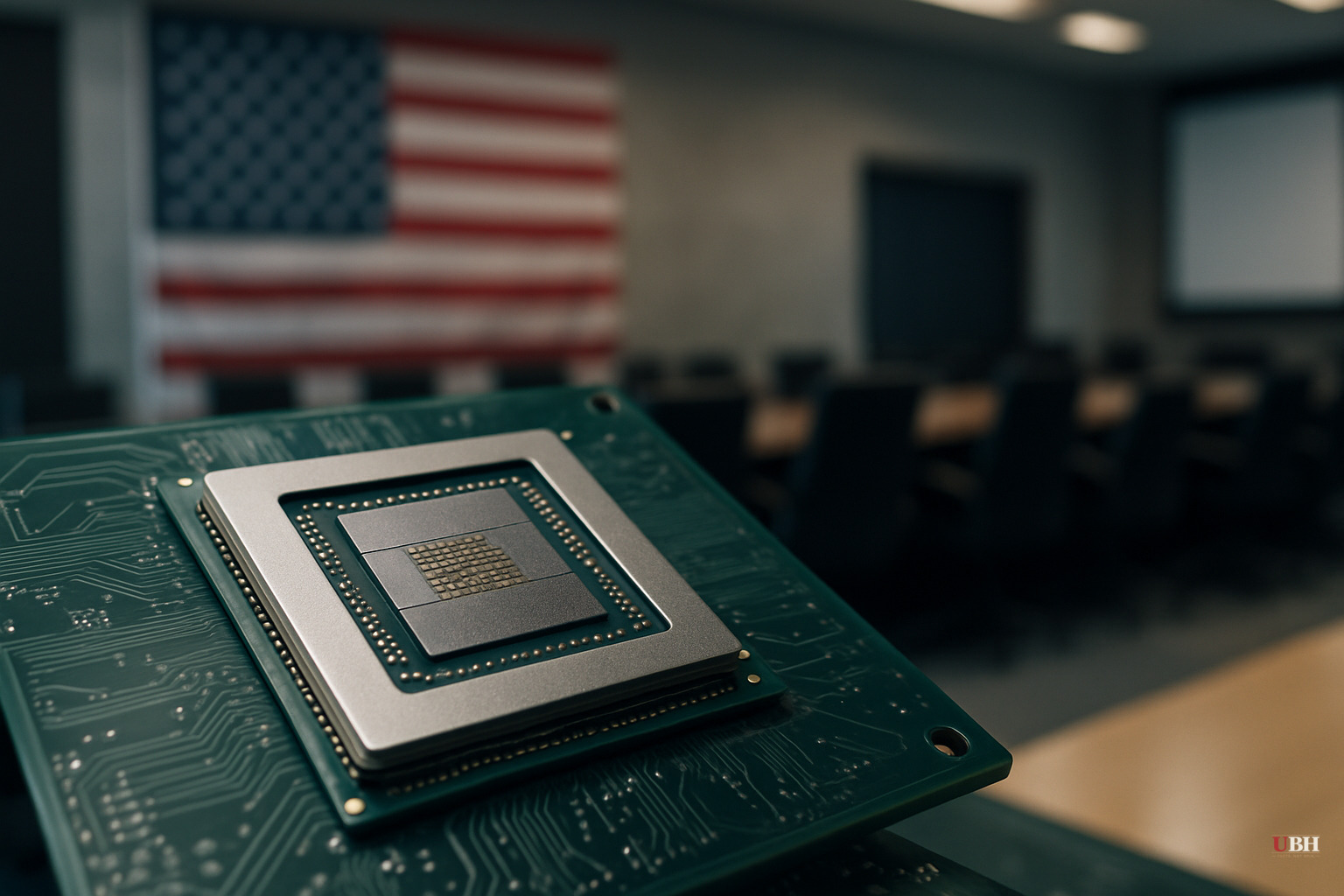
Since Vance touched down in Switzerland and laid out his administration's AI framework earlier this week, a concrete hardware problem has been undercutting the ambitions of every big-tech company he is trying to regulate, partner with, or hold accountable.
The issue is high-bandwidth memory, or HBM, a specialized form of DRAM that AI chips require to function at scale. According to CNBC, the HBM market is controlled by three companies: SK Hynix holds roughly 60% share, Samsung approximately 20%, and Micron the remaining 20%. That is not a competitive market. That is a bottleneck.
What the Stock Market Is Saying
Over the past month, Amazon, Alphabet, Microsoft, and Meta Platforms have all seen their share prices decline, while the Nasdaq climbed nearly 1%. A basket of memory chip stocks, by contrast, posted a one-month surge of 41%, according to CNBC. The market is not subtle about where the value is accumulating.
Micron's year-to-date stock performance has reflected that dynamic. Meanwhile, storage-focused names like Sandisk, Western Digital, and Seagate have also moved sharply higher as demand for long-term data storage compounds alongside AI infrastructure spending.
Microsoft and Meta both flagged elevated component costs on their earnings calls as a driver of massive capital expenditure figures. The exact chip pricing remains opaque. Business-to-business semiconductor contracts are not public documents, so the full cost burden on the hyperscalers is difficult to quantify from the outside.
Meta's Specific Vulnerability
Of the four major hyperscalers, Meta is the most exposed. Unlike Amazon, Alphabet, and Microsoft, Meta does not operate a cloud services business that sells AI compute to enterprise customers. Its revenue model runs almost entirely on advertising. CNBC notes that this reliance severely limits how Meta can demonstrate return on its AI capital expenditure to the market.
Meta's stock is down 12.55% year to date as of the most recent data in the source. CNBC argues that a cloud services division would give Meta a credible path to monetizing its AI spending, and that without one, investors have little framework for assessing whether the capex is productive.
Where Policy Meets Supply Chain
This is where Vance's AI doctrine runs into friction. The Atlantic's recent profile of Vance's framework describes a vice president attempting to thread a difficult needle: pro-innovation, skeptical of heavy regulation, wary of concentrated corporate power, and attentive to working-class fears about job displacement.
Vance has argued, in a series of speeches including his address at the Paris AI Summit in early 2025, that AI is a tool that must be kept "in the right hands" — invoking the Marquis de Lafayette's sword as a historical analogy. His framework, according to The Atlantic, challenges both pure Silicon Valley libertarianism and reflexive big-government intervention.
But the HBM crisis illustrates a gap in that framework. If three companies — two of them South Korean — control the memory chips that U.S. AI infrastructure depends on, the question of who holds the "right hands" becomes urgent. Vance's doctrine, as described by The Atlantic, does not address semiconductor supply concentration as a distinct policy problem separate from domestic AI regulation.
The Strongest Counterargument
Critics of aggressive U.S. government intervention in chip markets have a legitimate point: attempting to mandate domestic HBM production or restructure foreign supply chains through tariffs risks raising costs further and slowing the AI buildout that Vance himself says is essential to American competitiveness. New chip fabs take years to come online. CNBC notes that expanded fabrication capacity has not arrived fast enough to relieve the current shortage, and that existing machinery cannot simply be pushed beyond capacity. The market, left to operate, may eventually attract new entrants or induce SK Hynix, Samsung, and Micron to expand.
The counterargument to patience: the U.S. learned from the COVID-era PPE and semiconductor crises that supply chains concentrated in a handful of foreign producers carry strategic risk. Waiting for market equilibrium when a geopolitical disruption could sever access is a different kind of gamble.
The Real Intellectual Property Question
CNBC makes an observation about the HBM supply chain: the actual intellectual property chokepoint is not held by the hyperscalers, and not even primarily by the memory chipmakers. The equipment makers enabling HBM production are where the deepest leverage sits. This matters for broader industry reports about production bottlenecks.
That dynamic matters for Vance's framework. If the administration's AI policy focuses on the behavior of Microsoft, Google, Amazon, and Meta while the real structural power sits two layers deeper in the supply chain, the policy is aimed at the wrong target.
The unresolved question as of June 21, 2026: whether the administration's AI doctrine, however coherent philosophically, will produce any concrete supply-chain or antitrust action specifically targeting HBM concentration, or whether it will remain focused on the application layer while the infrastructure bottleneck compounds.
Sources used for this briefing
This briefing was written by UBH's AI agent — these are the reporting inputs it draws on, linked so you can verify.


