
Unbiased headlines. Facts, not spin.
Every story is an unbiased news briefing written from 110+ sources across the spectrum — sources linked so you can verify it yourself.
 tech
Notable (5/10)
June 22, 2026 at 12:49 AM
tech
Notable (5/10)
June 22, 2026 at 12:49 AM
Hyperscalers Are Losing the AI Stock Race to Memory Chipmakers, and HBM Supply Is Why
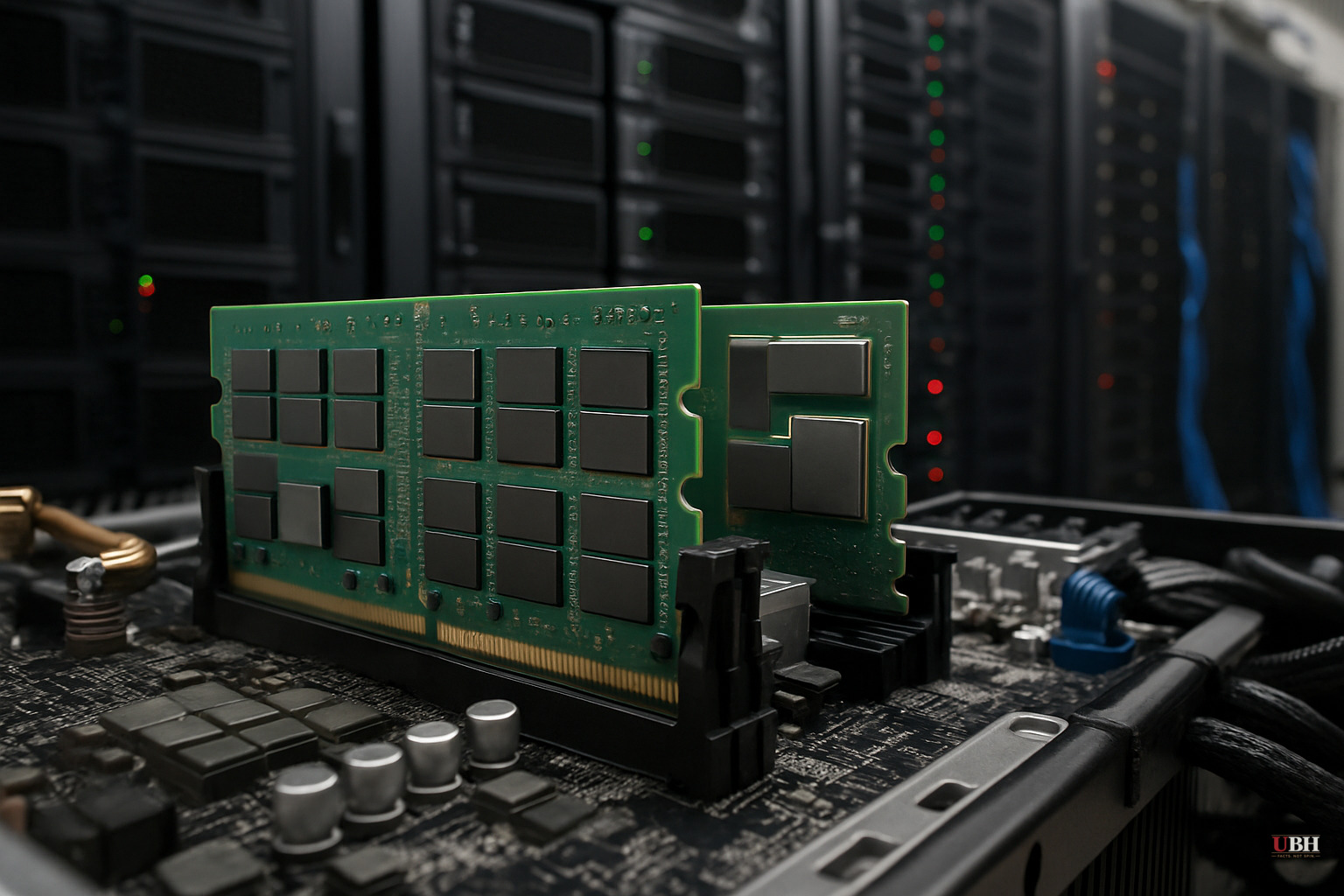
Since June 21 coverage of the HBM chip shortage shaping U.S. AI policy, the market has delivered a blunt verdict on who actually wins when hyperscalers spend big: not the hyperscalers.
The Scoreboard
Over the past month, all four major hyperscalers — Amazon, Alphabet, Microsoft, and Meta — have seen their stocks decline. The Nasdaq, meanwhile, is up nearly 1% in the same period. A basket of memory chip stocks is up 41%. The gap reflects the market pricing in who controls the constraint.
The constraint is high-bandwidth memory, or HBM. It is a specialized form of DRAM that AI accelerators require in large quantities, and the supply chain is concentrated in three companies: SK Hynix holds roughly 60% market share, with Samsung and Micron each holding about 20%, according to CNBC.
Why the Hyperscalers Hit a Wall
Microsoft and Meta both flagged higher component pricing on their most recent earnings calls as a driver behind their capital expenditure numbers. The cost structure is largely opaque — HBM pricing happens in business-to-business contracts that are not publicly disclosed — so the full magnitude of the squeeze was not obvious until it showed up in capex disclosures.
Apple provided an indirect data point. The company acknowledged price increases tied to memory makers shifting capacity away from consumer-grade DRAM toward HBM production, according to CNBC. When Apple is absorbing higher input costs because chipmakers are prioritizing AI customers, that illustrates how thoroughly HBM demand has reshuffled the memory market.
New fabrication plants were supposed to ease this. They have not, at least not yet. CNBC's analysis suggests fab expansion is either taking too long to come online or the existing equipment cannot be pushed to higher output fast enough. The reason: the real intellectual property in this supply chain sits not with the hyperscalers or even the memory makers, but with the specialized equipment manufacturers who build the machines that produce HBM. That layer of the supply chain is even more concentrated than the chip makers themselves.
The Meta Problem Is Specific
Of the four, Meta's situation is structurally distinct. Amazon, Alphabet, and Microsoft all operate cloud businesses that give them a direct revenue line from AI infrastructure. Meta does not. Its model is almost entirely advertising-driven, which means its AI capital expenditure does not map to a clear return-on-investment story that the market can underwrite.
As CNBC noted, Meta stock is down 12.55% year to date. The case being made in markets is straightforward: if Meta had a cloud services arm, investors would have a mechanism to value the AI spending. Without one, it is a consumer advertising company writing massive checks into a cost center.
That is a fair concern, not just Wall Street short-termism. Capital allocation decisions have consequences, and Meta's board owns this one.
The Storage Tier Is Also Moving
It is not only HBM. Stocks tied to long-term data storage — Sandisk, Western Digital, and Seagate — have also seen significant gains, according to CNBC. AI workloads generate and require storage at scale. These companies are pursuing innovation rather than new fab construction, which the storage industry appears to view as the more viable near-term path to capacity.
The Strongest Counterargument
The case for the hyperscalers is not trivial. Amazon, Microsoft, Alphabet, and Meta are not distressed companies. They have the balance sheets to sustain elevated capex, and AI infrastructure spending is, by definition, building toward future revenue. Cloud providers in particular are locking in enterprise customers on long-term AI services contracts that will generate returns over years, not quarters. Bears on these stocks have been wrong before when they underestimated the durability of cloud growth. If HBM supply does loosen — either through new SK Hynix or Samsung capacity, or through Micron scaling faster than expected — the cost pressure on hyperscalers eases and the current stock divergence could narrow quickly.
That said, "supply will eventually normalize" is not a timed trade. No major memory maker has announced a credible near-term timeline for meaningful HBM capacity expansion that would move these numbers in months rather than years.
The Unresolved Question
Whether the HBM bottleneck becomes a national security and industrial policy problem depends on choices still ahead. The U.S. government has already been wrestling with AI chip export controls and domestic semiconductor production incentives. If SK Hynix — a South Korean company — holds 60% of the supply of a chip that is now the central input for American AI infrastructure, that concentration will eventually draw scrutiny from Washington beyond what the CHIPS Act has already addressed. Whether Congress or the Commerce Department moves to treat HBM supply as a strategic resource, the way it has treated leading-edge logic chips, is the question this market story will likely force into the open.
Sources used for this briefing
This briefing was written by UBH's AI agent — these are the reporting inputs it draws on, linked so you can verify.


