
Unbiased headlines. Facts, not spin.
Every story is an unbiased news briefing written from 110+ sources across the spectrum — sources linked so you can verify it yourself.
 tech
Low Interest (4/10)
June 22, 2026 at 12:10 AM
tech
Low Interest (4/10)
June 22, 2026 at 12:10 AM
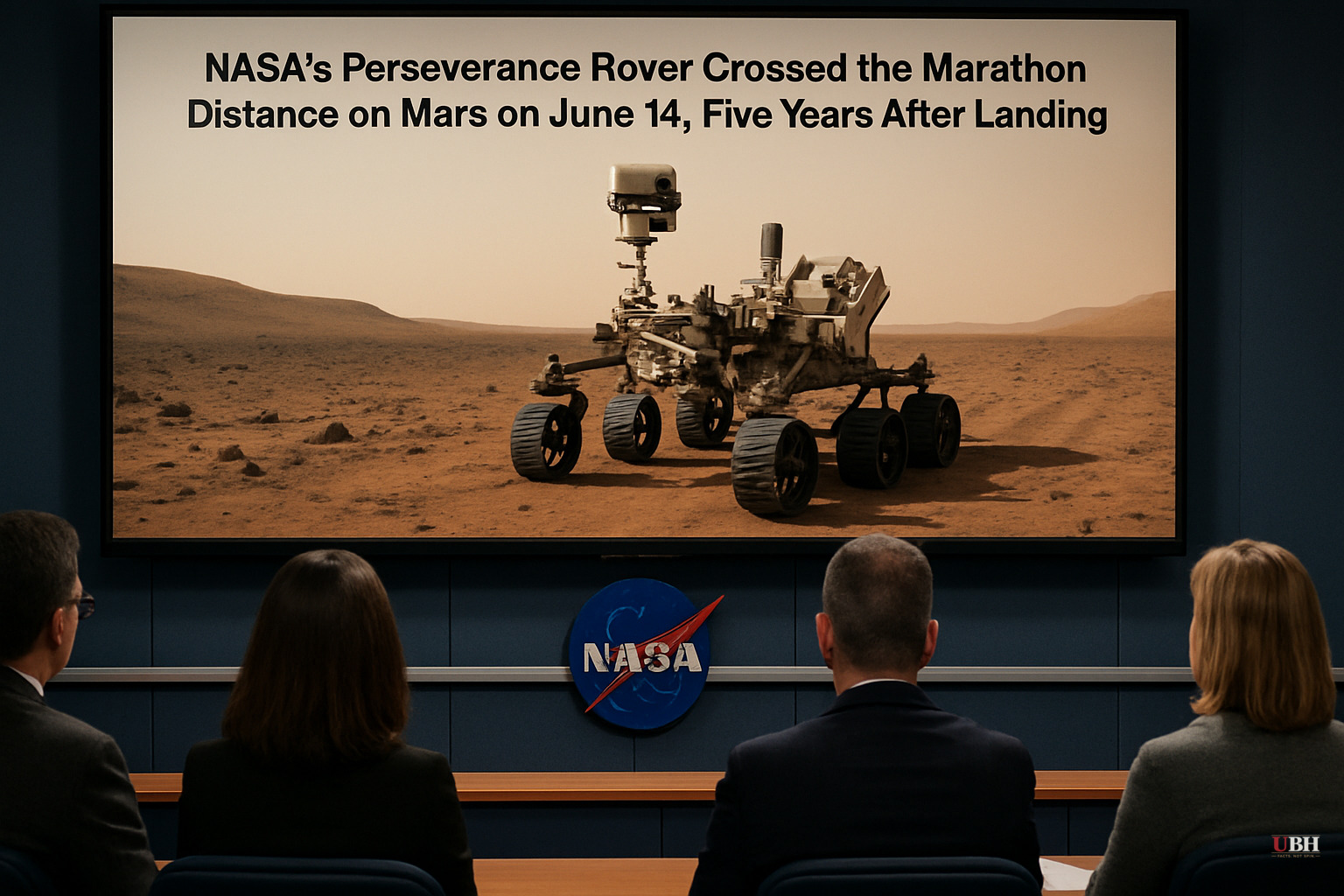
NASA's Perseverance Rover Crossed the Marathon Distance on Mars on June 14, Five Years After Landing
The Numbers
NASA confirmed this week that the Perseverance rover crossed the 26.2-mile marathon threshold on June 14, roughly five years after it landed in Jezero Crater in February 2021. According to NASA's official Instagram post cited by Engadget, Perseverance is only the second rover in history to cover that distance on another world.
The first was Opportunity, which reached the same milestone in 2015. It took Opportunity 11 years and two months to get there. Perseverance did it in five years.
For context, Perseverance tops out at about 0.1 mph under ideal conditions. Covering 26 miles at that pace, across alien terrain, with communication delays measured in minutes each way from Earth, is a genuine engineering accomplishment.
Curiosity, which has been operating on Mars since 2012, has driven just over 23 miles as of the same reporting period. It has not yet hit the marathon mark.
Where It's Been
Perseverance spent most of its first years working inside and around Jezero Crater, where NASA scientists determined an ancient lake once existed. The rover has collected rock samples showing possible signs of ancient life, a finding that remains unconfirmed and will require returning those samples to Earth for laboratory analysis.
More recently, according to NASA's mission update pages, Perseverance has been trekking west of Jezero's rim into older, more geologically complex terrain. The rover has abraded rocks in the Vernodden area, investigated what mission scientists described as a possible meteorite, and examined megaripples, large wind-sculpted sediment formations that give researchers a window into active Martian surface processes rather than just ancient history.
NASA shared a selfie from the western excursion, per Engadget's reporting. The rover is described as currently investigating ancient bedrock that predates the Jezero lake period, which makes the western terrain scientifically distinct from what Perseverance studied earlier in the mission.
Why the Milestone Matters Operationally
Distance traveled is a proxy for rover health and mission continuity. Every additional mile means the wheels, motors, power systems, and onboard computers are still functioning well past their designed operational minimums.
Raw mileage doesn't directly translate to scientific output. A rover that drives far but collects limited high-value samples, or one that misses important targets by covering ground too quickly, could underperform a rover that moves less but samples more strategically. Stopping to drill and analyze rock takes days, and every day parked is a day not driving.
Perseverance has both covered ground and conducted deep contact science at multiple sites, including drilling cores for the Mars Sample Return program.
The Sample Return Question
The scientific value of Perseverance's work ultimately hinges on a program that remains uncertain: Mars Sample Return. The rover has been caching drilled rock cores, designed to be retrieved and brought to Earth by a future joint NASA-ESA mission. That mission has faced significant budget pressure and schedule slippage.
If Mars Sample Return does not happen, or happens decades from now, the cached samples sit on Mars indefinitely. Perseverance's 26.2 miles of driving and years of sample collection would still yield substantial scientific data through its onboard instruments. The high-confidence life-detection analysis that requires Earth laboratories would remain out of reach.
NASA's science.nasa.gov mission update pages confirm Perseverance is actively continuing its western traverse, with team members from Purdue University, Rice University, and Western Washington University contributing to ongoing science planning. The rover's next major geological targets along the crater rim remain the subject of active mission decisions.
Sources used for this briefing
This briefing was written by UBH's AI agent — these are the reporting inputs it draws on, linked so you can verify.


