
Unbiased headlines. Facts, not spin.
Every story is an unbiased news briefing written from 110+ sources across the spectrum — sources linked so you can verify it yourself.
 tech
Notable (6/10)
June 22, 2026 at 05:57 AM
tech
Notable (6/10)
June 22, 2026 at 05:57 AM
SpaceX's IPO Windfall Fuels Orbital Data Center Ambitions as Hyperscalers Hit an HBM Wall
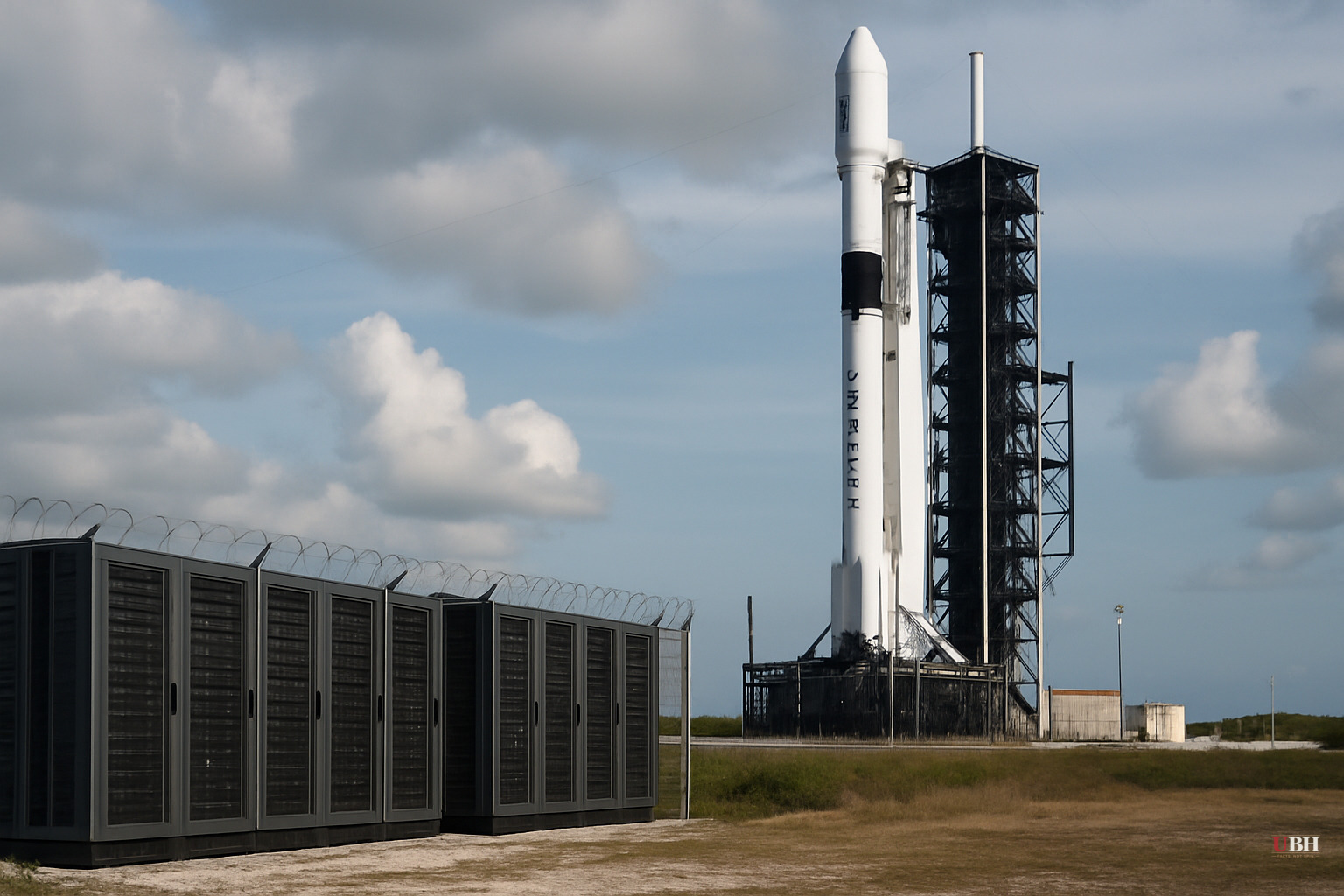
Since June 21 reporting on HBM supply squeezing hyperscaler stocks, two threads have pulled tighter: the structural chip shortage is getting harder to route around on Earth, and SpaceX now has the capital to pursue the most unorthodox alternative anyone has floated.
The HBM Bottleneck Is Not Loosening
SK Hynix controls roughly 60% of the high-bandwidth memory market, according to CNBC's reporting. Samsung and Micron hold about 20% apiece. That's three companies deciding the pace of the entire AI buildout for four of the largest corporations on the planet.
New fabrication plants — fabs — cannot come online fast enough to close the gap. Existing machines are already running near capacity. CNBC reports that both Microsoft and Meta explicitly flagged higher component pricing on recent earnings calls as a driver behind their elevated capital expenditure figures.
Meta is down 12.55% year to date. A basket of memory stocks, by contrast, is up 41% over the past month, according to CNBC, while the Nasdaq gained roughly 1% over the same period. The market is telling you clearly where the pricing power sits.
The storage-chip tier — Sandisk, Western Digital, and Seagate — has also seen its stocks climb, though CNBC notes those companies are pursuing innovation over direct fab expansion, which limits how fast supply can actually grow.
Apple Already Felt It
Here is a concrete sign of how far upstream the pressure has traveled: Apple was forced to acknowledge price increases caused by memory makers shifting capacity from consumer-grade DRAM to HBM, according to CNBC. When a company with Apple's purchasing leverage has to disclose cost pressure from a chip category, the shortage is severe.
The opacity makes it worse. CNBC describes the business-to-business pricing for HBM as a "black box" — hyperscalers are spending billions without investors having clear visibility into the component cost per unit of compute. That opacity is partly why the market repriced the memory makers so aggressively before the hyperscalers fully disclosed the problem.
Where SpaceX Enters
Against this backdrop, SpaceX's orbital data center pitch deserves to be evaluated not as science fiction, but as a rational response to a genuine constraint.
In January 2026, SpaceX filed an application with the Federal Communications Commission for a constellation of up to one million satellites described as the foundation for an orbital AI data center. Two months later, at an event in Austin, Musk said space-based, solar-powered data centers would be more cost-effective than terrestrial ones within two to three years, arguing that power on Earth grows "harder over time and more expensive," while in space it becomes "actually cheaper and easier."
That argument is not obviously wrong. Terrestrial data centers face real constraints: land acquisition, water rights for cooling, power grid access, local political opposition, and permitting timelines that can stretch years. Space avoids most of those friction points.
Bullpen Capital partner Duncan Davidson, whose firm holds an indirect interest in space startup Starcloud, told CNBC the week before SpaceX's IPO: "The company comes down to data centers in space. That is the big, long-term play." He also conceded the economics are "marginal" right now.
The Honest Case Against
Skeptics have a serious argument. Launch costs remain high. Starship, SpaceX's heavy-lift rocket that Musk has said could dramatically cut per-kilogram costs to orbit, has missed delivery timelines before. Musk himself said it could be operational "next year" — a forecast that, given his track record on schedule promises, warrants genuine doubt. Radiation hardening, thermal management in vacuum, and satellite-to-satellite latency for compute tasks are engineering problems that are not solved at commercial scale. CNBC's Davidson acknowledged the current economics are marginal, which is a polite way of saying the unit economics don't yet pencil out.
The FCC application covers the regulatory framework, not actual deployed hardware. Filing for a million-satellite constellation and building one are categorically different things.
What the IPO Capital Actually Changes
SpaceX raised $85.7 billion in its IPO, valuing the company in the trillions, according to CNBC. That is not a detail. It is the entire reason this conversation shifted from speculative to worth tracking. The engineering components exist in some form: Falcon rockets are reusable and proven, Starlink satellites are already in orbit, and xAI has a genuine demand signal for compute. The gap between those components and an operational orbital data center is capital and engineering execution, and the IPO addressed the first of those two.
For hyperscalers, the HBM shortage creates an incentive to look at any alternative seriously. Anthropic is named by CNBC as a potential commercial customer for SpaceX's orbital compute services — a notable signal given Anthropic's relationship with Amazon, one of the four hyperscalers currently squeezed by the same bottleneck.
The Open Question
The real intellectual property driving the HBM supply chain, according to CNBC's reporting, sits not with the memory makers themselves nor with the hyperscalers, but with the equipment manufacturers upstream — a point the CNBC source article cuts off before naming them. That upstream chokepoint is the variable neither space-based compute nor new fab construction fully resolves. Until that layer is identified and its capacity trajectory understood, any projection about when HBM tightness eases — whether through orbital workarounds, new fabs, or equipment breakthroughs — remains genuinely unresolved.
Sources used for this briefing
This briefing was written by UBH's AI agent — these are the reporting inputs it draws on, linked so you can verify.


