
Unbiased headlines. Facts, not spin.
Unbiased Headlines is an independently owned news organization. We bring you the facts, not opinions, written fresh from 110+ named sources. Sources linked so you can verify it yourself.
 economy
Major Story (7/10)
Event date: November 10, 2025 ·
USTR Extends 178 China Tariff Exclusions to Jan. 9, 2027. Customs Entry Date Decides Who Pays
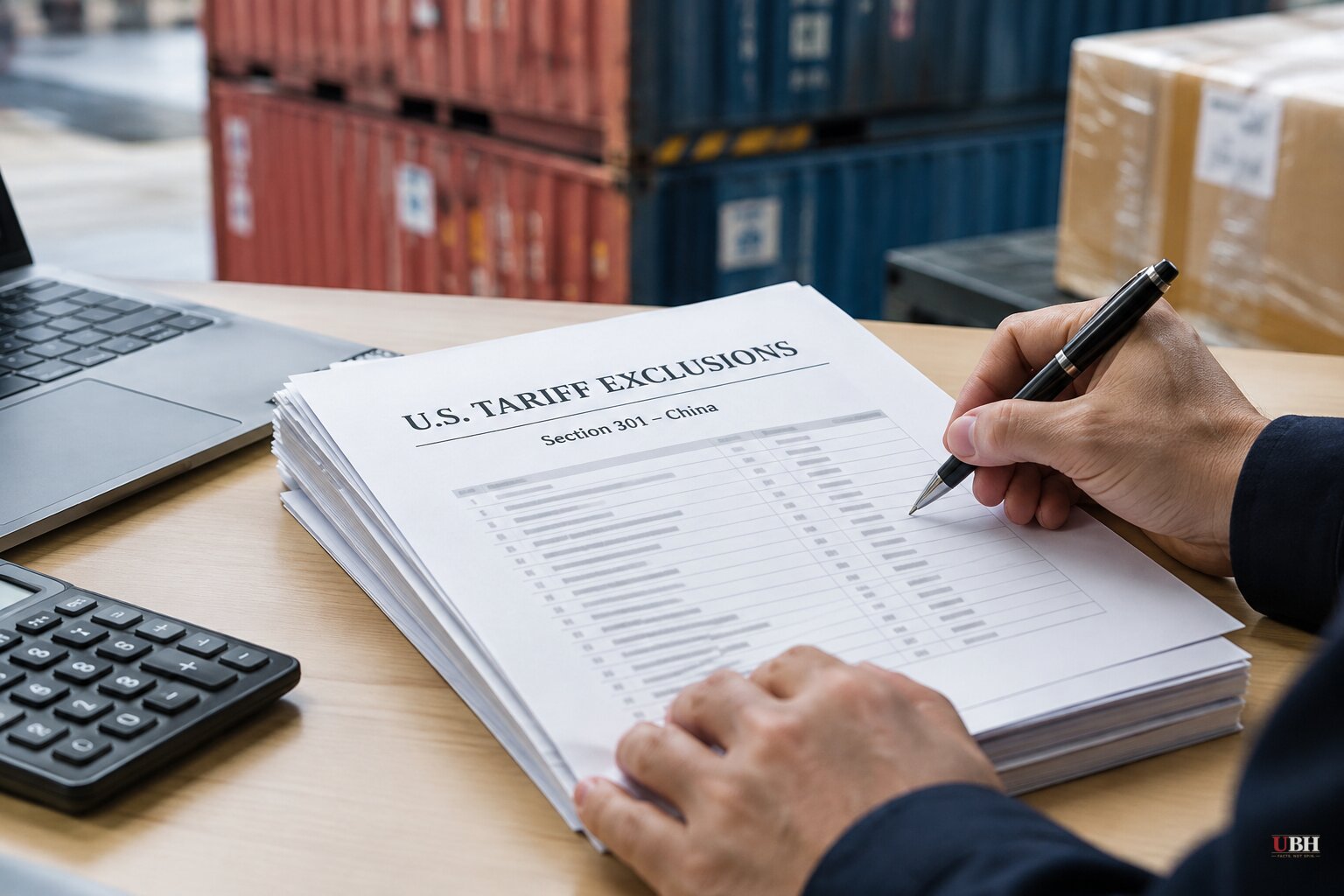
Since the Busan truce in October 2025, the U.S. and China have taken turns pushing back their tariff deadlines. The latest round is now formal on both sides. China's two-month extension of its 24% tariff pause is already on the record. The U.S. half has gotten less attention, and it carries more fine print for anyone who actually imports goods.
What USTR extended
The Office of the U.S. Trade Representative announced on Nov. 6 that it was extending all 178 exclusions from its China Section 301 tariffs. They were due to lapse at 11:59 p.m. ET tonight, Monday, Nov. 9. The new cutoff is 11:59 p.m. ET on Saturday, Jan. 9, 2027.
The extension takes effect at 12:01 a.m. ET Tuesday, Nov. 10. It covers heading 9903.88.69 (164 general exclusions) and heading 9903.88.70 (14 solar-manufacturing exclusions). No exclusions were added or removed.
USTR also extended through Jan. 9 the suspension of port fees aimed at Chinese ships and of additional tariffs on Chinese-made ship-to-shore cranes. That suspension covers the Section 301 action on China's maritime, logistics and shipbuilding sectors. USTR said that during the extension it will "negotiate with China on issues related to the investigation and continue discussions with allies on reviving the US shipbuilding industry."
The entry-date cliff
The exclusion attaches when goods are entered at customs or withdrawn from a bonded warehouse. It does not attach when they are ordered or shipped. A container that sails in December but is entered after Jan. 9 pays full duty.
If the exclusions lapse, the regular Section 301 rate applies again. That is an additional 25% on Lists 1, 2 and 3, including the 14 solar-equipment items, and 7.5% on List 4A. The rate is the one in effect at the time of entry.
By list, the 164 general exclusions break down as 47 under List 1, 22 under List 2, 70 under List 3 and 25 under List 4A, per an exclusions tally from freight firm Gateway Lines. The solar group covers equipment that makes photovoltaic wafers, such as silicon growth furnaces and diamond-wire saws.
Coverage is narrower than it looks. Customs systems match on exact product descriptions, and Tech Times reports that only 26 of the exclusions cover every product under a statistical line.
A notice that disagrees with itself
According to Tech Times, USTR's notice gives two end dates. Its Dates section and both annexes say the exclusions run through 11:59 p.m. ET on Jan. 9. Other text in the notice refers to Jan. 10.
The operative language points to Jan. 9. Importers who plan entries around Jan. 10 risk paying full duty on anything that lands late. USTR did not request new comments for this extension and said it considered comments received in response to its Sept. 16, 2025 notice.
The pattern of late action is also on the record. In each 2025 renewal, USTR announced the extension between zero and three days before the deadline and published it in the Federal Register after the deadline had passed, according to an importer guide published by e-commerce prep firm PrepVia. This time the announcement came three days ahead.
Beijing's matching moves
China's Customs Tariff Commission said Monday it will keep suspending the 24% additional tariff on U.S. goods for two months from 1:01 p.m. Beijing time on Nov. 10, with the 10% rate staying in place. Its statement tied the move to the outcomes of the leaders' meeting in Washington.
According to Seoul's Financial News, China also pushed back to Jan. 10 tighter export controls on rare earths, synthetic diamonds, lithium and graphite. It also extended by two months the suspension of sanctions on five U.S subsidiaries of Hanwha Ocean, including Hanwha Philly Shipyard. Those sanctions were imposed over the company's cooperation with the USTR investigation.
China's Transport Ministry separately extended its suspension of special fees on American ships docking at Chinese ports until Jan. 10.
The friction under the truce
The calm has conditions. Beijing's commission said it has noted that Washington has "repeatedly stated its intention" to replace the tariffs imposed under the International Emergency Economic Powers Act, which have been ruled invalid, with Section 301 tariffs. It said it will "closely follow" those moves and adjust its countermeasures to fit. The Supreme Court held earlier this year that IEEPA does not authorize tariffs.
Washington has its own complaints. Last week Treasury Secretary Scott Bessent and Trade Representative Jamieson Greer held a call with Vice Premier He Lifeng. Greer's office said he stressed that China must take "concrete actions" on its Busan pledges, specifically on "agricultural purchases, rare earths, and other critical minerals."
Presidents Trump and Xi are scheduled to meet at the Asia-Pacific Economic Cooperation gathering in Shenzhen later this month, their third summit this year. At their September talks in Washington, they agreed to extend the truce to Jan. 10.
Both sides have now bought themselves roughly two months. It is unclear whether any replacement Section 301 tariffs aimed at the invalidated IEEPA duties will arrive before then. Beijing has said it will respond if they do.
Sources used for this briefing
7 links from 7 independent newsrooms (syndicated copies of the same report count once)
These are the sources it draws on, linked so you can verify.


