
Unbiased headlines. Facts, not spin.
Unbiased Headlines is an independently owned news organization. We bring you the facts, not opinions, written fresh from 110+ named sources. Sources linked so you can verify it yourself.
 energy
Notable (5/10)
Event date: November 25, 2026 ·
US Uranium Output Falls 78% in Third Quarter as Utah Mill Sits Idle on Planned Pause
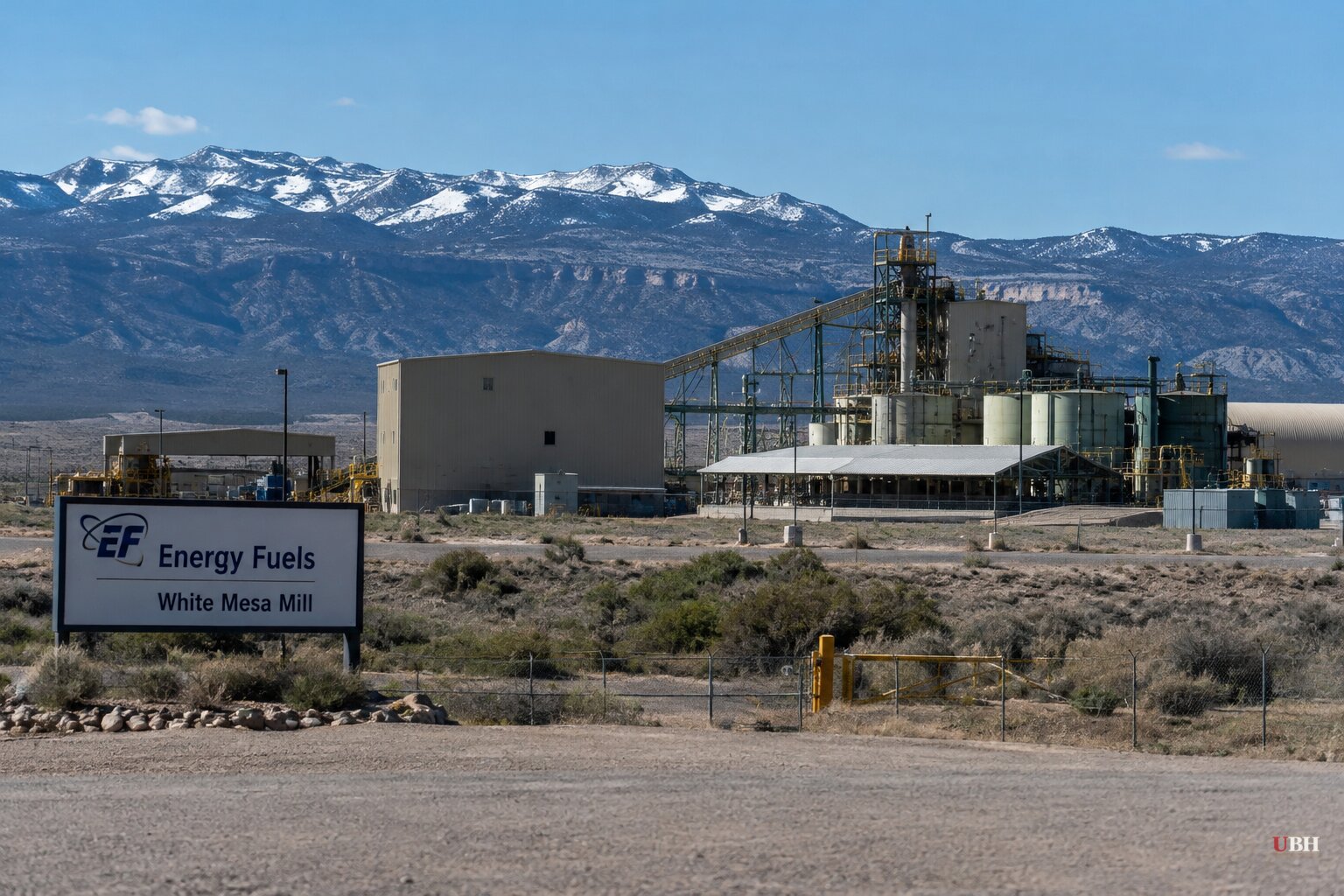
The US Energy Information Administration put out its quarterly Domestic Uranium Production Report on Nov. 20. It shows American facilities produced 243,673 pounds of U3O8 in the third quarter of 2026. That is down 78% from 1,087,504 pounds in the second quarter.
The agency attributes the decline primarily to one facility: the White Mesa mill near Blanding, Utah. It is the only operating conventional uranium mill in the country.
One mill, one pause
White Mesa produced 867,442 pounds in Q2 and nothing in Q3. Energy Fuels, which owns the mill, stopped processing uranium at the end of June. The company had already hit its full-year production guidance at the halfway point and wanted to rebuild its ore stockpile. It switched the mill to rare earth elements in the meantime.
This was not a breakdown or a market shock. It was a planned stop.
The other eight producing facilities did fine. All are in-situ recovery operations: four in Wyoming (Ross CPP, Lost Creek, Smith Ranch-Highland and Willow Creek), three in Texas (Alta Mesa, Burke Hollow and Hobson) and one in Nebraska (Crow Butte). Excluding White Mesa, output actually rose from Q2, led by Uranium Energy Corp.
One soft spot: enCore Energy's Alta Mesa in Texas produced about 10,000 pounds, down from roughly 206,000 a year earlier, while a finished wellfield waits on regulatory approval.
The company's side
Energy Fuels says the campaign schedule explains the swing, and it says it intends to stay on top. "Energy Fuels is currently America's leading producer of uranium, and we intend to maintain and build upon that position," President and CEO Ross Bhappu said. He said the company expects to produce about 1.6 to 2.0 million pounds of mined and produced uranium in 2026.
The company has said it will begin a new processing campaign in December, targeting about 1 million pounds of U3O8. It says that supports deliveries under existing contracts through 2028 and leaves room for spot sales. The mill is then expected to run rare earths through much of the rest of 2027 and into 2028.
The December start is a plan, not an event. In its Nov. 4 quarterly filing, Energy Fuels said the next run was expected in Q4, subject to market conditions, contract requirements and the mill's schedule. Today is Nov. 29, and no restart has been confirmed.
Timing of the campaign is also not uniform across accounts. Some describe a December start with a run of three to five months. Others place the output in early 2027.
Context that matters more than the quarter
The quarterly number looks dramatic because the base is tiny. US mines produced about 2.1 million pounds in 2025, more than triple the 657,000 pounds of 2024. First-quarter 2026 output was 1,039,075 pounds, the highest first quarter since 2015. By our math, the first nine months of 2026 already exceed all of 2025.
But US utilities took delivery of 46.9 million pounds of U3O8 equivalent in 2025, and only 7% was US-origin, down from 8% in 2024. Canada supplied 32%, Kazakhstan 28% and Australia 15%, at a weighted-average price of $58.46 per pound.
At the Q3 pace, annualized domestic output is about 975,000 pounds. That covers roughly 2% of what utilities buy. Even the best 2026 quarter, annualized, covers less than 10%.
The gap is not closing by itself. The EIA says US utilities had 186 million pounds of uncontracted requirements through 2035 at the end of 2025. The World Nuclear Association projects global reactor requirements more than doubling by 2040.
Washington wants domestic pounds
In August, the National Nuclear Security Administration asked suppliers for information on providing about 4 million pounds a year of unobligated, US-origin uranium, plus conversion, from as early as 2030 through the 2040s. Defense uses such as tritium production and naval reactors need material free of the peaceful-use restrictions that come with foreign-origin uranium.
That request is nearly double what the entire US industry produced in 2025. Uranium Energy Corp. says it can fully support the requirement.
Policy has pushed demand toward American producers through strategic reserve purchases and limits on Russian uranium imports. Those steps do not add processing capacity. Only new mines and mills do, and they take years to permit and build.
Energy Fuels is working on that. Its Pinyon Plain mine in Arizona is expected to wind down in the coming years. The company is advancing Whirlwind in Colorado, Energy Queen and Bullfrog in Utah, and additional drilling at Nichols Ranch in Wyoming. Together they could add about 1.25 million pounds a year. Whirlwind is nearly production-ready, pending permits.
What comes next
The EIA's next quarterly release is listed for February 2027 and will cover Q4. It will show whether the December campaign got underway and how much of the 1 million pounds started to flow. For a country planning a reactor buildout, one mill's calendar still sets the national number.
Sources used for this briefing
7 links from 6 independent newsrooms (syndicated copies of the same report count once)
These are the sources it draws on, linked so you can verify.


