
Unbiased headlines. Facts, not spin.
Unbiased Headlines is an independently owned news organization. We bring you the facts, not opinions, written fresh from 110+ named sources. Sources linked so you can verify it yourself.
 energy
Notable (6/10)
Event date: November 27, 2026 ·
Federal Judge Rules Northern Mariana Islands Seabed Lease Plan Violated Endangered Species Act, Second Deep-Sea Mining Loss This Month
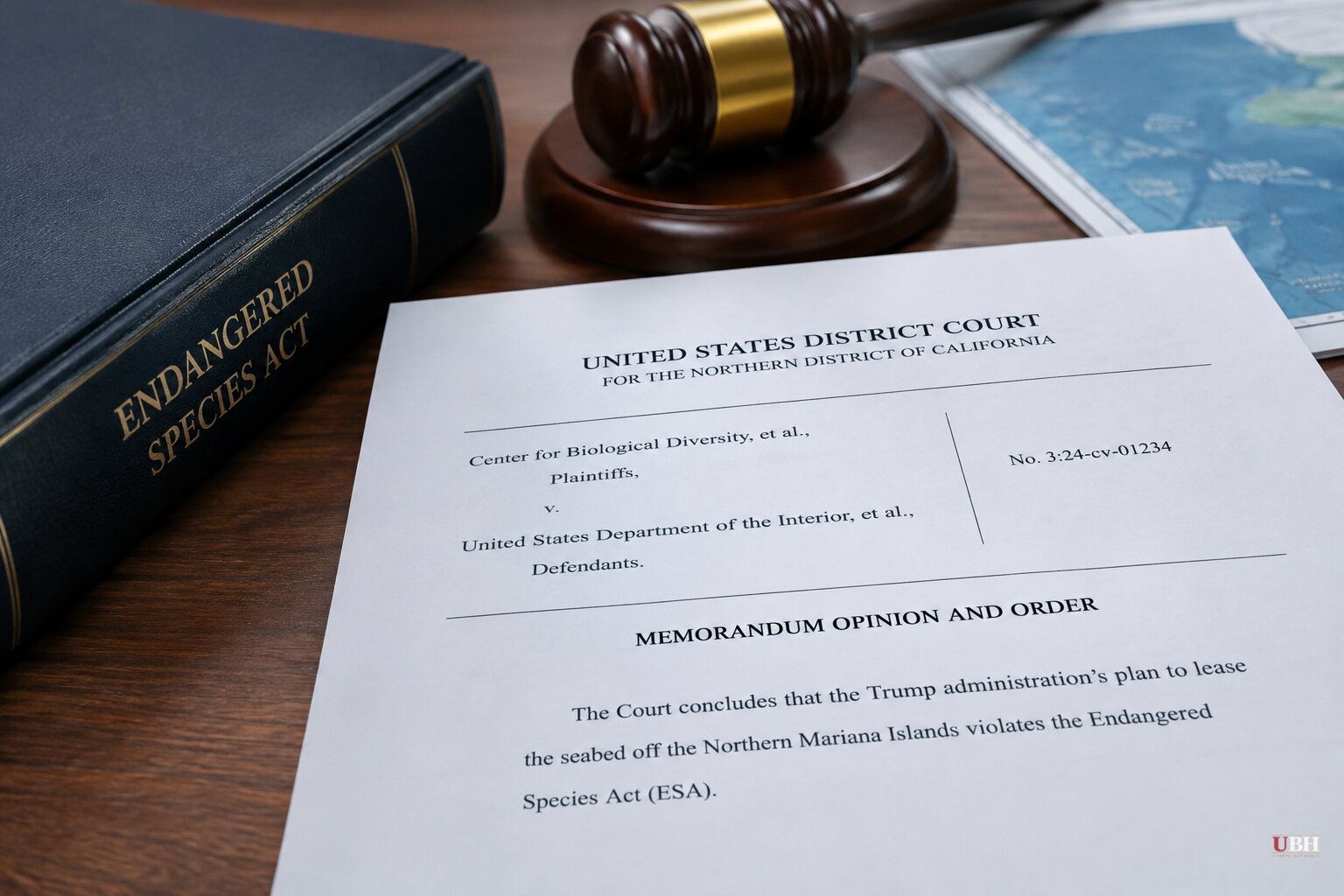
Since the Interior Department sold two deep-sea mining leases off American Samoa on Nov. 19, three days after a federal judge faulted the wildlife review behind them, the administration has taken a second hit in court. A federal judge has now ruled that plans to lease seabed off the Northern Mariana Islands also violated the Endangered Species Act.
Opposition groups that sued over the Northern Mariana Islands plan said they fear deep-sea mining could cause long-term damage to the ocean ecosystem. The ruling was reported Nov. 27.
It follows the same legal logic as the first case.
What the first ruling found
On Monday, Nov. 16, Judge Jill Otake of the U.S. District Court for the District of Hawaii threw out a finding by the National Marine Fisheries Service that the American Samoa lease sale would not likely harm endangered species. Otake is a Trump appointee.
The agency, she wrote, "failed to even attempt to consider the potential effects on ESA-listed species." She called the review "cramped, expedited, informal."
The core problem, in her 41-page order, was scope. The fisheries service reviewed only the lease sale and early survey work, not the mining the leases are meant to enable. "Limiting the agency action here to the lease sale and preliminary activities ignores the reality that the purpose of the leases being sold is eventually to conduct deep-sea mining," she wrote.
She also noted the government effectively conceded at an Oct. 30 hearing that it had no prior example of such a review. The Marine Minerals Administration asked for the quicker informal route, and the fisheries service agreed in February. It issued its letter 10 days after determining it had enough information to begin consultation.
The review covered an area home to several dozen protected species, including blue, fin, sei and sperm whales, sea turtles and five types of coral.
The sale went ahead anyway
The auction was held Thursday, Nov. 19, at the Ventura County Fire Department Headquarters in Southern California. Two areas covering 12.7 million hectares (31.5 million acres) northeast of American Samoa's Manu'a Islands sold for $3 million each, the minimum bid, to Wetstone U.S. Ventures. Two bidders took part, but only Wetstone placed bids, according to the Marine Minerals Administration.
The 20-year leases allow mapping and other preliminary seabed work. They would give Wetstone the exclusive right to mine the areas commercially if further environmental reviews approve it.
The Marine Minerals Administration said in a statement that it had addressed the court's opinion by starting consultation.
Interior Secretary Doug Burgum called the sale "a historic step for America's energy and mineral security." MMA Director Mike Olsen said the action advances the administration's agenda "to advance the responsible development of America's offshore critical mineral resources."
That agenda traces to President Trump's April 2025 executive order, which describes seabed nickel, cobalt, copper, manganese, titanium and rare earths as vital to national security and economic prosperity. The administration has framed the push as a response to China's grip on critical minerals.
The challengers
Earthjustice, which brought the American Samoa case, says the ruling made the auction unlawful. "We will use the full extent of the law to vigorously push for the leases to be voided," attorney Chris Eaton said.
The nonprofit Finafinau filed a petition for an injunction in the Hawaii district court on the eve of the sale. It did not stop the auction.
Founder Sabrina Suluai-Mahuka cited "more than 76,000 public comments, repeated calls for meaningful consultation, and now a federal court ruling that the government violated the Endangered Species Act." American Samoa has its own moratorium on deep-sea mining in its waters and has formally opposed federal proposals to mine the outer continental shelf near the territory.
David Cabrera, who leads a group working to revive Indigenous fishing in Saipan, described the public comment process this way: "When they ask us for public comments, it always feels like we're just screaming at a moving train."
What comes next
The American Samoa leases face three lawsuits, and the court has ordered the fisheries service to assess the mining impacts more thoroughly. Whether the sold leases survive is unresolved.
The Marine Minerals Administration, formed this summer by merging two offshore energy bureaus, is considering further auctions near the Northern Mariana Islands, Virginia and Alaska. The Northern Mariana Islands ruling puts that part of the schedule in legal doubt. What the agency does next there is unclear.
The National Oceanic and Atmospheric Administration is also reviewing permit applications from companies seeking to mine in international waters. No company anywhere has started commercial deep-sea mining.
Sources used for this briefing
7 links from 7 independent newsrooms (syndicated copies of the same report count once)
These are the sources it draws on, linked so you can verify.


