
Unbiased headlines. Facts, not spin.
Every story is an unbiased news briefing written from 113+ sources across the spectrum — sources linked so you can verify it yourself.
 defense
Major Story (7/10)
Event date: September 18, 2026
defense
Major Story (7/10)
Event date: September 18, 2026
US Trade Agency Funds Study for New Undersea Cable That Skips the South China Sea
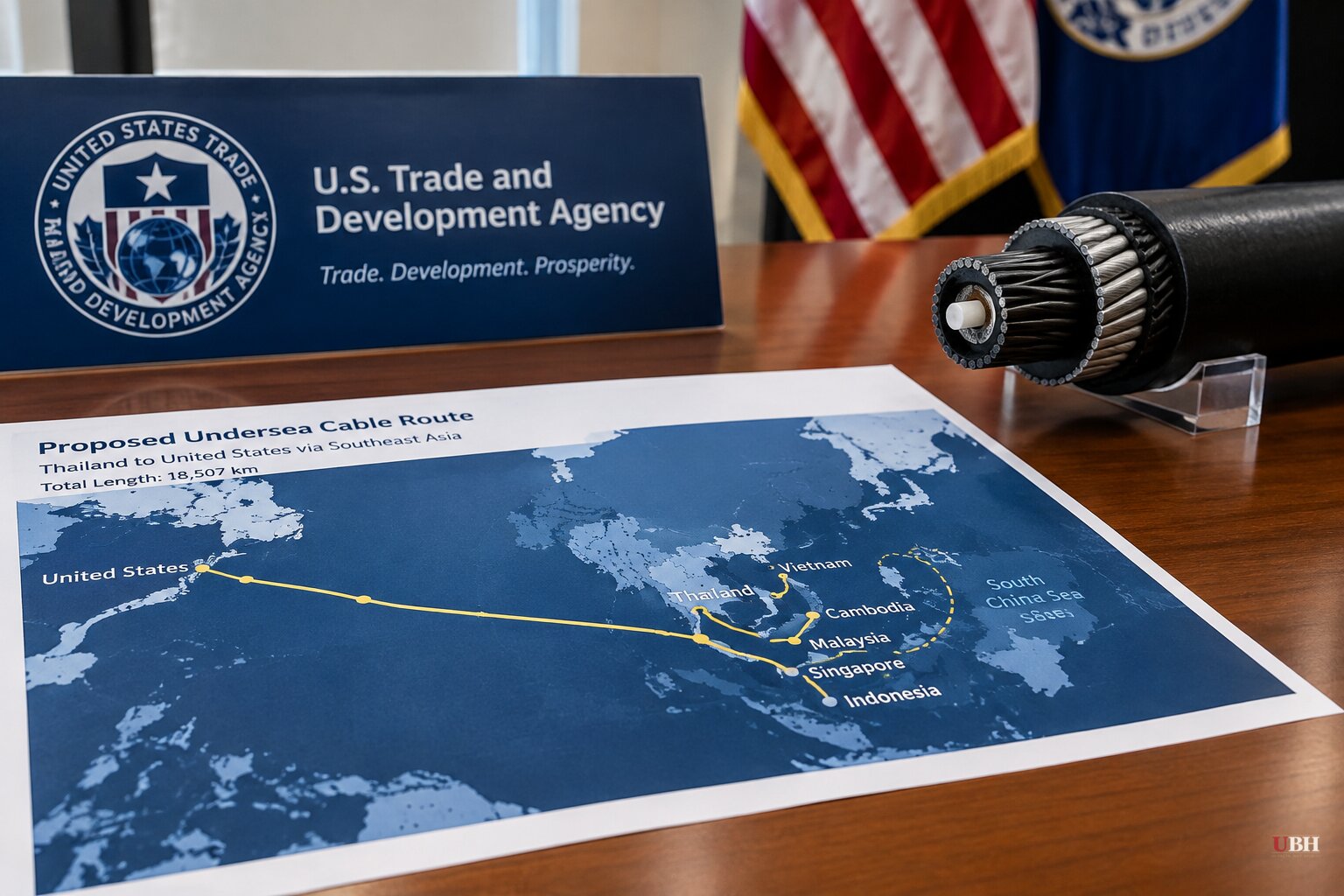
The U.S. Trade and Development Agency announced on Monday, September 14, that it will fund a feasibility study for a new trans-Pacific submarine cable connecting Thailand to the United States, according to Bloomberg and The Japan Times. The project, called the Thailand-US Submarine Cable System, would run up to 11,500 miles (18,507 kilometers) through Indonesia, Malaysia, the Philippines, Singapore and Vietnam. According to USTDA, the design is intended to avoid "the South China Sea and other routes that carry security risks."
The cable would replace the aging Asia-America Gateway, the only current cable directly linking the U.S. and Thailand, built in 2009. That cable is notorious for frequent outages, particularly on the segment near Vietnam between Singapore and Hong Kong, according to Fortune. When it goes down, countries like Cambodia and Malaysia have had few alternatives for rerouting traffic.
"It is only natural that a new cable be built, both for resilience and capacity reasons," Asha Hemrajani, a senior fellow at Singapore's Nanyang Technological University, told Fortune. "The aging AAG has experienced several serious outages."
Why Route Matters
China claims sovereignty over most of the South China Sea, a claim that overlaps with Vietnam, Brunei, Indonesia, Malaysia and the Philippines. Under Chinese domestic regulations, any cable work in what Beijing considers its territorial waters requires prior approval and notification, according to Fortune.
"Subsea cables regularly require maintenance, and if a cable goes down, it needs to be repaired in a time-sensitive manner," Hemrajani said. Operators and insurers prefer routes where repairs don't require navigating a geopolitical dispute.
Muhammad Faizal Bin Abdul Rahman, a research fellow at NTU, pointed to recent history as the backdrop. "The military conflicts in the Middle East and Europe show that geopolitical crises can trigger cyber or physical disruptions to subsea cables," he told Fortune. "The U.S. and its Asia-Pacific allies believe that China could use similar tactics."
Colonel Sanpachai Huvanandana, president of Thailand's state-owned National Telecom Public Company, framed the project around Thailand's own ambitions, telling Bloomberg it will "strengthen the resilience and diversity of our international networks, support the growth of Thailand's data center, cloud, and AI sectors, and expand affordable connectivity."
Fortune's headline describes this as "a $14 billion cable," but that figure, as Bloomberg and The Japan Times both note, actually reflects the aggregate estimated cost of all new undersea cable construction expected between 2025 and 2027, not the price tag of this single project. USTDA has not disclosed an expected cost for the Thailand-US system itself.
Southeast Asia's Balancing Act
The cable is one piece of a broader U.S. push. The week before the announcement, USTDA also announced support for expanding port facilities at Subic Bay in the Philippines, building a nationwide public Wi-Fi network there, and developing LNG and nuclear projects to lower electricity costs, according to The Japan Times.
But the region isn't uniformly lining up behind Washington. Singapore joined the U.S.-led Pax Silica alliance in December while reportedly weighing an invitation to join China's World Artificial Intelligence Cooperation Organization. The Philippines has joined Pax Silica; Cambodia, Indonesia, Laos, Malaysia and Myanmar have joined China's bloc, per Fortune.
"Southeast Asian countries need to re-evaluate what neutrality means today for each of them, and how policy decisions across sectors collectively determine whether they are too dependent on any major power during times of peace or crisis," Muhammad said. Smaller nations face a real constraint: picking infrastructure partners increasingly means picking a geopolitical lane, whether they want to or not.
The Tension Driving the Urgency
The cable announcement lands against a backdrop of escalating friction in the exact waters the new route avoids. On Friday, September 18, the Chinese Coast Guard rammed a Philippine Bureau of Fisheries and Aquatic Resources vessel roughly 54 nautical miles off the Philippine coast, according to the Daily Wire. The vessel, on a fuel resupply mission for a fishing expedition, suffered deck and railing damage; no injuries were reported.
Philippine Coast Guard spokesman Jay Tarriela said the Chinese vessel carried out a series of dangerous maneuvers before striking the BFAR ship. A Chinese Coast Guard spokesman gave a different account, claiming the Philippine vessel ignored "solemn warnings" and "cut across the bow" of the Chinese ship, warning Manila to "immediately cease all acts of infringement and provocation." The two sides dispute who caused the collision, and no independent investigation result is cited in either account.
A State Department spokesman told the Daily Wire that a 2016 arbitral tribunal ruling found China's expansive South China Sea claims have no basis in international law and is "final and legally binding on both China and the Philippines." China has not accepted that ruling.
The collision came roughly two weeks after a defense conference in South Korea where Philippine Defense Secretary Gilberto Teodoro publicly criticized China after a Chinese military official sent what the Daily Wire described as a provocative letter to him.
President Trump is scheduled to host Chinese President Xi Jinping at the White House this Thursday. Whether the South China Sea confrontations or the new cable project come up in that meeting remains to be seen, and neither the Chinese nor American government has previewed the agenda publicly.
Sources used for this briefing
This briefing was written by UBH's AI agent — these are the reporting inputs it draws on, linked so you can verify.


