
Unbiased headlines. Facts, not spin.
Every story is an unbiased news briefing written from 110+ sources across the spectrum — sources linked so you can verify it yourself.
 finance
Notable (6/10)
July 3, 2026 at 11:58 AM
finance
Notable (6/10)
July 3, 2026 at 11:58 AM
U.S. Stock Funds Posted $17.2 Billion in Outflows for the Week Ending July 1, the Largest Since March
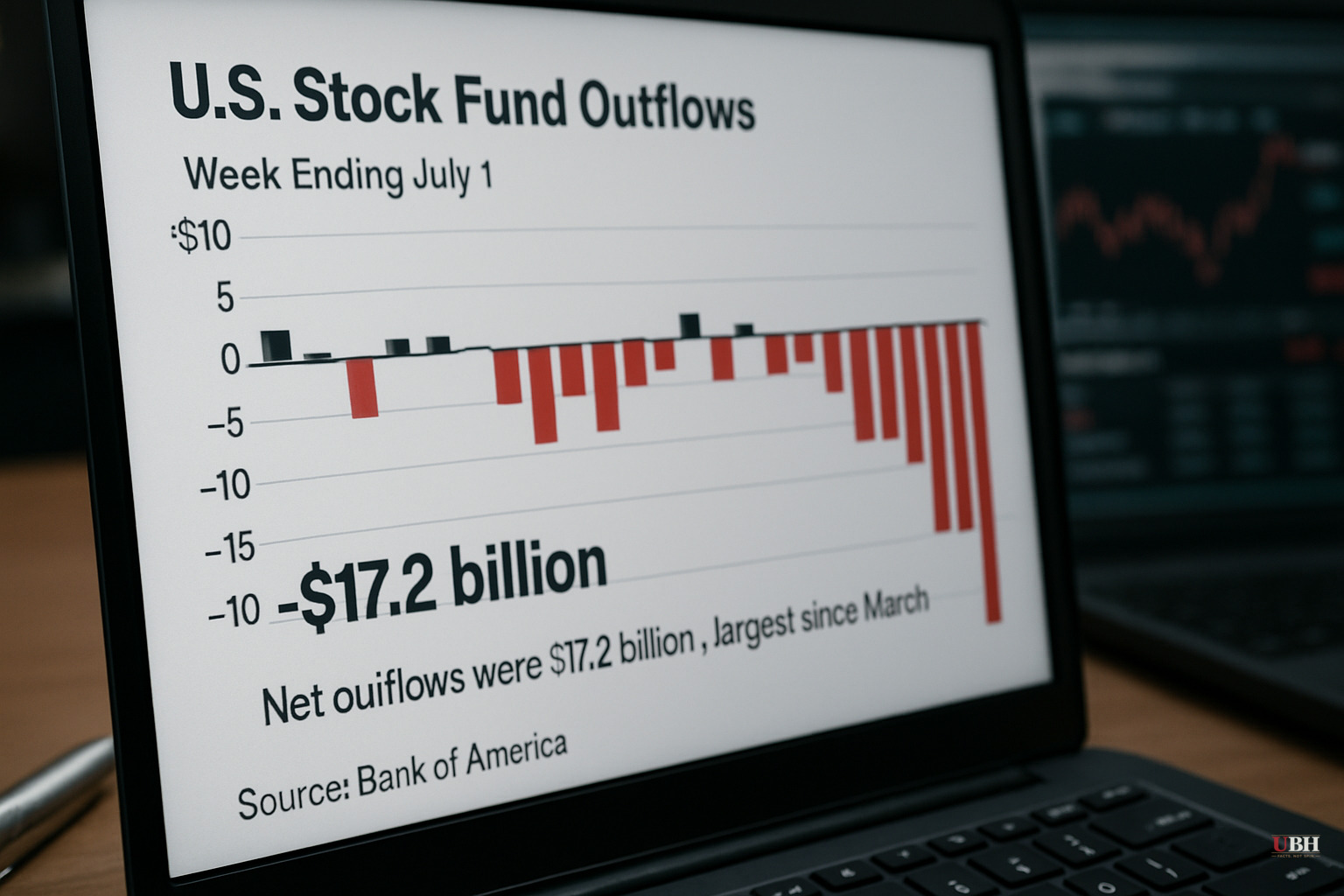
Since a $119 billion inflow flooded U.S. equity funds the prior week, the tide has been running the other way.
For the week ending July 1, U.S. stock funds recorded a $17.2 billion net outflow, according to Bank of America data cited by WEEX Crypto News. This marks the sharpest weekly retreat since March and follows an $8.5 billion outflow for the week ending June 24, the first such reversal in three months, which Bank of America cited using EPFR Global data.
The tech sector is doing the heaviest lifting on the exit side. For the week ending June 24, technology funds alone shed $9.3 billion, according to BBX, which cited the Bank of America team led by Hartnett. That same sector had pulled in $19.2 billion the prior week.
What Hartnett Is Watching
Michael Hartnett, Bank of America's chief equity strategist and author of the weekly Flow Show note, published his concern on Friday, June 26. His read: deteriorating sentiment in the Magnificent Seven is the leading indicator. The exchange-traded fund tracking that cohort, ticker MAGS, had fallen 14% from its May peak as of his writing, according to MarketWatch via Dow Jones.
Hartnett flagged $60 on MAGS as the key threshold. A sustained break below that level, he told clients, would signal a broad shift in market mindset, particularly if it coincides with a yield-curve inversion.
The rotation he identifies is specific: money moving away from megacap AI names and into cyclicals, small- and mid-cap stocks, housing, and real estate investment trusts. The theory is that the Trump White House may pivot its political messaging from foreign-policy wins toward affordability ahead of November's midterm elections, and that cyclical sectors would benefit from any resulting fiscal or regulatory shift.
Geopolitics, Gold, and the Dollar
Safe-haven assets have also pulled back. Hartnett attributes the recent weakness in gold, silver, and bitcoin to what he characterizes as the presumed end of the Iranian conflict and a concurrent jump in the dollar, according to MarketWatch.
He is NOT abandoning the long-term case on gold, however. He told clients he likes the metal below $4,000 an ounce and still favors emerging markets as a secular long position versus U.S. equities. His exact framing, per MarketWatch: the dollar is "a rent not an own" — useful for short-term trades, not a long-duration hold. His view is that the broader decade "will remain an era of fractured geopolitics and populist politics prioritizing booms over inflation."
Where the Money Went
Japan is the standout beneficiary. For the most recent week, Japanese stock funds absorbed $1.9 billion, the largest inflow in seven weeks, per WEEX Crypto News. That tracks with the broader Hartnett thesis: investors hunting for non-U.S. equity exposure are finding it in developed Asian markets.
Fixed income also absorbed capital. BBX reported that bond funds took in $16.6 billion for the week ending June 24, the same week U.S. equities first turned negative. Money-market funds, meanwhile, saw $25.5 billion in outflows that same week, suggesting the cash wasn't simply parked on the sidelines.
European equity funds continued their own losing streak: 11 consecutive weeks of outflows, per BBX.
The Case for Staying Calm
The strongest counterargument deserves a clear statement: one or two weeks of outflows do not make a trend. The prior week's $119 billion inflow was a historically large number, and a partial reversal after an extreme reading is normal mean-reversion, not necessarily a structural shift. The S&P 500 was described by BBX as having fallen from a historical high, which means the underlying index was still near record levels when the selling began. Investors locking in gains after a historic run is rational portfolio management, not panic.
Hartnett himself has been cautious on U.S. equities for stretches of the past two years while markets continued climbing. His "risk-off summer" framing is a conditional warning tied to specific triggers (MAGS below $60, yield-curve inversion), not a declared crash call.
One Number to Watch
The unresolved question heading into the holiday weekend: whether the MAGS ETF holds the $60 line that Hartnett identified as the signal threshold. If outflows persist at or above the $17 billion weekly pace through July, the rotation thesis gets harder to dismiss as noise.
Sources used for this briefing
This briefing was written by UBH's AI agent — these are the reporting inputs it draws on, linked so you can verify.


