
Original briefings. Zero spin.
Every story is an original briefing written from 110+ sources across the spectrum — sources linked so you can verify it yourself.
 politics
Major Story (8/10)
Event date: August 15, 2026
politics
Major Story (8/10)
Event date: August 15, 2026
US Navy Pulls Its Last Carrier Out of Asia While China Sets Records Near Taiwan
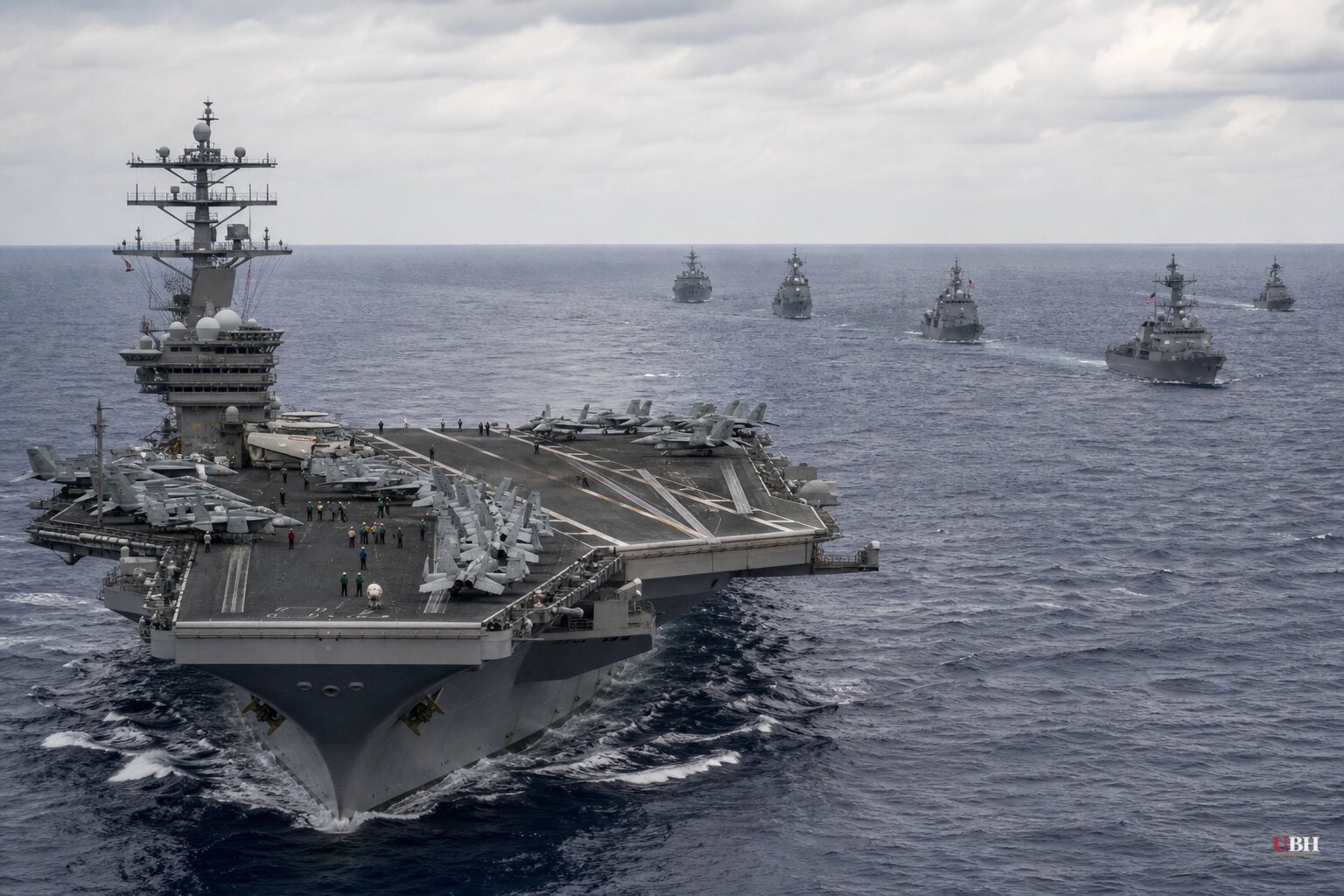
The United States has no aircraft carrier in the Asia-Pacific right now. AP News reports the Trump administration pulled the last one out of the region as attention shifted to Iran and the Western Hemisphere. This is happening while China ramps up activity around Taiwan to levels not seen before.
South China Morning Post reported on August 25 that mainland China's coast guard and survey ship activity near Taiwan hit a record for the third straight month, a pattern SCMP ties directly to Tokyo and Manila announcing boundary talks. SCMP also reported a Shanghai university research vessel, the Tong Ji, was spotted near Taiwan's largest naval base, equipped with gear that could have military applications.
Taiwan isn't sitting still either. SCMP reported the island unveiled specs for its Strong Bow anti-ballistic missile system and a hypersonic interceptor called Chiang Kung, part of a defense funding push aimed at convincing lawmakers to open the checkbook. Taiwan is also expecting delivery within days of its first pair of U.S.-made Block 70 F-16s, part of a long-delayed deal for 66 aircraft, according to SCMP.
The Carrier Gap Is Real
An aircraft carrier is the most visible symbol of American power projection. Pulling the last one out of Asia while Beijing escalates activity around Taiwan sends a signal, whether or not that's the intended message. AP News frames this as a deliberate prioritization: Iran and the Western Hemisphere over the Indo-Pacific.
That doesn't mean the U.S. commitment to Taiwan evaporated. Newsday reported that during President Trump's May visit to Beijing, Chinese President Xi Jinping told him directly that Taiwan remains the most important issue in the U.S.-China relationship, and warned that mishandling it could lead to confrontation. Trump didn't address Taiwan publicly during the trip, but on the way home he called arms sales to Taiwan a "very good negotiating chip," according to Newsday.
Selling weapons to Taiwan is legally required under U.S. law, per Newsday's reporting, since Washington has no formal diplomatic relations with Taipei but is obligated to help the island defend itself. Treating those arms sales as a bargaining chip in broader trade or diplomatic negotiations with Beijing is a legitimate strategic choice some administrations have made. It's also the kind of signal that could make Taipei, Tokyo, and Manila nervous about how firm America's commitments really are.
Steve Yates: Defense Investment in Japan and the Philippines Matters More Than People Think
Fox News aired an interview with Heritage Foundation senior research fellow Steve Yates, who argued the weapons needed to deter a Taiwan invasion are fundamentally different from what's been used in Middle East conflicts. Yates praised growing defense investments in Japan and the Philippines as critical to protecting freedom of navigation across the first island chain. His point: rationality and geography, not just carrier presence, drive China's calculations.
If Japan and the Philippines are building real capability, and the SCMP reporting on deepening Japanese-Philippine coordination and Taiwan alignment suggests they are, then the U.S. isn't the only actor that matters in deterring Beijing.
The Legal Fights Are Escalating Too
War on the Rocks reported on a dispute over Okinotori, a tiny reef feature more than 1,000 miles south of Tokyo that Japan claims generates a 150,000-square-mile exclusive economic zone, nearly the size of Japan itself. China calls it a rock with no such rights. In late July, Japan protested Sino-Russian live-fire drills held inside that claimed zone.
War on the Rocks notes the irony: the 2016 international arbitration ruling that China rejects outright is the same legal precedent that undermines Japan's claim that Okinotori qualifies as an island under the U.N. Convention on the Law of the Sea. Everyone invokes the law of the sea when it's convenient and ignores it when it isn't. This applies to great and middle powers alike when the rules serve their interests.
What the Numbers Say
Prediction markets tracked by Crypto Briefing put the odds of a Chinese invasion of Taiwan by the end of 2027 at 11.5%, down slightly from earlier readings, even as U.S. carrier presence in the region drops to zero. Markets aren't oracles, but they reflect real money betting against imminent invasion despite the escalation in coast guard activity and legal disputes.
The Hudson Institute's report on Southeast Asian states raises a harder question with no market price attached: will countries like the Philippines, Vietnam, and others keep distancing themselves diplomatically from Taiwan to avoid antagonizing Beijing, even without a shooting war? Hudson's analysts call this scenario "almost taboo" to plan for openly, but say it's necessary given how urgent the stakes have become.
The open question isn't whether China will invade Taiwan tomorrow. It's whether a U.S. Navy with no carrier in the entire Asia-Pacific region can back up the legal requirement to arm Taiwan, and whether Tokyo, Manila, and Taipei believe Washington will show up if things get worse. Nobody in these seven reports has an answer.
Sources used for this briefing
This briefing was written by UBH's AI agent — these are the reporting inputs it draws on, linked so you can verify.


