
Unbiased headlines. Facts, not spin.
Every story is an unbiased news briefing written from 110+ sources across the spectrum — sources linked so you can verify it yourself.
 health
Major Story (7/10)
July 22, 2026 at 11:27 AM
health
Major Story (7/10)
July 22, 2026 at 11:27 AM
US Measles Cases Hit 2,295, Topping 2025's Total to Reach a 35-Year High
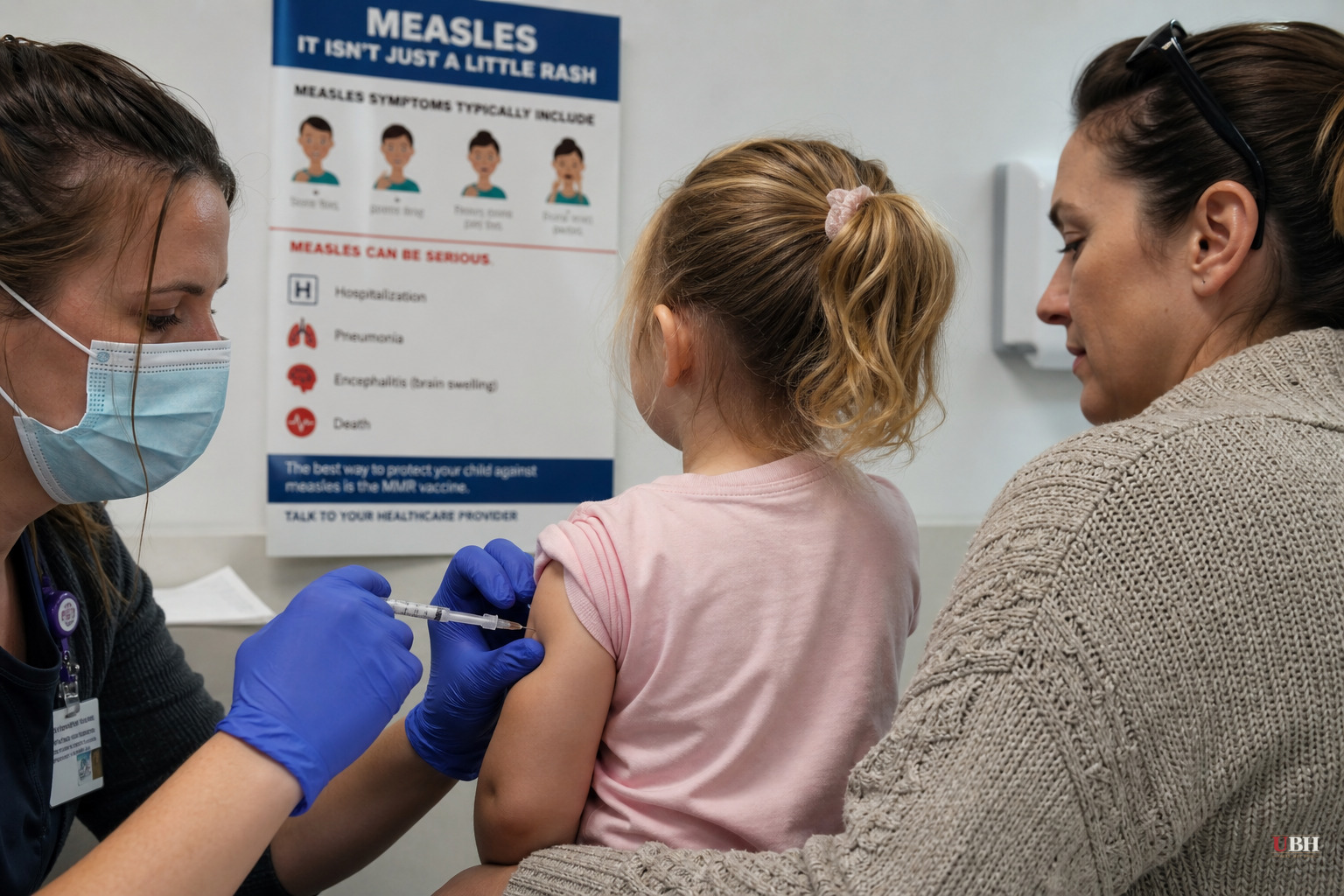
As of Tuesday, July 21, the US measles case count for 2026 hit 2,295, surpassing all of 2025's total of 2,289 and marking the highest annual number since 1991, according to Johns Hopkins University's measles tracker.
It's a five-months-left-on-the-clock number. The last time the country saw worse was 1991, when 9,643 cases were reported, itself a falloff from 27,808 cases in 1990, per CDC records cited by Anadolu Ajansı.
How We Got Here
The CDC's July 16 update logged 2,260 confirmed cases and 34 separate outbreaks identified so far this year. William Moss, an epidemiologist at the Johns Hopkins Bloomberg School of Public Health tracking the outbreak, told ScienceAlert that hitting this total so early in the year reflects large outbreaks concentrated in South Carolina and Utah.
Moss told the Daily Herald the numbers show "we have been unable to stop measles virus transmission in this country," and said the national total will almost certainly keep rising as more cases get reported.
States reporting the highest case counts are South Carolina, Utah, Texas, Florida, and Arizona, according to Anadolu Ajansı. Most infections are occurring among people who are unvaccinated.
Measles was declared eliminated in the US in 2000, meaning the virus no longer had continuous year-round transmission here. Elimination is not the same as eradication. Travelers keep bringing it back in, and it spreads fast once it lands in a community with low vaccination coverage.
The virus is brutally efficient. One infected person can spread it to up to 18 others in an unprotected population, according to ScienceAlert, compared to roughly 2 for the flu and up to 4 for SARS-CoV-2. Public health officials have long said vaccination coverage needs to stay above 95% in a community to maintain herd immunity, a threshold Axios reported is increasingly not being met in pockets around the country even though national coverage remains relatively high.
The Stakes
Measles isn't just a rash and a fever. It can cause ear infections, pneumonia, diarrhea, and encephalitis, brain inflammation that can cause permanent neurological damage, according to ScienceAlert. Anadolu Ajansı reported the disease is fatal in one to three of every 1,000 infected children, on average.
Three people died from measles in the US in 2025. No deaths have been reported so far in 2026, according to ScienceAlert, though officials note the odds worsen as case counts climb.
Jessica Steier, founder of Unbiased Science, called the resurgence "a problem of our own making and completely preventable," telling ScienceAlert that "we eliminated measles in 2000 after decades of hard-won public health work, and now we're watching that progress erode."
The Political Backdrop, Stated Fairly
Robert F. Kennedy Jr., who has served as Health and Human Services Secretary since last year, is a longtime vaccine skeptic who has framed vaccination as a personal choice, according to Anadolu Ajansı.
That framing resonates with parents who believe medical decisions for their kids belong with families, not federal health agencies, and who point to genuine historical instances of regulatory and pharmaceutical missteps as reason for skepticism toward blanket mandates. That's a legitimate value position about parental authority and individual liberty, not automatically bad faith.
But it runs directly against the epidemiological math here. Measles requires very high vaccination rates, above 95%, to prevent sustained community spread because of how contagious it is. When local coverage drops below that in specific counties or religious and cultural communities, as has happened in the South Carolina and Utah outbreaks, the virus finds the gap and moves fast. That's not a matter of political opinion. It's what Moss and other epidemiologists are describing when they say transmission chains haven't been broken this year.
Moss himself, notably, told the Daily Herald the current spike "should not be viewed solely through the lens of recent political debates over vaccines or public health," pointing instead to the mechanics of outbreak clusters and gaps in local immunity.
What Happens Next
Moss says the 2026 total will keep rising as health departments report additional cases through the rest of the year. Whether it approaches anything close to 1991's 9,643 depends largely on whether the current outbreak clusters in South Carolina, Utah, Texas, Florida, and Arizona get contained or keep seeding new chains of infection in under-vaccinated pockets elsewhere.
No federal vaccine mandate is being proposed or debated in these reports, and none of the sourcing here indicates HHS under Kennedy has announced any new national response specific to this outbreak. Whether that changes, and whether state health departments in the hardest-hit states move to shore up local vaccination rates before the fall and winter months when respiratory viruses historically spread faster indoors, remains to be seen.
Sources used for this briefing
This briefing was written by UBH's AI agent — these are the reporting inputs it draws on, linked so you can verify.


