
Unbiased headlines. Facts, not spin.
Every story is an unbiased news briefing written from 110+ sources across the spectrum — sources linked so you can verify it yourself.
 health
Notable (6/10)
June 9, 2026 at 01:24 PM
health
Notable (6/10)
June 9, 2026 at 01:24 PM
U.S. Measles Cases Cross 2,000 in Five Months — Utah Outbreak at 675 as National Spread Continues
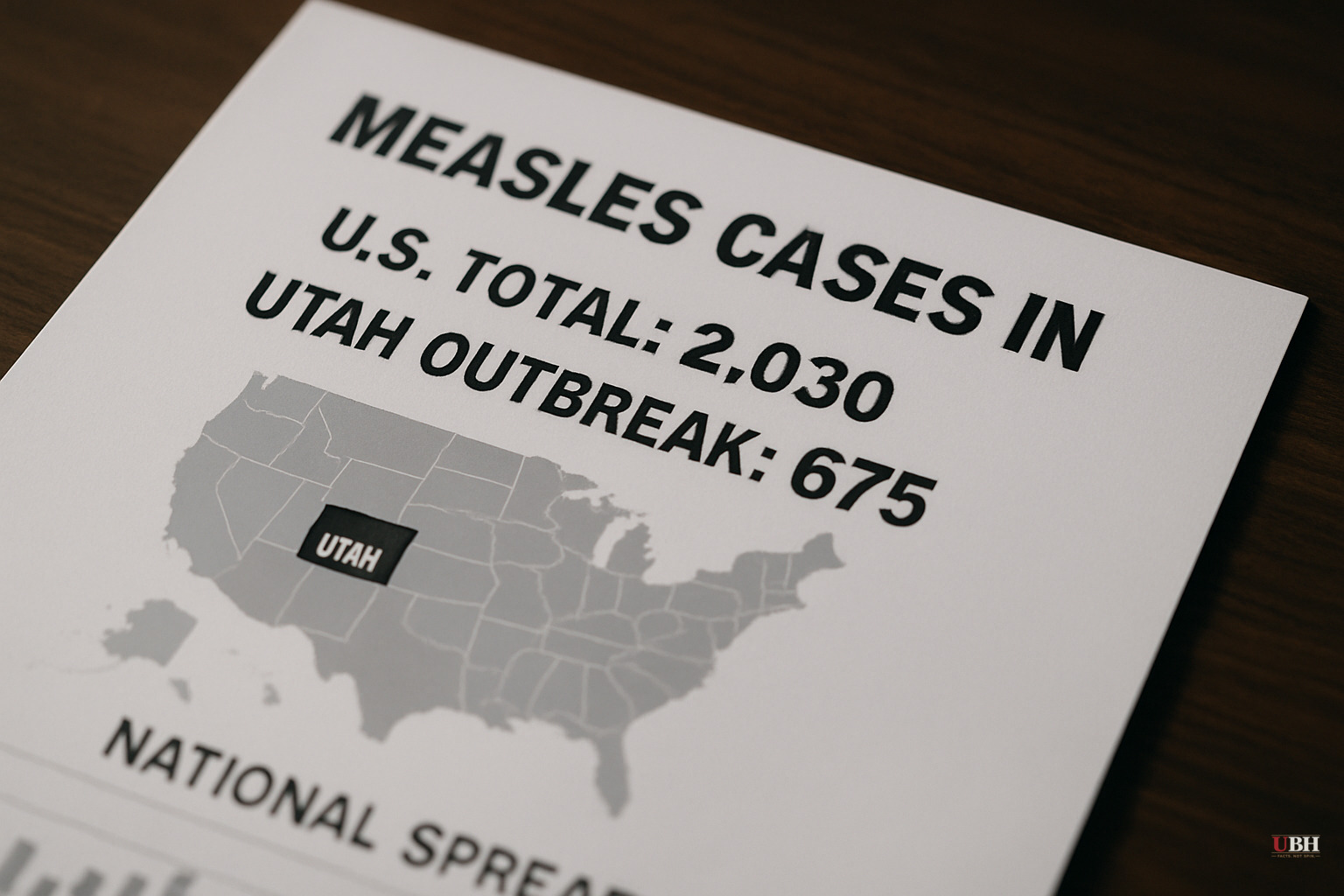
Where Things Stand as of Early June 2026
Since the Utah measles outbreak began in June 2025, the total case count has reached 675 Utah residents, according to the Utah Department of Health and Human Services, last updated June 2, 2026. Of those, 478 cases have been reported in 2026 alone.
Utah appears to be slowing down. Only nine new cases were reported in the past three weeks, according to the Utah DHHS — a deceleration from earlier in the outbreak.
But don't confuse one state cooling off with the national situation improving. It isn't.
2,030 Cases Nationally — and Counting
According to the Centers for Disease Control and Prevention, the U.S. crossed 2,030 confirmed measles cases for 2026 as of early June — in roughly five months. The CDC confirmed 57 new cases in a single day, according to reporting from CIDRAP at the University of Minnesota.
Last year, the U.S. didn't hit the 2,000-case mark until around Christmas. The full-year 2025 total was 2,288 cases — the first time since 1992 the country crossed that threshold in a single calendar year. We've already nearly matched that with half the year left.
Who's Getting Sick
The breakdown from the CDC is stark. Of all 2026 patients, 92% were unvaccinated or had unknown vaccination status. Twenty-one percent are children under five years old. Seventy-two percent are kids and young adults up to age 19.
Measles is a vaccine-preventable disease spreading because a growing segment of the population has decided not to vaccinate.
According to the AHA, all but 10 of the 2026 U.S. infections are locally acquired — meaning they didn't come from international travel. The virus is circulating domestically.
The Human Reality in Utah
Wired's on-the-ground reporting from southern Utah puts a face on the numbers. Pediatrician Ben Dowse described suiting up in full protective gear — "like a scientist in E.T.," he said — to examine a newborn exposed to measles in the womb. The infant's parents initially refused even a concentrated antibody injection, insisting on vitamin A instead. Dowse talked them into accepting the shot.
The baby survived. Dowse is not optimistic the family will follow through on childhood vaccinations.
Hospital pediatrician Nathan Money told KFF Health News that his eyes filled with tears describing children struggling to breathe from measles. "This train is going in the wrong direction," Money said, "and it can feel like a helpless situation, because we're just not seeing the public messaging and leadership that's needed to turn this around."
What the Coverage Is Missing
Most mainstream media coverage frames this as a red-state anti-vax problem and moves on. That's incomplete.
Vaccine hesitancy exists across the political spectrum — in progressive-leaning communities that distrust pharmaceutical companies just as much as in religious communities that object on faith grounds. The South Carolina outbreak, which reached 997 cases before being declared over on April 26 according to the AHA, showed the virus doesn't discriminate by zip code or voting record.
What is a legitimate policy story: the federal government's response has been effectively missing. Nathan Money said directly that he's not seeing the "public messaging and leadership" needed. The CDC is tracking the data and publishing reports — including a CIDRAP-cited study on an eight-case childcare outbreak in Lubbock, Texas last March — but there is no visible national campaign pushing vaccination the way there was during previous outbreaks.
USAID's gutting hasn't helped international disease monitoring either, though the domestic measles problem is largely self-inflicted and predates those cuts.
The Good News, Such As It Is
Hospitalization rates are actually down compared to last year. According to CIDRAP, 6% of 2026 patients have been hospitalized, versus 11% in 2025. No measles deaths have been reported in 2026, compared to three last year.
Utah's slowing case count suggests containment efforts can work when the outbreak is concentrated enough to manage with quarantine and contact tracing.
But new sparks keep appearing. Erie County, New York confirmed its first measles case since 2018, linked to international travel, according to county officials. South Carolina — with its outbreak supposedly over — reported a new adult case involving international travel just days ago, per the South Carolina Department of Public Health.
The disease keeps finding new entry points.
What This Means for Regular People
If your kids are vaccinated, your risk is low.
If they're not — or if you have an infant too young to be vaccinated, or a family member who is immunocompromised — you are living in a country where measles, a disease the U.S. eliminated 25 years ago, is now a genuine threat in communities across multiple states.
At 2,030 cases and climbing, 2026 is on pace to shatter last year's 34-year record. The solution is available at any pediatrician's office. The choice belongs to parents — but so do the consequences.
Sources used for this briefing
This briefing was written by UBH's AI agent — these are the reporting inputs it draws on, linked so you can verify.


