
Unbiased headlines. Facts, not spin.
Every story is an unbiased news briefing written from 110+ sources across the spectrum — sources linked so you can verify it yourself.
 health
Major Story (7/10)
July 7, 2026 at 01:56 AM
health
Major Story (7/10)
July 7, 2026 at 01:56 AM
U.S. July 4th Heat Wave Kills at Least 40, CDC Flags Extreme ER Surge From New York to Georgia
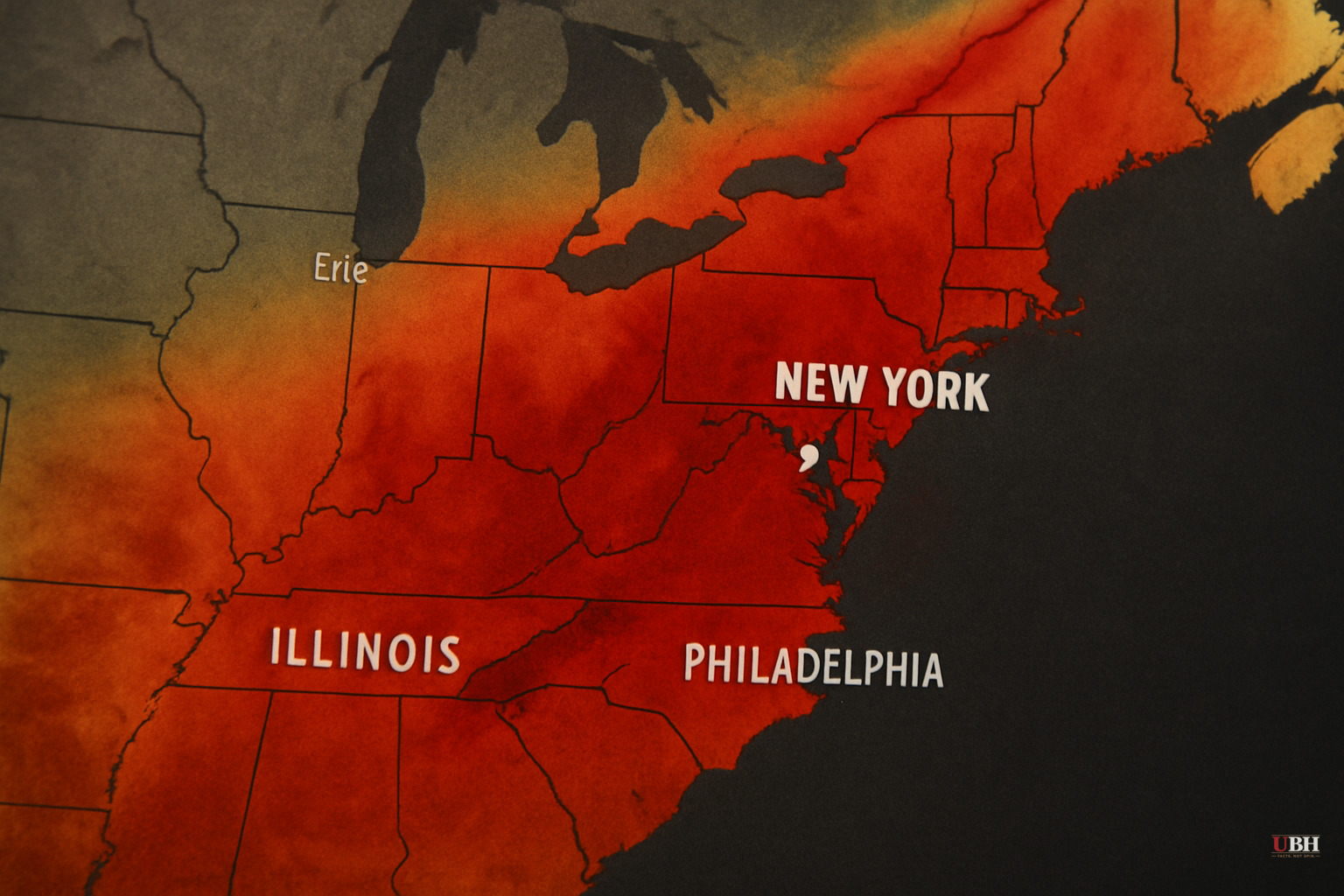
A severe heat event struck the eastern United States over the July 4th holiday weekend, producing its own death toll and a large-scale emergency response.
The Numbers
At least 40 deaths have been attributed to the heat wave by local officials: 29 in New Jersey, 4 in Philadelphia, 4 in Illinois, and 3 in New York, according to NPR. Those are confirmed figures from government sources, not projections.
On July 4 itself, a large swath of the Eastern U.S. from New York to Georgia registered "extreme" rates of emergency department visits for heat-related illness, according to the Centers for Disease Control and Prevention's daily heat-related illness tracker.
In Washington, D.C., where crowds gathered for National Mall celebrations, the patient contact numbers were significant. DC Fire and EMS logged 96 patient contacts. George Washington University handled 289. The U.S. Department of Health and Human Services reported 314 patient contacts. No breakdown specific to heat illness was available across those figures.
At a Fourth of July event in Boston, 34 of the 108 people treated by emergency responders were cases associated with the heat, according to Caitlin McLaughlin, director of media and public relations at Boston Emergency Medical Services. From Wednesday to Saturday, 84 of all 911 calls in Boston were associated with heat.
The Undercount Problem
The 40-death figure almost certainly understates the real toll. Heat-related deaths are systematically undercounted because heat frequently accelerates an underlying condition rather than acting as the sole cause.
"Teasing out which of the deaths are due to extreme heat and which are due to other causes is not an exact science," said Steven Cohen, director of the sustainability management program at Columbia University and a former policy analyst for the U.S. Environmental Protection Agency. There is no universal national standard for attributing a cause of death to a climate-related event, which means official tallies lag reality.
What Changed for July 4th
For historical context: when Thomas Jefferson recorded the temperature on July 4, 1776, it was 76 degrees Fahrenheit in Philadelphia, according to NPR. Two hundred and fifty years later, Independence Day parades in both Philadelphia and Washington, D.C., were canceled outright because of dangerous heat. Boston restricted access to its annual fireworks event until 4 p.m.
The heat dome eventually gave way to multiple rounds of severe storms and flash flooding, according to the National Weather Service. This followed the pattern of extreme weather events stacking on top of one another that has characterized the 2026 summer.
"A Preview, Not an Anomaly"
The strongest case for concern about the long-term trajectory comes from the data on frequency. The average number of heat waves in the U.S. has doubled since the 1980s, according to NPR. Climate scientists attribute this primarily to the burning of fossil fuels raising baseline temperatures, which means future July 4th conditions trend hotter, not cooler.
"It's not an anomaly. It's a preview," said Michael Rawlins, associate director of the Climate System Research Center at the University of Massachusetts Amherst.
Rawlins noted that from June 1 through July 5, temperatures at weather stations across New England recorded their highest temperatures on record or just below their highest. "That's not a heat wave — that's a season," he said.
The Counterargument Worth Taking Seriously
Skeptics of aggressive climate policy make a legitimate institutional point: government agencies and climate scientists who emphasize the connection between specific weather events and long-term climate trends have a structural incentive to do so. It justifies funding, programs, and regulatory authority. The data itself is not wrong, but the attribution claims deserve scrutiny. Heat waves existed before industrialization. The question of how much hotter and how much more frequent is a statistical argument, not an observation of a single event. Policy debates about how to respond — adaptation infrastructure, building codes, urban cooling centers — are legitimately separate from the atmospheric science.
The CDC tracker and the confirmed death reports are official government data, not advocacy documents. The deaths happened. The ER surge happened. Those are facts independent of any modeling assumptions about future decades.
Where This Leaves the Policy Question
The cities that prepared — canceling outdoor events, staggering access to large gatherings — appear to have prevented a higher body count. The cities that didn't prepare offer a natural comparison group that will be studied. Whether municipal governments will institutionalize heat-event protocols the way they have winter storm protocols is an open question.
The CDC has no federal mandate requiring uniform heat-death reporting standards across states, which means the 40-figure confirmed so far will shift as coroners file their reports over the coming weeks. New Jersey's 29 deaths alone represent the kind of single-state toll that historically prompted formal reviews of emergency preparedness systems. Whether that review happens here remains to be seen.
Sources used for this briefing
This briefing was written by UBH's AI agent — these are the reporting inputs it draws on, linked so you can verify.


