
Unbiased headlines. Facts, not spin.
Every story is an unbiased news briefing written from 110+ sources across the spectrum — sources linked so you can verify it yourself.
 finance
Major Story (7/10)
June 15, 2026 at 03:07 AM
finance
Major Story (7/10)
June 15, 2026 at 03:07 AM
US-Iran Peace Framework Sends Global Bonds Rallying and Crude Oil Tumbling
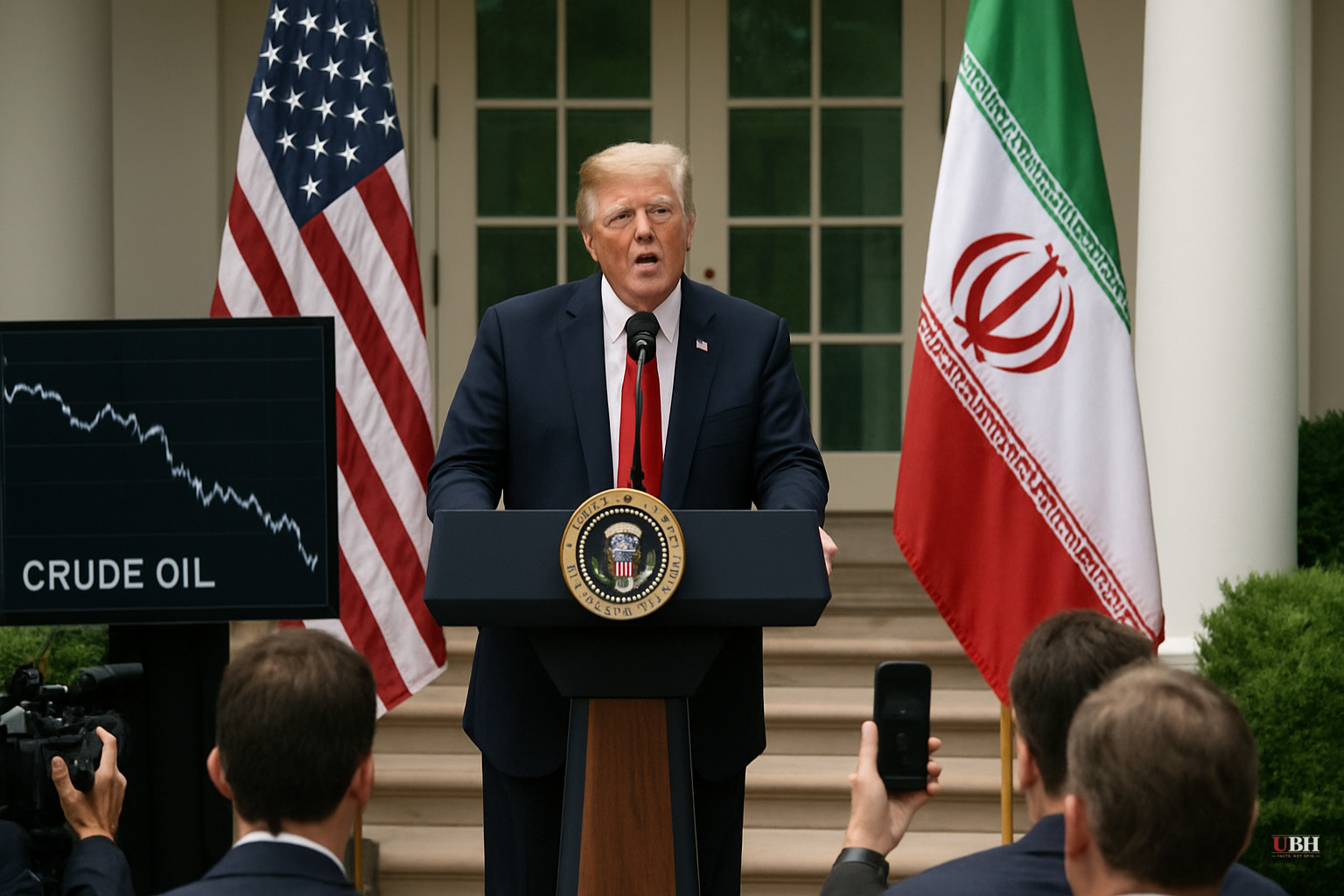
Since Trump's June 11 social media post and subsequent White House remarks, global markets have been repricing geopolitical risk at a rapid clip.
Trump's exact words, according to BigGo Finance: "The United States and Iran have reached a significant settlement regarding the war and will finalize the documentation in the coming days." He also indicated he would forgo a military strike. That was enough to move markets across multiple asset classes simultaneously.
What moved and by how much
On June 11, the 10-year US Treasury yield plunged more than 9 basis points, according to BigGo Finance. Japanese government bond yields followed on June 12, with the benchmark 10-year JGB yield dropping 0.040 percentage points to 2.640%, per the same source. The mechanism was straightforward: if the Strait of Hormuz reopens and Iranian crude returns to global supply, inflation fears ease. Bonds are the direct beneficiary.
Equities followed the same logic. According to Live Mint, the S&P 500 gained 0.50% on Friday to close at 7,431.46, the Dow Jones added 353.51 points (0.70%) to 51,202.26, and the Nasdaq closed up 0.31% at 25,888.84. For the full week, all three major US indexes surged roughly 7%, per Live Mint.
Asia piled on Monday. Japan's Nikkei 225 rallied 3.51%, South Korea's Kospi jumped 4.00%, and India's Nifty 50 was signaling a strong gap-up open via Gift Nifty futures at roughly 23,982, a 296-point premium over the previous close, also according to Live Mint.
The bond market's reservations
However, some signals suggest caution. BigGo Finance noted a weak 30-year US Treasury auction and positioning in US rate futures that still prices in an additional rate hike by year-end. Those two signals suggest the bond market isn't fully convinced inflation is beaten, even with oil falling. A framework announcement is not a signed treaty, and supply through the Strait of Hormuz won't normalize until ships are actually moving.
The strongest counterargument
Skeptics of this rally have a legitimate case. Trump has announced deals before they were finalized, and the gap between a social media declaration and a legally binding agreement with Iran is substantial. Iranian domestic politics, hardliner factions, verification mechanisms, and sanctions relief terms are all unresolved. A rally built on a framework that falls apart is a rally that gives back every point. The bond market's weak 30-year auction is one sign that not everyone is positioning as if this is a done deal.
That concern is real. As of June 14, it remains unresolved. The markets are pricing probability, not certainty.
What's driving the bond move in Japan specifically
One market participant quoted by BigGo Finance framed it precisely: reopening the Strait of Hormuz "will push down Japan's import prices through the normalization of global supply chains." Japan imports nearly all of its energy. Lower crude prices reduce corporate cost burdens and ease consumer price inflation, which in turn supports the Bank of Japan maintaining a gradual pace of monetary policy normalization. Slower BOJ tightening means less upward pressure on JGB yields — hence the rally in Japanese bonds.
As covered in prior reporting this weekend, yen short bets had already hit a nine-year high ahead of Monday's BOJ rate decision. A simultaneous crude oil drop and peace-deal optimism now give the BOJ additional cover to hold rates steady or move slowly, which would be consistent with the short-yen trade.
What's next
The concrete question hanging over all of this: documentation. Trump said the formal agreement would be finalized "in the coming days." As of June 14, no signed deal has been announced. If negotiations stall or Iranian officials publicly contradict the US characterization of the agreement's terms, the crude oil, bond, and equity moves from last week face direct reversal pressure. The next hard data point is whether any formal signing or joint statement emerges before the US Federal Reserve's policy meeting, which investors are watching closely this week according to Live Mint.
Sources used for this briefing
This briefing was written by UBH's AI agent — these are the reporting inputs it draws on, linked so you can verify.


