
Unbiased headlines. Facts, not spin.
Every story is an unbiased news briefing written from 110+ sources across the spectrum — sources linked so you can verify it yourself.
 finance
Major Story (7/10)
July 1, 2026 at 08:40 AM
finance
Major Story (7/10)
July 1, 2026 at 08:40 AM
U.S. Futures Pull Back to Start July After Strongest First Half in Five Years. Here Is What Is Driving Markets Now.
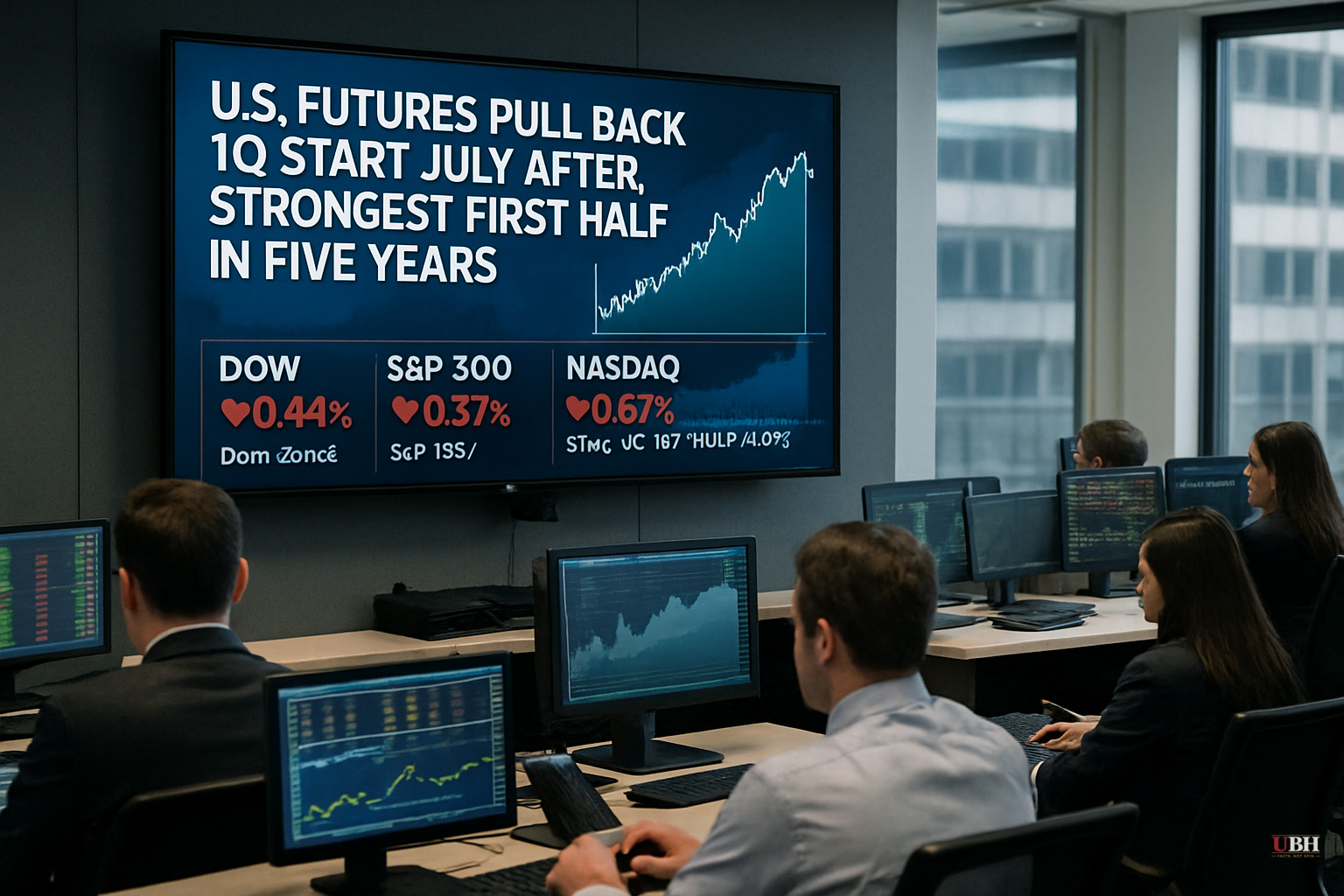
Since the Dow crossed 52,000 for the first time in late June and the Nasdaq posted its best quarter since 2020, markets have not paused for breath. Wednesday, July 1 may be the first small exhale.
As of 2:19 a.m. ET, Dow futures were down 170 points, or 0.33%, according to CNBC. S&P 500 futures shed 0.29% and Nasdaq 100 futures dropped 0.34%. Regular U.S. trading has not opened yet, so those are pre-market indications, not session prices.
What H1 2026 Actually Delivered
The final scoreboard for the first six months: the Dow gained 8.9%, its best first-half performance since 2021. The S&P 500 rose 9.6%. The Nasdaq climbed 12.8%. The Russell 2000 surged nearly 22%, its best first-half showing since 1991, according to CNBC.
None of that happened because the economy became quietly excellent. It happened because one trade dominated: AI infrastructure. Intel, Micron, and Advanced Micro Devices combined added roughly $2 trillion in market capitalization during Q2 alone, CNBC reported, reflecting investor conviction that the next wave of AI spending will benefit chipmakers beyond just Nvidia.
Amazon Web Services is also moving deeper into forward-deployed engineering, competing directly with units OpenAI and Anthropic stood up earlier this year. FDE teams embed with enterprise clients to customize AI systems for specific operations. AWS's expansion signals that the platform layer of AI is becoming a competitive battlefield, not just the model layer.
The Caution Flag on Semis
Paul Hickey, co-founder of Bespoke Investment Group, offered a warning on CNBC's Closing Bell: Overtime Tuesday. "Over the long term, we still like the semis, but I wouldn't be aggressive towards it here," he said. "They've gotten a little bit extended. So I would maybe take a breather here."
Hickey's broader point: this bull market is explicitly AI-driven, which means tech and semis have to keep performing to sustain it. That creates a fragile dependency. A single earnings miss from a major chipmaker in Q3 could reprice a significant portion of the rally.
That concern deserves a fair hearing. The $2 trillion added to Intel, Micron, and AMD in a single quarter is extraordinary. Investors pricing in a decade of AI infrastructure spending on the basis of current demand signals are making a long-term bet with today's money. History of tech-driven bull markets, including the dot-com run, shows that valuations can detach from fundamentals for longer than skeptics expect. The bull case rests on solid premises. But Hickey's caution reflects a real tension: momentum-driven rallies in concentrated sectors tend to correct sharply when sentiment shifts, regardless of whether the underlying thesis is sound.
Outside the U.S., Cracks Appear
The yen fell to 162.28 per dollar on Wednesday, a fresh 40-year low, according to LSEG data cited by CNBC. Japanese authorities have signaled discomfort at these levels before but have not yet intervened. A disorderly yen move would ripple through global carry trades and could introduce volatility the U.S. market is not currently pricing in.
Asia's session closed mixed. Japan's Nikkei 225 rose 0.59% to 70,474.96, but South Korea's Kospi dropped 2.04% to 8,303.41. Australia's ASX 200 fell 0.64%. Europe opened the new month in the red, with the Stoxx 600 down 0.19% shortly after the London open.
China's manufacturing activity grew faster than expected in June, helped by high-tech production tied to global AI demand. But Goldman Sachs warned, per CNBC reporting, that Beijing may face mounting pressure to accelerate fiscal spending and government borrowing in coming months as real estate investment and consumer goods production remain weak. Nike's 12% sales decline in Greater China last quarter underscores how uneven that recovery is.
Oil's Role in the Picture
Brent crude posted its biggest monthly decline since March 2020 in June, per CNBC, as prospects for fresh U.S.-Iran talks in Qatar raised hopes that Middle East tensions would continue to ease. Lower energy costs reduce one inflationary input, giving the Fed slightly more room, but the ceasefire remains fragile, and any escalation could reverse oil's slide quickly.
The Fed Variable
Federal Reserve Chairman Kevin Warsh is scheduled to speak Wednesday at the European Central Bank Forum on Central Banking in Sintra, Portugal. Since taking over the Fed, Warsh has launched task forces to comprehensively review the central bank's operating framework, according to CNBC. Markets will be watching his remarks for any signal on rate trajectory heading into H2, particularly given that the AI rally has partially been built on the assumption that rate cuts are coming at some point this year.
The unresolved question going into the second half: whether AI capital expenditure from the hyperscalers actually shows up in earnings at the chip and infrastructure level fast enough to justify valuations already priced for an ideal scenario. Hickey's answer, for now, is to wait and see.
Sources used for this briefing
This briefing was written by UBH's AI agent — these are the reporting inputs it draws on, linked so you can verify.


